My Momentum MxV’s have no problem controlling the M-3’s. The Magico’s do require me to turn up the volume a bit as compared to the Wilson’s but nothing significantly. Still using the 2V level from my Vivaldi.
Andrew
No I did not listen to the S5’s before going with the M3’s.
Pricing wise the S5’s cost less than the recently discontinued M3’s yet they are a much newer design and probably take advantage of recent technological advances in Magico design.
No questions about the power delivery of the Dan. But what about the capability of the M3 to deliver power? The feeling i had when listen the M2 was they have very low power delivery, the woofers clic very easy.
By contrast the Wilson deliver amazing power with big authority

Nice system! A friend has A5s and he upgraded from Pass to a Gryphon Antileon with a lot more power and he said it made a huge difference.
Magicos definitely do better with extra power
Wow! What a great looking system in a beautiful looking room.
Happy listening!
That is one good thing (of many) about the higher end Gryphon (and Boulder) amps: You are never short on power.
A former dCS employee, Andrew P, once posted a picture of his system, which was Vivaldi 3-box + Boulder 3060 + Magico M3. I imagine that was an amazing combination.
Don’t worry, a pair of Xa 160.8 will always have enough power and is certainly as good than the Antileon…
I’m not as sure about that anymore having heard a spectacular Antileon Revelation system nearby over many visits. The new amp is very special.
I remain a big Pass fan though and they make terrific stuff.
Today I visited Odeon Audio in Germany and met Mr. Gersdorff, the owner and designer. I came to pick up a smaller speaker that was traded in by a good customer of his. They repainted it, and did a full inspection and tune-up. I am meaning to use these for a future second system, and will also use them temporarily while we sell our house - it will be less conspicuous and overbearing than my larger Odeon 32’s are in our current living room.
Here are two pictures of the Odeon Audio listening room. While they were packing up the Rigoletto for me, I also asked if I could briefly hear the Carnegie - their top model (second picture). That was a treat, although they did mention the system was not setup for them at the moment, so the sound would be better still.
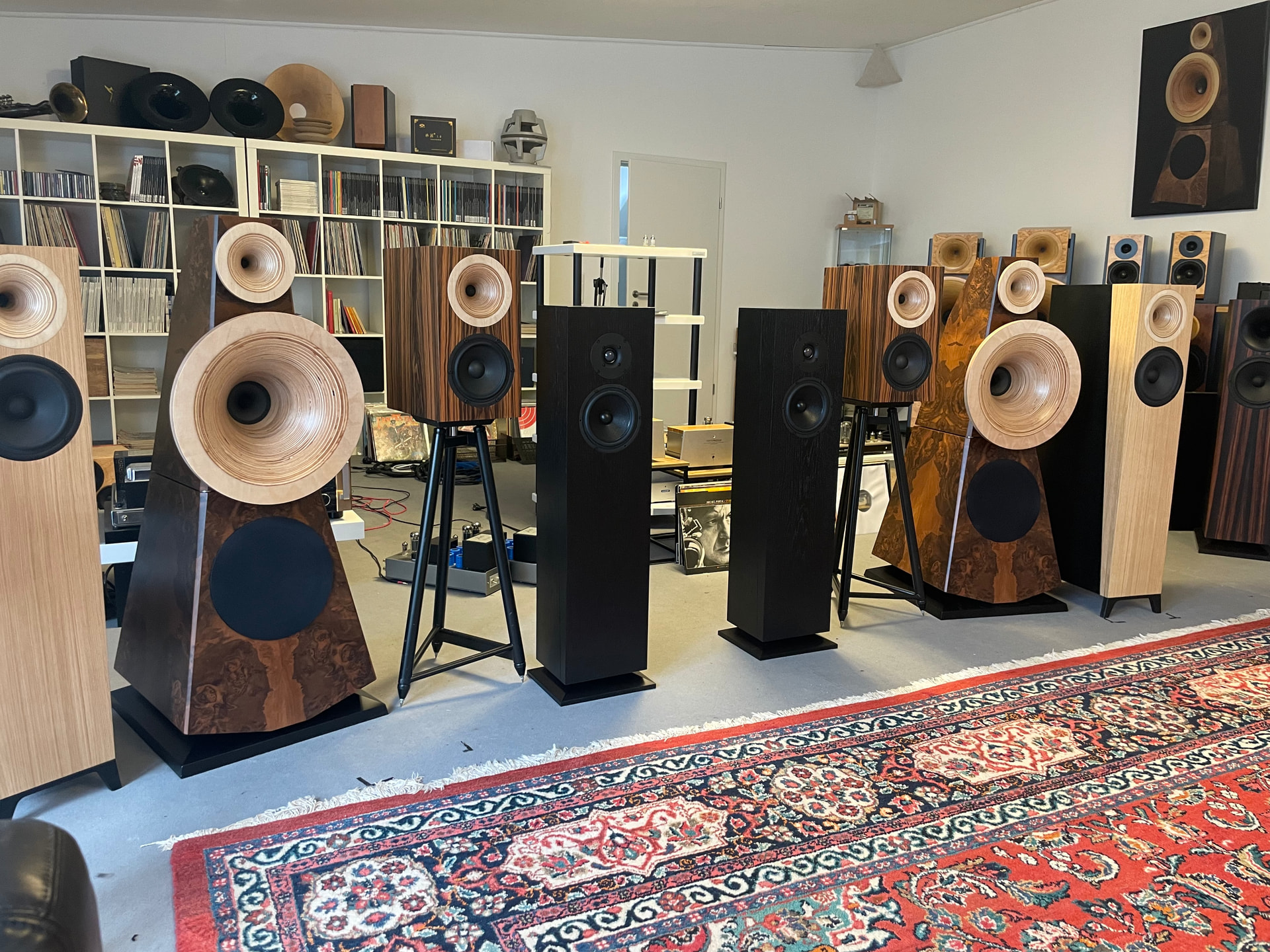
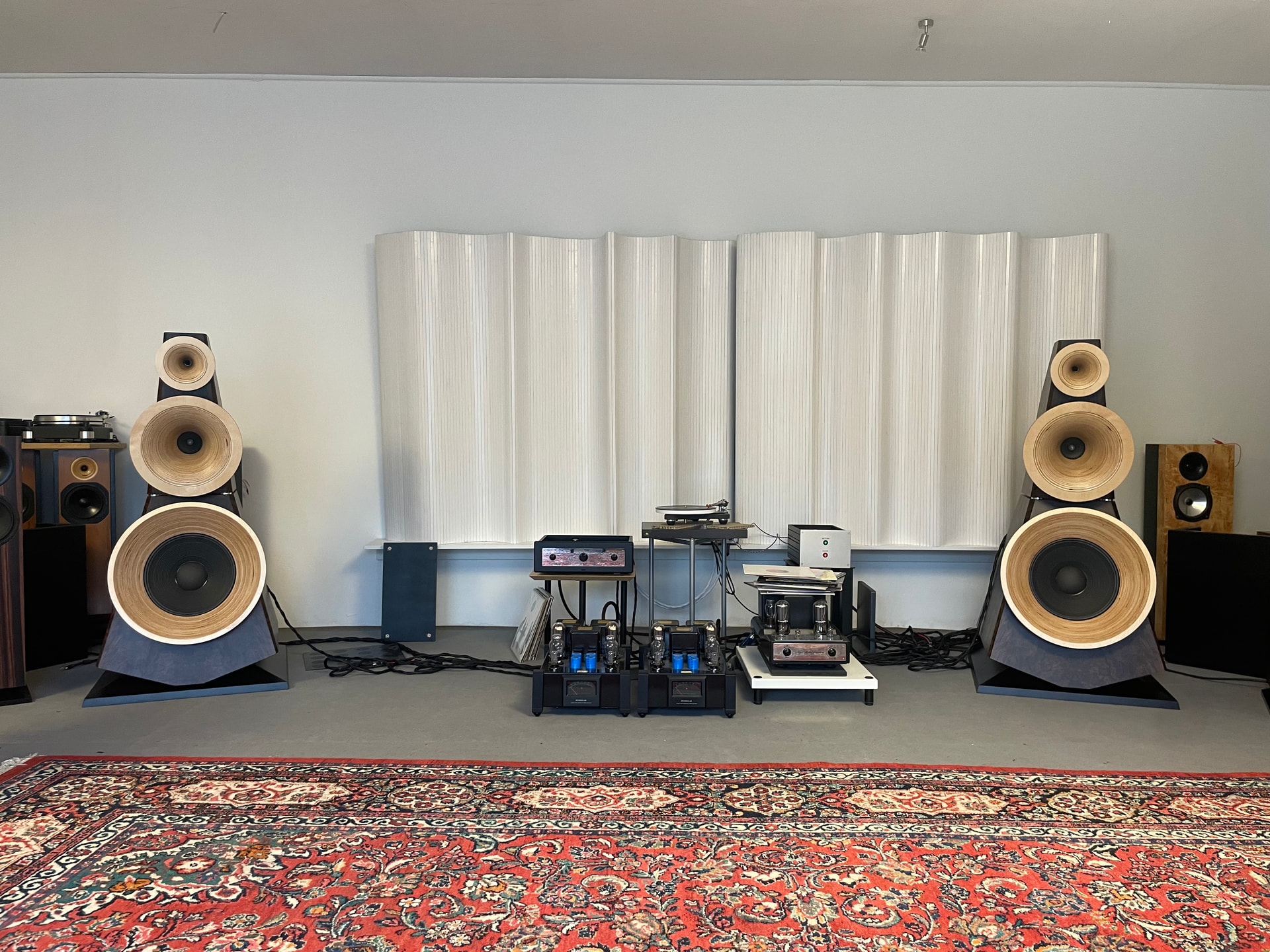
It was very nice to visit and I was able to talk with Mr. Gersdorff for a while on his ideas behind loudspeaker design. When I told him I had a pair of 32 speakers at home with Semper upgrades, he instantly knew which speakers they were and could tell me all about them and who had been their first owner. Odeon is a small company, but they have been going for over thirty years and they make great speakers.
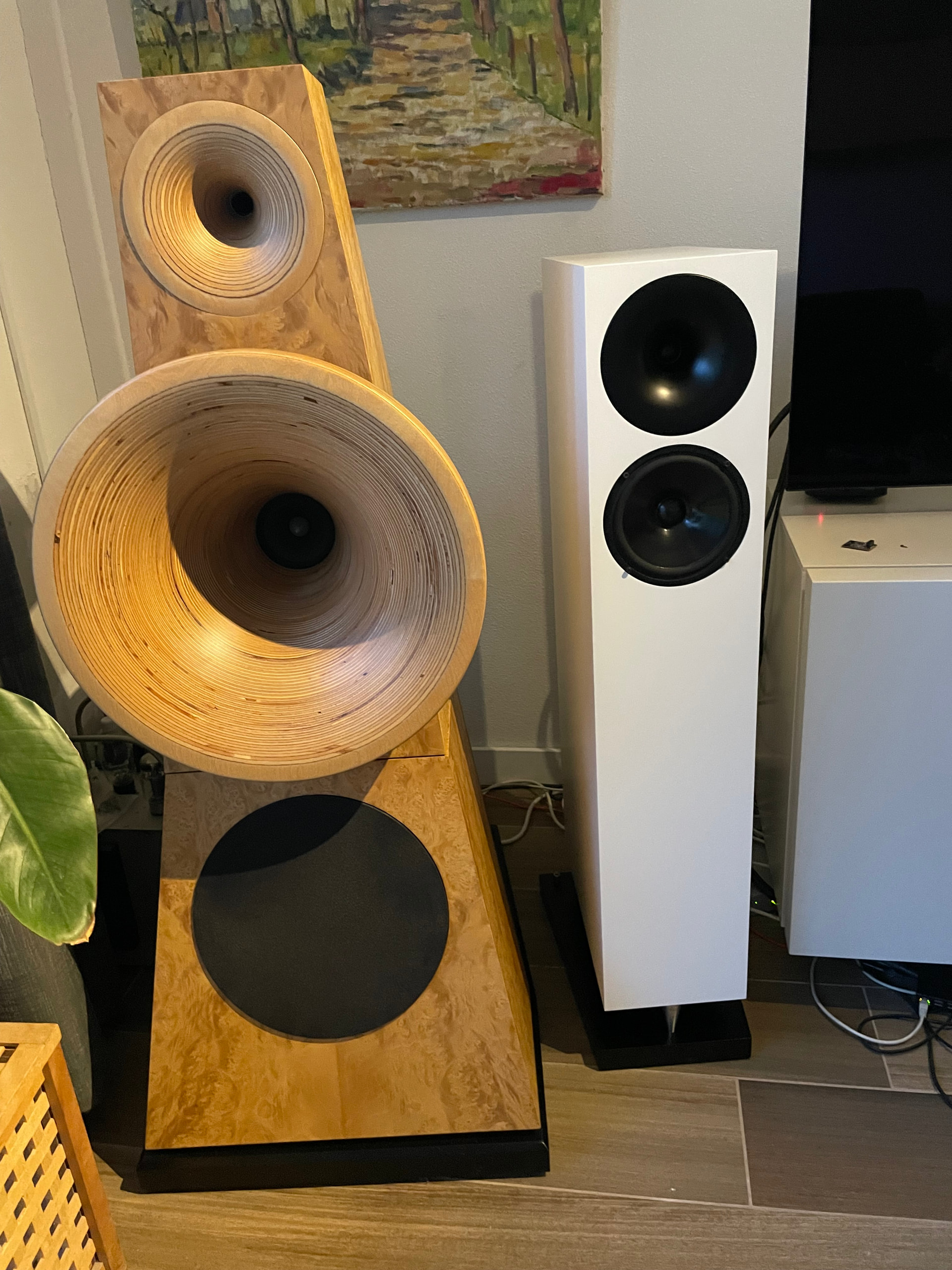
Here are the Rigoletto next to my 32 at home. Very much more WAF. I have been running them the rest of the day and of course they are not near the 32 in detail, transparancy and bass extension. But I must say they are so musical I can’t get myself to turn the system off.
Hi August,
Have you ever connected with @miguelito ?
He also has a wonderful horn-based speaker system….
Best regards
Ah yes, Avantgardes I think. At least there are more of us who found the call of horns 
That’s right, Avantgarde Duo Mezzo.
Isn’t that what it’s all about?
Hi Andrew
I understand perfectly that the Ethernet connection is bit perfect, so other elements to reduce noise are not needed.
My concern, and I love to hear your point of view, is the noise level impacting the data packet retrieval, meaning, in a noisy line , the faulty packet will have to be resent again , so the receiver side needs to store the good packets until the bad one is sent again.
When done , the network card processor needs to rearrange the packets in the correct order before streaming it to the DAC .
If the above assumption is correct, then the network card processor needs to speed up and down, creating internal noise and higher power supply demand. This may affect the noise or jitter added after the network card- no?
So by having a fiber network, we may reduce the packet loss and make an “easier “ life to the network card.
Does it make sense?
Eyal
Hi Eyal,
No, sorry but I really don’t think it does. And the reason is that error correction is simply what the protocol is designed to do and the cost of any packet resends is accounted for in the dimensioning of all the resources. In a gigabit copper network (1000BASE-T) the cables (Cat 5e/6) are certified to deliver up to a billion bits per second correctly up to their rated maximum length, i.e. the cost of the error correction is included. Any draw on the resources of the ethernet chip/circuit is already accounted for. So it’s “business as usual” rather than an “un-budgeted overhead”.
As I have pointed out a number of times, the option of an optical fiber physical layer in ethernet networks was principally conceived to increase the distances over which these certified bandwidths could be delivered, and not to address any deficiencies in copper connections used within their certified performance envelopes. From a domestic audio perspective they represent a complex solution to a non-problem.
You’ll find a lot more discussion in this thread which discussed some of the trade-offs of shielded vs unshielded copper cables, and you may also find the dCS Guide to Streaming has some useful background, in particular the discussion about optical networks in section 2.1 “Synchronous vs Asynchronous Interfaces”.
I love this phrase and am going to try to use it in my everyday life…(!)
; )
Hi Andrew
Thank you for the detailed explanation. I really understand the science behind your answer, but I still hear a difference when switching between Ethernet cables.. do I need to look for a psychologist? 
Hi Eyal,
Playing with the search function will quickly reveal countless previous threads on this perennial topic where I think every possible fact, opinion and religious belief has been stated and restated ad nauseum.
I would summarize my own position with the following three points:
-
There is always an unspoken caveat when presenting scientific arguments, proofs or facts, that one is referring to known science. “Science” held that atoms were fundamental particles until Rutherford and Chadwick discovered protons and neutrons, the latter less than 100 years ago. It took another thirty years before Gell-Mann proposed the existence of quarks, and another three before this had been ratified by empirical observation. The point here is that similarly it could just be that, despite thinking that we know everything, there is some real electrical effect that we have yet to discover and either don’t even attempt to, or know how to, or have sensitive enough instruments to measure.
-
Alternatively the perceived differences might just be the result of expectation bias. There is a wonderful story told by one of my colleagues, who used to run a retail store, and who has a huge amount of listening experience (“good ears”) that is one of my favorites. There was a sales rep from one of the audiophile cable vendors who had been calling him repeatedly and trying to convince him to take on their line, but my colleague just wasn’t interested. Finally after months of attrition he caved in and the sales rep turned up with a suitcase of samples, a number of levels of ethernet cable with exponentially increasing prices. My colleague set up a network-enabled active speaker on a stand in the middle of the demo room and sat in the hot seat. The sales rep connected it with the first cable. Fine. Then he switched to the second and my colleague wanted nothing more than to hear no difference at all and send him on his way. But damn if there was a difference, a noticeable one. So on to the next cable, and once again a noticeable improvement. And so on for every cable. So my colleague agreed to take the line and the salesman packed up and left. It was while he was returning the speaker to its place my colleague realized it had been set to wifi all along. Of course this in itself proves nothing about the quality of the cables or their relative performance or value.
-
And finally, yes, you may indeed benefit from seeing a psychologist, although you might find that high-end ethernet cables are a much more efficient way to drain your bank account. Choose whichever you find more enjoyable.
No, you don’t need to see any doctor. If your system is revealing enough, any change in the chain will be manifested in the output. e.g. Let us say the power cable of your DAC is made of stranded wires. Try replacing it with a power cable made of solid-core wires, you will hear the difference. Whether it will be better or worse, that is up to your interpretation.