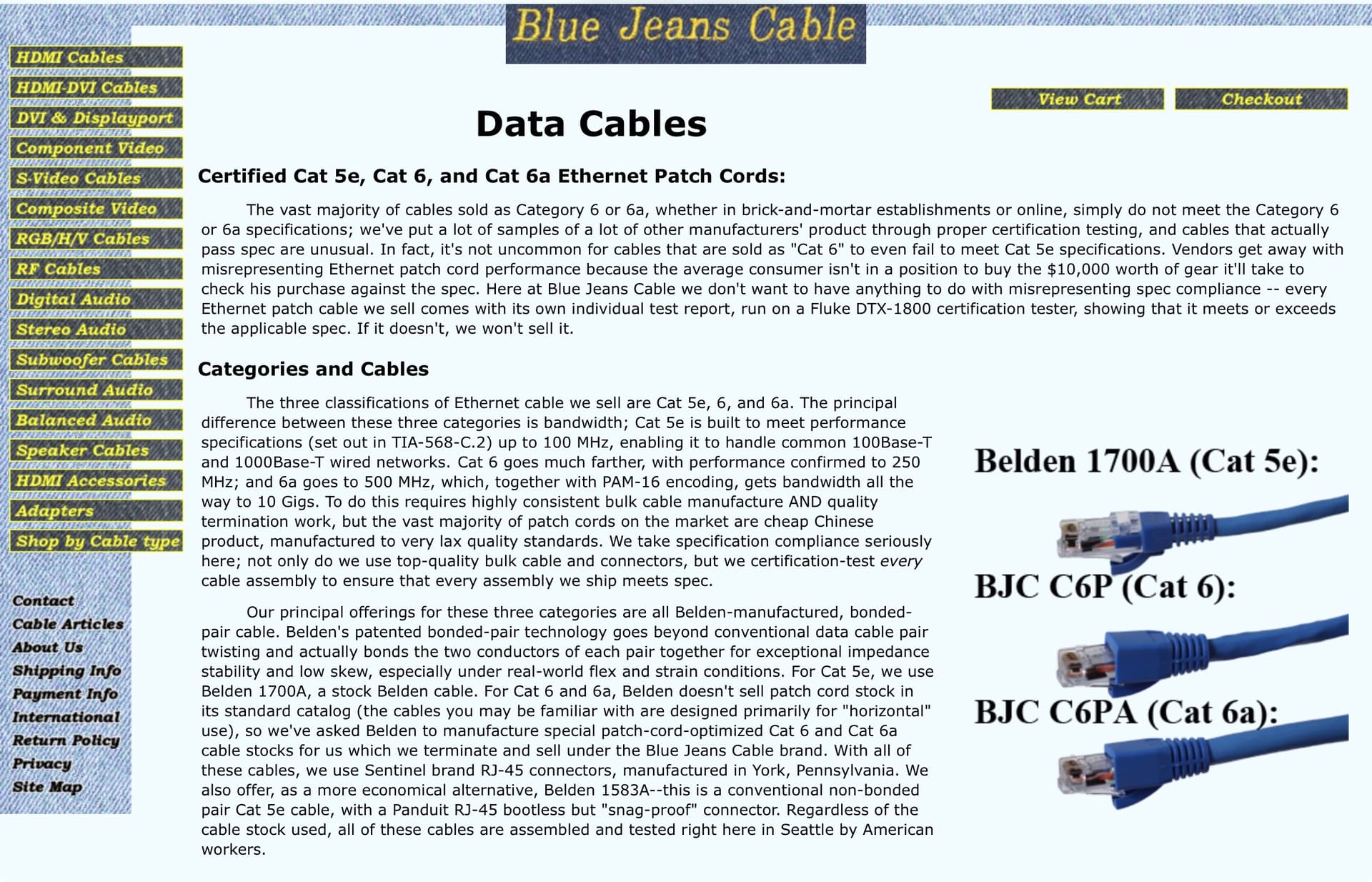
I bought to 5e cables of Blue Jeans Cables recently- very economical, no customs issues, arrived within 10 days. Wayne at BJC provided their views on shielding - the comments were most interesting.
The following article (written by the owner of BJC) goes into the subject of shielding on ethernet:
Shielding is, in most cases, not of much use on Ethernet cable. The noise rejection characteristics of the pairs (common-mode noise rejection) are the most important consideration whether the cable is shielded or not, and there are all sorts of practical issues – foil isn’t a very low-resistance path to ground, and noise currents on the shield can sometimes hurt as much as they help.
Performance-wise, the shield causes problems. For one thing, the shield-to-pair spacing is hard to keep consistent, and it affects the pair impedance slightly; for another thing, a lot of the energy at these frequencies bounces off of shields, so internal crosstalk suffers for the benefit of alien crosstalk; and for a third thing, the nature of four pairs in a shielded bundle is such that the symmetry of the pairs is effectively disrupted by a shield which each conductor approaches, and then recedes from, with each twist (the other pairs don’t affect this symmetry as profoundly because of the effect of different twist rates).
The result is that if you take two patch cords: our Cat 6, and our Cat 6a, and test both of them both at Cat 6 and at Cat 6a standards, you find that both of them pass both standards, but the Cat 6 passes by larger margins than the 6a due to the effects of the shielding. One might suppose that this means that the 6a should never be used – but the difference is that in order to be certified the bulk cable must meet tests as well as the finished assembly, and Alien Crosstalk is tested only on bulk cable – the Cat 6 would fail AXT, while the 6a passes it. It’s a design tradeoff – deterioration in cable internal electricals in order to achieve external targets.
Now, that has some interesting implications in a home or small network environment; if the patch cables are deployed at work stations, rather than on patch panels, then they typically do not run close to one another in bundles. Regardless of what the spec says, the Cat 6 patch would be better than the 6a in such a case, because the actual installation conditions make alien crosstalk no longer a meaningful consideration.
But, more importantly, in most American network installations the backbone cable is unshielded. What this means is that use of shielded cables in these systems can result in partial shield paths – which can cause ground-loop problems and the like that can be rather hard to diagnose. The best practice is, if the installed horizontal cabling is unshielded, to use unshielded patch cords, and correspondingly, if the installed horizontal cabling is shielded, to use shielded patch cords. Either the entire system should be shielded, with shields tied to ground at patch panels, or none of it should be grounded. This is one of those “how to tell the customers” conundrums – we need, when we do make a shielded product available, to be sure that people understand that it really should only be used in particular environments, because the assumption tends to be “shielding = good” and this really does depend on the installation.
 I have actually got two of those, but don’t use them as I was reliably told that they introduce lots of noise. Good idea though.