This clock business is all very confusing. What purpose does the 10 MHz external clock input into the Vivaldi clock serve and what is the purpose of multi output master clocks like the Mutec if not to provide a digital synch signal for multi box systems ?
10Mhz master clocks and 41 and 44 KHz clocks - how do they work together ?
I can help answer that. I’ve purchased a number of box sets - some have more than 60 CDs. These are mostly classical compilations - e.g The Murray Perahia first 40 years, Warner sets featuring the works of conductors like John Elliot Gardner, Sir Charles Mackerras, William Christie. et al.
Ripping all of these and managing is a real pain. Even with Roon - which is the best of the best -sorting through a 70 disc set can be a challenge. Bad meta data upon rip, finding what you want, finding the right liner notes etc. Working with the physical media is so much easier in this case
Some clocks replace the clock in the device as in master clock, these are normal at 10Mhz.
Word clocks like what dCS use is a clock that provides a clock signal that the clocks in each device use as a signal that they lock on too, it doesn’t replace them clocks. The benefits to this method is the clock remains very close to where they need to be, they all work exactly the same, and so when the didtal signal reaches the dac from say the upsampler, the rate is perfectly matched to the clock in the dac, this means that no extra clocking is needed, this in turn means less work by the dac, or processing needed, resulting in less noise generated in this sensitive area.
I think i have that right, but sure it could be explained better.
Just to add dCS clock works at 44.1, cd red book quality and then 48, for higher resolution, or a mixture off them both for certain upsampler rates. That’s why you need both clock frequencies and not just one.
If you use the Mutec (or any 10MHz Rubidium Clock) with multiple 10MHz outputs, and use them for both the Teac’s 10MHz clock input and the Vivaldi Master Clock’s 10MHz Reference Clock input, it would work as all elements will be synchronized to the same single clock source.
What he said. In this case all products would be operating in the same clock domain.
Just to point out however that our clocking architecture has two main components, the clock signal from the master clock, its jitter and accuracy characteristics, and the PLL that connects it to the clock(s) in the DAC(s) and source component(s). These are every bit as important as the quality of the clock signal itself.
In my flywheel analogy, if the master clock is the flywheel that stabilizes the rotational speed of the driven wheel, the PLL is the belt that connects them together. If the belt is stretchy or uneven, it doesn’t matter how accurate the rotational speed of the flywheel is, that accuracy won’t be conveyed to the driven wheel and it might actually make things worse.
Our PLLs are developed by us and implemented in FPGA code. We don’t use off-the shelf PLL chips. They are a core part of our clocking architecture.
I just ordered an SMSL P200T for my living room system because of the experiences here and I’m curious about how it does with wordclock out from the Bartok. Cheap enough for occasional CD spinning.
Well I finally decided to take the risk and went for a used Vivaldi Mk1 Transport to complete my Vivaldi system. It’s the wrong colour but it was not too old and a good price so could not resist.
CD replay is as expected wonderful. Just one problem: when using the Vivaldi remote to control CD replay the Upsampler input is also changed.
Setting the Upsampler input to dual AES 1&2 initially and then using the remote to play a CD causes he Upsampler input to flip to a different input ?
Help please. Am I doing something wrong with the play CD sequence ?
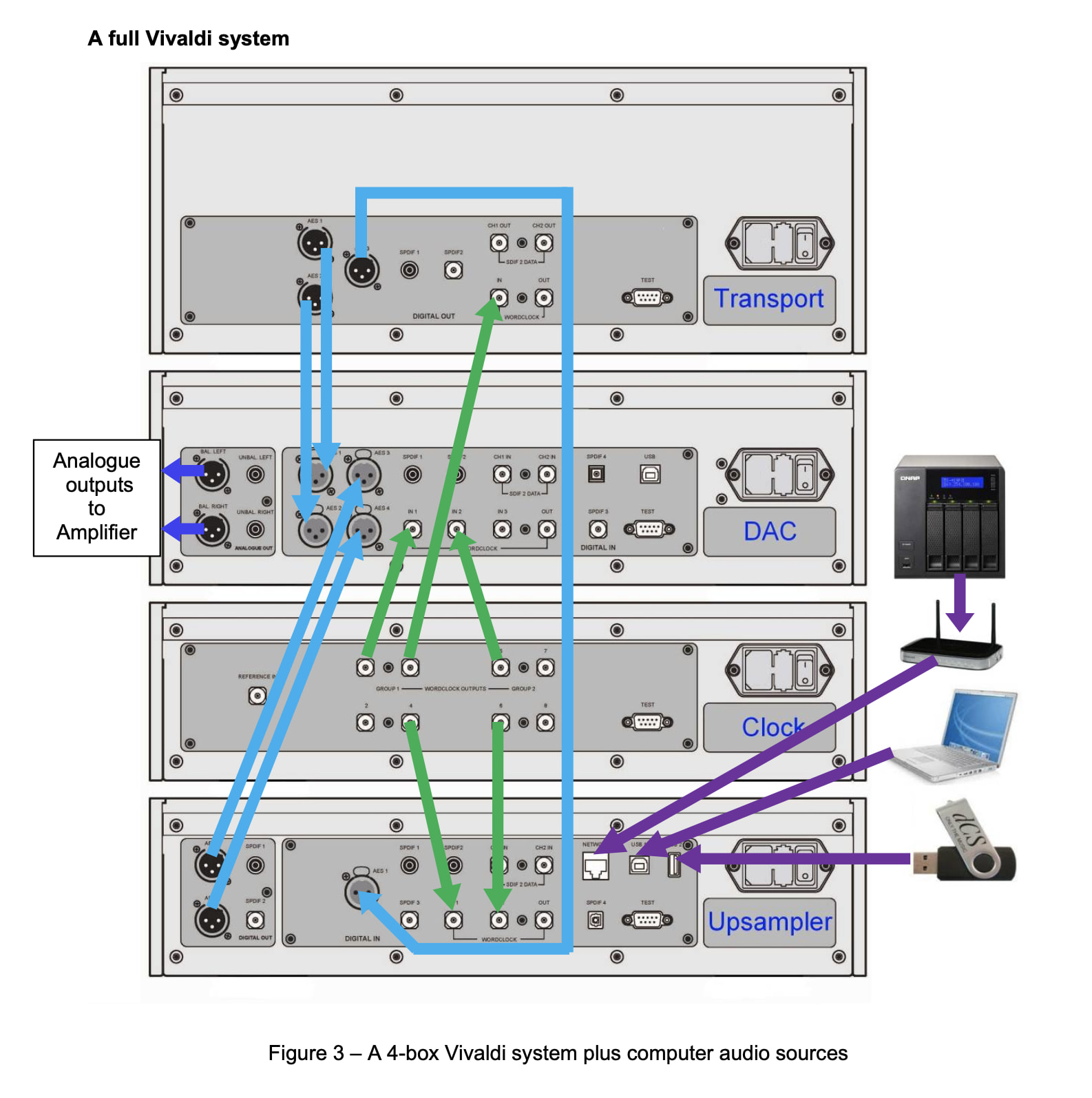
Switching to the transport will usually mean chossing the correct DAC input on the IR remote ( the plank). depending on how ow the transport is connected. You may have,say, AES 1&2 for the transport and AES 3& 4 DAC inputs for for streaming.
Alhough the plank has a button called UPS IN, that selects between the Upsampler’s AES or S/P/dif inputs it does not switch your system from streaming to silver disc. Perhaps you are using this by mistake when you switch from streaming to silver disc? It’s a guess as there is limited information .
It depends if you want to play the CD upsampled or not. If yes, connect AES 1+2 on the Transport to AES 1+2 on the DAC, if no connect AES 3 on the Transport to AES 1 on the Upsampler and set the Upsampler to output 44.1kHz for this input.
If you connect AES 1+2 on the Transport to AES 3+4 on the DAC EasyPlay won’t work.