Same for me, until recently where the Roon server couldn’t restart after the last update.
Impossible to reboot the Rock OS either. I had to power it off and then on and everything restarted eventually.
Sources of concern are for me the change of UI, deprecation of MacOS systems can be dramatic for some users as well.
If you read the full article you will see that the incompatibility only relates to Roon Server running on some very old MacOS and Linux distributions. May affect users of some older NAS drives. No device compatibility is affected.
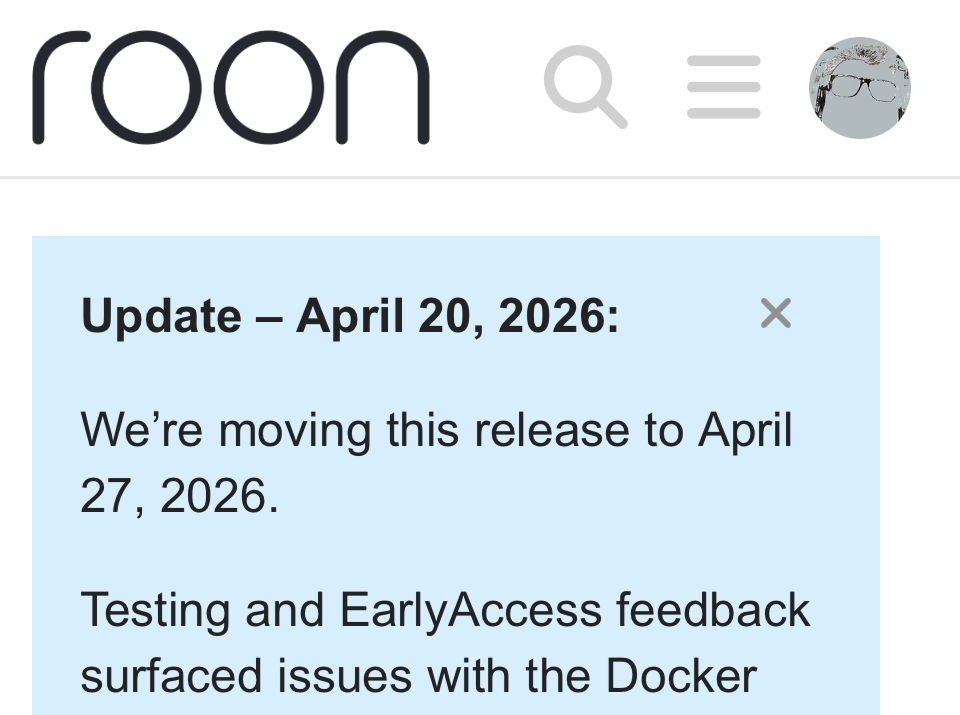
Much more details provided Today in the headlines of the Roon community forum (same as what @AndrewS found - But Big-Sur/MacOS-11 isn’t that old, it was still updated earlier this year):
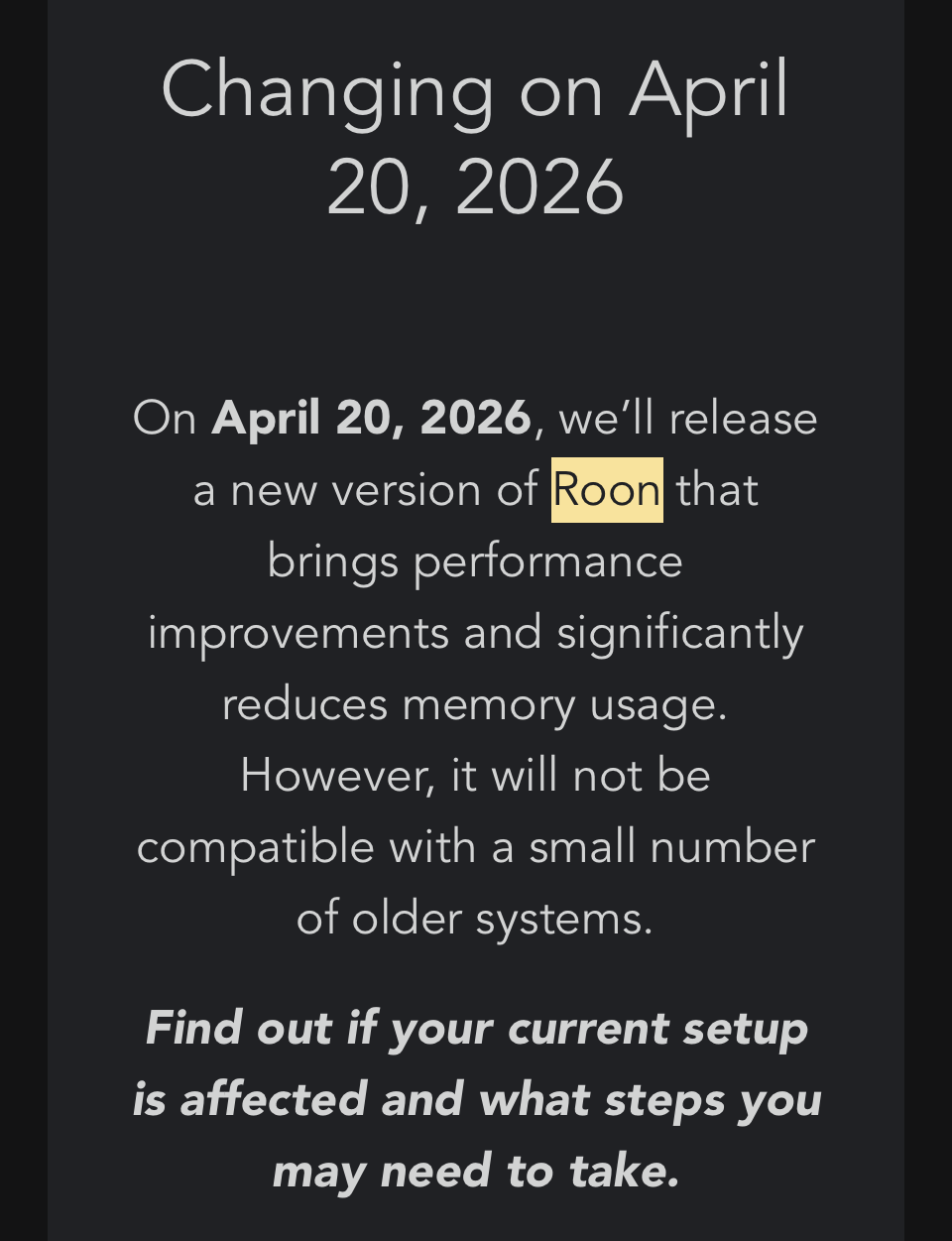
On April 20, 2026, we’ll release a new version of Roon that brings performance improvements and significantly reduced memory usage. However, it will not be compatible with a small number of older systems.
What minimum system requirements are changing?
Starting with this release on April 20th, 2026:
Roon on macOS will require macOS 12 (Monterey) or later
Roon on Linux will require glibc 2.27 or later and OpenSSL 1.1.1
If you are running Roon OS (ROCK or Nucleus), you are not impacted.
If you are running a modern Linux distribution since approximately 2019+, you should not be impacted. We know popular distributions such as Ubuntu, Debian, Arch, and Fedora are not impacted. If you aren’t sure, continue reading on how to test your system.
NAS operating systems, including QNAP, Synology, ASUSTOR, Unraid, and FreeNAS, may be impacted depending on the product you own. Continue reading on how to test your system.
Check OpenSSL
$ openssl version
OpenSSL 1.1.1, 11 Sep 2018
Check glibc
$ ldd --version
ldd (Ubuntu GLIBC 2.27-3ubuntu1.6) 2.27
Copyright (C) 2018 Free Software Foundation, Inc.
This is free software; see the source for copying conditions.  There is NO
warranty; not even for MERCHANTABILITY or FITNESS FOR A PARTICULAR PURPOSE.
Written by Roland McGrath and Ulrich Drepper.
Check glibc, alternative:
$ getconf GNU_LIBC_VERSION
glibc 2.27, February 1, 2018
Update your Linux distribution to a version that supports glibc 2.27 or above, and openssl-1.1.1 or above.
NAS
Update your NAS’s operating system to one that supports glibc 2.27 or above, and openssl-1.1.1 or above.
What if I can’t update my Linux computer or NAS?
Run RoonServer via Docker - Docker is an operating system-level virtualization technology that will let you run a newer set of software on top of your older operating system. We are launching an official supported Docker image for RoonServer. Early access users will get it first, with a production release shortly after.
Run ROCK - If your Linux machine is dedicated for Roon Server, you can consider running Roon’s own operating system for Intel NUC hardware. See here for more information.
Get a Nucleus - Roon’s dedicated hardware, designed to run Roon Server out of the box
Can I stay on an older Roon version?
We will make a pre-update Roon software packages available for users who need more time to plan their transition. A few things to keep in mind if you choose this path:
You’ll need to disable automatic updates to remain on older software
This software will not receive updates, which includes security fixes
Over time, it will drift further from the current version, which may make it incompatible with software deployed on phones and tablets.
in the beginning this was true for me as well, but over the past year things have changed. (and I have a rock solid 1.5g fibre pipe)
Searching has slowed down (perhaps because I added Qobuz) but really my own database should be prioritized when searching
Roon has issues with discovering many of my devices (often requiring a restart of the end point) Thankfully this is rare with my Bartok
Graphics performance is lousy - scrolling through albums lists is choppy on certain devices (even ones with graphics boards that generate more heat than a class A amp)
IMHO Roon really needs to optimize their code across Mac, Win and Linux.
I didnt know this - thanks. Quick Internet search suggests .net v6 or higher was used for Roon v2. Good news (i think) for M based Macs at least.
Roon use to be rock solid. Performance issues have been creeping in over time. Lagy / choppy graphics performance, network discovery issues. We will see what the April 20th update brings…
I’m glad for you. Roon is a fantastic app overall.
Not to be augmentative, it is possible we have different priorities. The graphics performance in Roon is terrible IMHO. I see scrolling artifacts on every device I have: iOS, iPad OS, MacOS, Windows, Android, with graphics hardware that ranges from bog standard integrated graphics to boards meant for multi physics CAE and film rendering. Perhaps I’m just sensitive to it as I work with computer graphics.
Scrolling the album view should be as smooth as looking at a graphics heavy web page - or any graphics intensive app. In Roon it ranges from smooth with choppy stutters, to choppy to smooth with wavy artifacts. No issues with my old version of Audirvana, or any other graphics intensive app for that matter.
I realize it is a waste to complain here rather than on the Roon forum, but I’ve done a few searches over there with no clear answers. My guess is that it may come down to how they implement OpenGL.
Given the price tag and that they’ve built their reputation on a rich visual experience, they ought to have a better and more consistent graphics experience. Lets see what the next release brings





 Sorry, what was your name again?