I don’t have any of the symptoms you describe @UrbanLuthier. How many Albums/tracks do you have and what sort of hardware are you running your Roon Server on (CPU/memory)? I suspect the bottleneck is in your server end rather than your remotes.
I have absolutely no lag or distortion you note when I scroll via album view. I use a IPad Pro M4.
Over 1400 albums 33K tracks - hardly a massive library. Mac Mini M4 16GB of RAM. More than enough for Roon core. 1.3 Gb fibe pipe with wi fi speeds of over 500Mbps, 950Mbps with standard 1g ethernet.
The types of artifacts I see would be a result of the receiving Roon app not the core and seems to be more problematic with my workstations with higher graphics power. Oddly, my 3 year old iPad air performs the best with minimal to no artifacts. My guess is it has something to do with their OpenGL implementation.
Some may say I’m being too picky but it is not too much to ask for a consistent UX across devices! I tested across 7 different devices.
1 Like
Weird.
I have a library larger than yours and don’t have to complain about the UI rendering.
On the iPhone 17, scrolling isn’t fully smooth, problem already reported on Roon forums for iOS devices, but is more than practicable.
On the MacBook Pro M4 it’s quite smooth…
My Roon core is a hard wired fanless ROCK NUC with 16GB Ram. I gave up years ago with the Roon core installed on a Mac mini has it ended up being un-practicable: macOS frequent security updates/changes and whatever background services were eventually ruining the Roon core performance…
Hope finally to see an uptick of sound quality in Roon. Which got neglected over the years. Also their music discovery is very weak compared to others.
The new Roon 2.65 release based on .NET10 was released today. I didn’t see anything in the release notes about OpenGL but it might be worth re-testing.
1 Like
Compared to the now long out-of-support .NET6 they used for Roon 2.0, .NET10 should deliver about a 3-times performance improvement even if Roon didn’t update their code.
2 Likes
I have just updated Roon, and yes, it is way more snappy!
1 Like
Unfortunately that doesn’t change or improve the mobile/tablet app experience:-/
Which most of us do not experience
Yep, snappier as ever!
1 Like
Any experience with Taiko XDMS on here?
Snappier searching for sure!
Graphics are still the same. I’m not the only one experiencing issues. The crazy thing is that scrolling is acceptable on my iPhone and iPad Air (not really state of the art graphics) and remains choppy on my MacBook Air and high powered windows workstations. So clearly nothing to do with the core. Scrolling is quite nice on the Arc app!!
1 Like
Roon is a very network chatty product, the front-end has heavy communication with the Roon Core. I wonder if there’s something else going on in your setup 
What WiFi Access Point are you using?
1 Like
Weird as everything is directly plugged into our ISPs Fibre modem. Wired and wireless is very stable with wireless speeds over 400 megabits per second even in remote areas of the house.
Graphics performance of Roon Arc is very very nice. Quite different experience than using the Roon app
The Arc app is on another dev platform. Roon confirmed for many years that since Apple introduced iPhones with 120hz displays the choppy scrolling bug exists and over all that time it’s still not fixed. Obviously will likely never be fixed as the underlying dev platform would need to change. So bad news for users affected.
Another BIG Roon update has just come live:
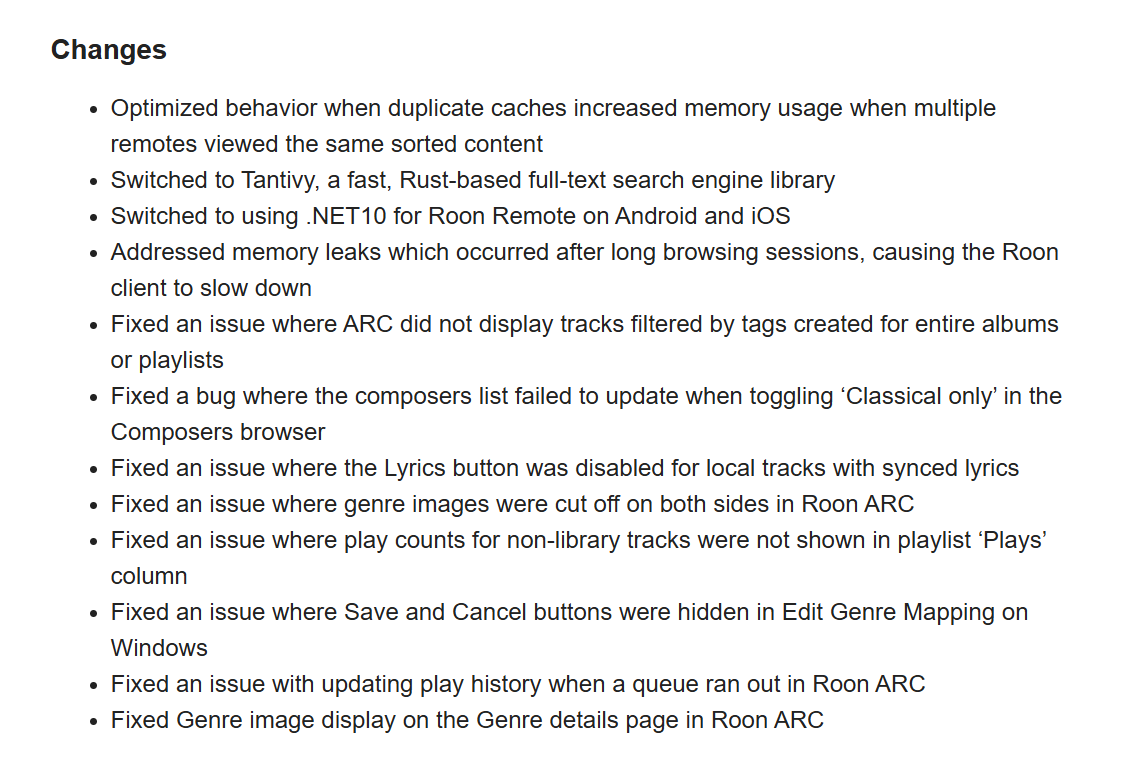
More about Tantivy, the new seach engine in Roon:
4 Likes
Quite snappy!
Even better than with the previous release that proved to be significantly faster already!…
1 Like
Would be cool to see a dCS Roon Core at some point.
Something in a fitting chassis. As always I’d love to see it in the Lina Lineup
1 Like
This is not a ”yes”, ”no” or a ”maybe”, just a personal reflection.
The hardware needed to run a Roon Server (as they are now called) is a PC, no more, no less. PC hardware lifecycles are one year, no more, no less. A new generation of CPUs, DDRx RAM and NVE SSDs is released every year, without fail, not to mention sporadic architectural advances such as integrated LPDDRx. And that drumbeat does not bow to ”audiophile preoccupations” such as heroic engineering, the rolling of DDR5 between the thighs of Haitian virgins, etc. Moreover Moore’s Law still applies (notwithstanding supply chain factors). Transistor density doubles and cost halves roughly every two years.
Those economics and product lifecycles require, IMHO, PC-scale addressable markets and product volumes to sustain. And given that a state-of-the-art ASUS NUC can be had for €500-600, I doubt that the market would bear what it would cost dCS to develop, package and certify one to Lina engineering standards, for highly questionable gain, even if the lifecycles were longer.
Digital audio moves fast at the streaming service level, but far less fast at the state-of-the-art sound quality level. I suspect this is because DACs are not PCs, but highly specialized (and relative to PCs low-volume) ”audio appliances”.
Don’t get me wrong, I would love one too! I just question whether it would make economic sense - either for the consumer or for dCS.
11 Likes