Paul McGowan - Founder, Maestro & PS Audio - just has introduced Maestro:
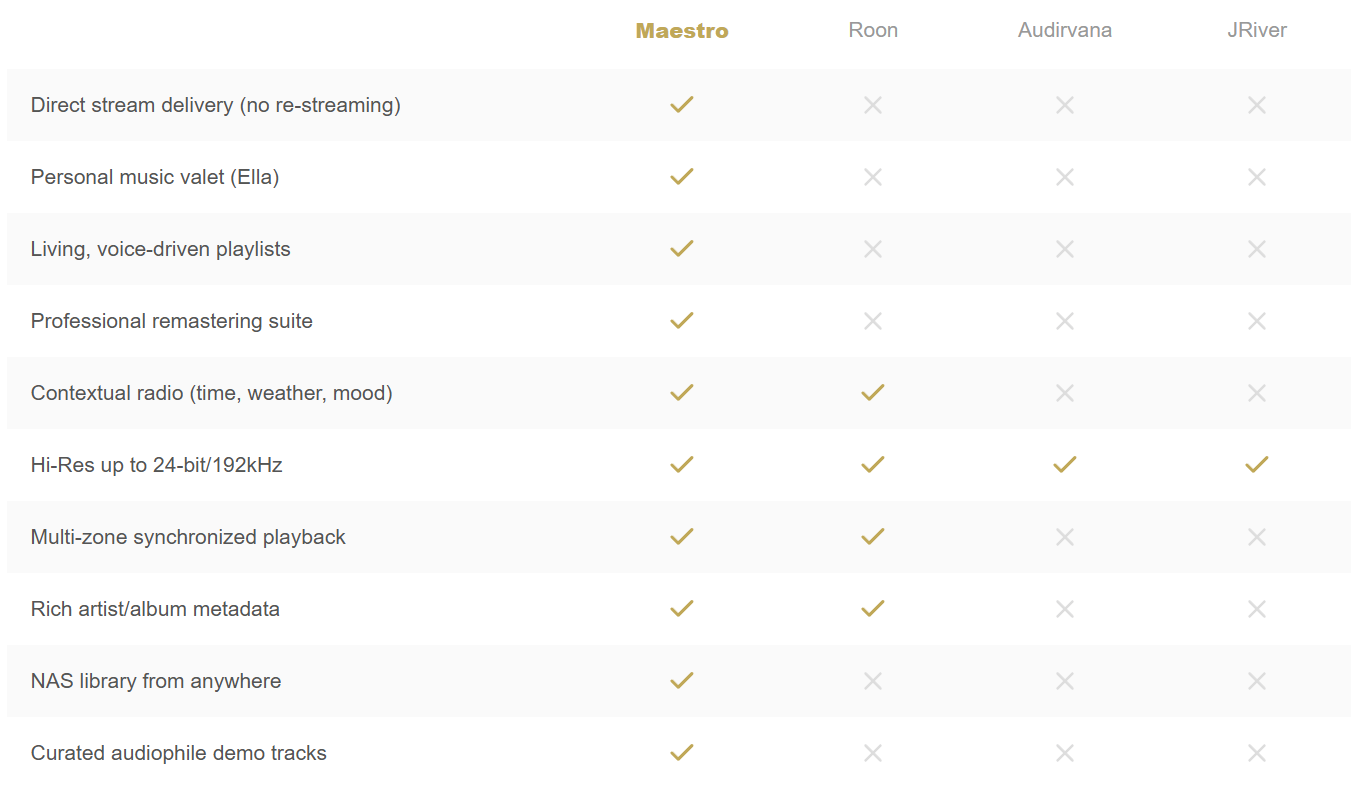
the world’s first music platform that never touches your audio stream. Paired with Qobuz — the world’s finest hi-res streaming service — Maestro delivers sound that Roon, Audirvana, and JRiver simply cannot match
Maestro is the world’s first music platform that never touches your audio stream .
No it’s not.
Maestro removes the server from the audio path entirely. Instead of receiving and redistributing the stream, Maestro:
Authenticates your Qobuz session
Directs the renderer to fetch the stream itself
Leaves playback entirely to the endpoint
There is no intermediate audio engine, no re-streaming layer, and no server-defined delivery model. The renderer interacts directly with the source and operates in a more native, less mediated state.
This is how Qobuz Connect, Tidal Connect, Spotify Connect, and all the UPnP Control-Points Clients (e.g. BubbleUPnP etc.) which support those Streaming Service Providers work. (AND dCS Mosaic of course).
There’s very little that’s fundamentally new with Maestro. As usual, Paul M is full of hyperbole and B.S.
"And yes, at the moment, Maestro is probably best not to use if you’re not up for a little adventure and not ok with hiccups. I truly appreciate those who have given it a try.
We’ll get it slicked up and ready for general use without hiccups, but it’ll probably be a few months."
Curious to (1) see a measured null test of the analog output of an identical DAC fed by Maestro vs. Qobuz Connect vs. Roon-with-DSP-off; (2) learn mechanically how a network-isolated control host alters samples that the renderer pulls directly from Qobuz; and (3) understand how to reconcile “never touches your audio stream” with Prism’s ("in-app remastering suite”) existence.
In fact, that’s pretty much exactly the definition of a UPnP Control-Point; first introduced in the year 1999. In other words, what Paul M is talking about is actually a quarter of a century old technology
When it comes to Streaming services like Qobuz, there’s only ONE specific IP call that allows a Streaming DAC like the Rossini to pull down a track from a Qobuz Caching Server on the Internet. It doesn’t matter whether the Rossini was instructed to make that IP call by dCS Mosaic, Qobuz Connect, BubbleUPnP, JPlay, or Maestro. They all cause the exact same IP call to be made.
Anyone who suggests that such a Control Point (that’s not in the music path) can make a sonic difference is either lying, or just plain delusional.
Roon and Audirvana are different though because they’re more than just a Control-Point. Both provide a processing pipe through which capabilities such as a DSP can be applied to the signal before streaming to the DAC. However, with both, once their DSP is turned off, it’s trivially easy to prove that the bit paths through them are completely transparent.
Well if it’s already sounding better than Roon, JPlay etc even at this early stage than it might be promising. Who else has given it a try and can report?
“Timeline for Prism DSP which will be a real game changer allowing folks to remaster individual tracks or whole albums or whole systems should be live sometime in late May. I need to get all the bugs and niggles fixed so I can then submit for approval as an IOS and Android app.”
Interesting but just to state the obvious, this thread is about Maestro a control point whereas Prism seems to be a DSP application.
Previous comments in this thread refer to the features of existing control points and that Maestro seems to offer no novelty. Of course DSP results in an altered file so is not bit perfect . But you might like the result. Who knows?
My understanding is that Prism is an added option for those users seeking DSP, like what Roon and others have too. Though also the DSP engine has a somewhat different approach than the current ones as it’s running in the cloud as a feature thus avoiding another noisy device within a users chain.
(A) The comparison table between the platforms does not show any feature related to sonic quality! : )
[quote=“Pdave, post:13, topic:8744”]
Well if it’s already sounding better than Roon, JPlay etc even at this early stage than it might be promising
[/quote
]
(B) If all three platforms deliver a bit-perfect file to the same DAC, how could this claim be possible, technically?
(C) I like Paul and his folksy way of explaining things. I think he is a great representative for our industry. However, he is, by his own admission, not the industry’s leading technical expert, and so you always need to keep that in mind when listening to his explanations or claims.
(D} In this case, I think PS Audio is dramatically underestimating the software investment required to make this work long-term. It is one matter to debut a software platform that can play one file correctly once. It is a totally different matter to ensure that thousands, or tens of thousands of users–all with variable audio setups and signal paths–all have a great experience consistently, year over year. Without wishing any ill fortune on PS Audio, I would expect market exit in 3 years or less.
Fully agreed and I don’t understand PSAudio’s move here: even with all the AI Agentic in the world, they are not humanly staffed to handle such a software development…
Unless the software product is just a “fraud” (just a wrapper around Qobuz connect) or a tentative to “take the temperature” and see if they could have a chance to get a piece of the software player/agregator market for McGowan’s believers.
Also, I really question the recent coming of new dCS community members whose first posts are only there to promote the PSAudio’s solution and to state “it already sounds better than Roon/Audirvana/…”.