Yesterday received and connected my new Vivaldi DAC .
My Fanless PC with JCat network card and USB card connected to the 2.0 USB input and everything worked fine right away.
Roon also immediately recognized the DAC and plays all formats well.
So Windows 10 Pro automatically recognized and installed the Vivaldi DAC.
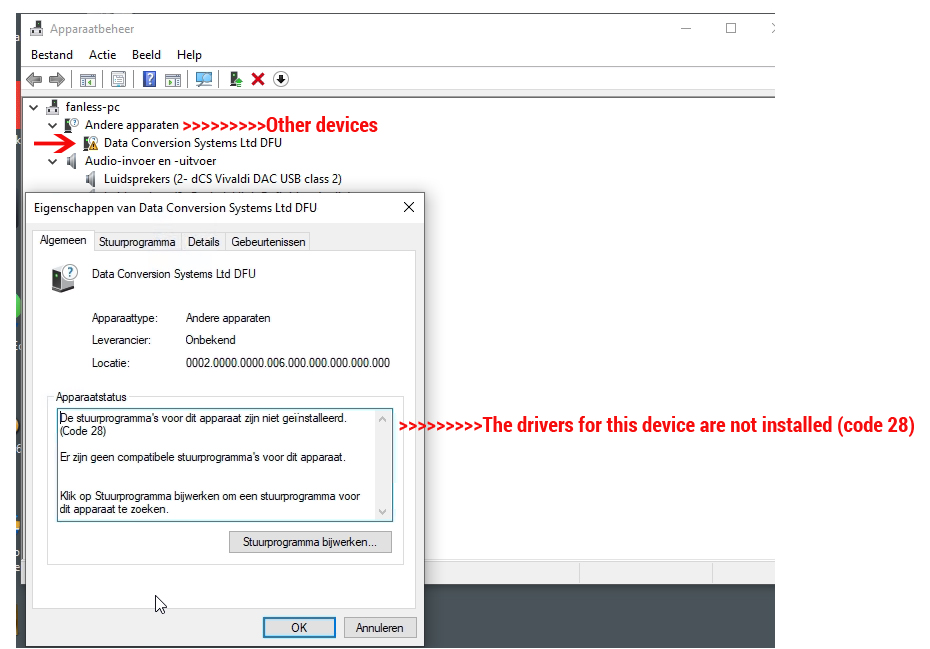
But when I look at in my PC by the ādevice managerā, I see that there is an error message: The drivers for this device are not installed (code 28)
So I installed the dCS driver as stated in the manual but the error message remains.
What can that be?
I see that the audio path does recognise the audio-class 2 device, and I assume you get sound out of the DAC. It even reports the correct name. So far so good.
Iām suspecting that what you see in āOther Devicesā is not the audio part of the Vivaldi, but another device on the same USB bus for some other purpose. āDFUā could mean Device Firmware Utility, but Iām guessing here. Contrary to Rossini, since Vivaldi DAC does not have a network connection, firmware updates have to be done through the USB port so there must be a path inside the equipment to enable that - thatās my guess.
I donāt have a Vivaldi DAC in front of me currently, but Iām guessing that this is partially due to MQA support in the DAC. Weāre required to present an additional interface via USB that the player can query in order to find out MQA capabilities and get MQA status. It presents as an HID device. Iām wondering if on first connection Windows didnāt recognize it and that didnāt get overridden when you installed the dCS driver.
You could try uninstalling the dCS driver and deleting the device in device manager. Pull the USB cable, then install the dCS driver. That might get it going correctly.
Regardless, this has no impact on playback so unless it causes concern Iād just queue up another track and enjoy it
Rewaking an old post as Iāve the same āproblemā. The Vivaldi One is correctly recognized and displayed by Windows and music plays fine.
But Iām having this quite enigmatic device listed as well, with the same error. I guess itās not really an issue. The driver link page in the manual seems broken, I guess because newer Windows revisions already include it and that would be of no use anymore?
Indeed the driver now seems to be unavailable. However I think that you may be correct that it is no longer needed as Windows now supports USB Audio 2.0. However I will tag @Phil at dCS support to bring this query to his attention if he needs to comment.
Just to remind users of Win10 that Microsoft support for it ends in a few days.
As @PAR has already suggested there is no longer any requirement for a USB audio driver under Windows (since the May 2017 Windows 10 āCreatorsā update), OSX or Linux as all three OSs now fully support Class 1 and Class 2 USB audio hence there is no driver available for download. Earlier versions of Windows (7 / 8 / 8.1 etc.) are no longer supported.
The online manuals have been updated to reflect that with the printed manuals being updated as new print runs have been produced.
The DFU device that is seen under āOther Devicesā I BELIEVE is for doing a low-level Direct Firmware Update of the USB hardware (as has been suggested above) but I thought that DFU device should be hidden so Iāll check with the software guys on that.
I see the Vivaldi DAC manual reflects this, thereās no mention about old Windows versions not natively supporting Class 2 or about the driver. The Vivaldi Oneās still has those old informations. But I understand the One isnāt officially on sale anymore, while the Vivaldi is, thus not much interest into updating the manual.
I was curious about this, so I did a USB interface probe with my Bartok connected. Turns out it actually exposes 4 interface types; 1x Control, 1x Streaming (with 2 channels;), the DFU, and a HID for MQA.
For those who might be interested;
Number of Interfaces: 4
Configuration Value: 1
Attributes: 0xC0 (self-powered)
MaxPower: 0 ma
Interface Association Audio/Unknown
First Interface 0
Interface Count 2
Function Class 1 (Audio)
Function Subclass 0 (Unknown)
Interface Protocol 32
Function String 0 (none)
Interface #0 - Audio/Control .............................................. "dCS Bart\363k USB class 2"
Alternate Setting 0
Number of Endpoints 0
Interface Class: 1 (Audio)
Interface Subclass; 1 (Control)
Interface Protocol: 32
Interface #1 - Audio/Streaming .............................................. "dCS Bart\363k USB class 2 "
Alternate Setting 0
Number of Endpoints 0
Interface Class: 1 (Audio)
Interface Subclass; 2 (Streaming)
Interface Protocol: 32
Interface #2 - Application Specific/Device Firmware Update .............................................. "Data Conversion Systems Ltd DFU"
Alternate Setting 0
Number of Endpoints 0
Interface Class: 254 (Application Specific)
Interface Subclass; 1 (Device Firmware Update)
Interface Protocol: 1
DFU Functional Descriptor
bmAttributes: 0x07 (Download, Upload, Manifestation Tolerant, Reserved bits: 0x00)
wDetachTimeout: 250 ms
wTransferSize: 64 bytes
Interface #3 - HID .............................................. "MQA Decoder"
Alternate Setting 0
Number of Endpoints 1
Interface Class: 3 (HID)
Interface Subclass; 0
Interface Protocol: 0
HID Descriptor
Descriptor Version Number: 0x0110
Country Code: 0
Descriptor Count: 1
Descriptor 1
Type: 0x22 (Report Descriptor)
Length (and contents): 21
Raw Descriptor (hex) 0000: 06 00 FF 09 01 A1 01 15 00 26 FF 00 75 08 95 40
Raw Descriptor (hex) 0010: 09 01 B1 01 C0
Parsed Report Descriptor:
Usage Page (Vendor defined 0)
Usage 1 (0x1)
Collection (Application)
Logical Minimum......... (0)
Logical Maximum......... (255)
Report Size............. (8)
Report Count............ (64)
Usage 1 (0x1)
Feature................. (Constant, Array, Absolute, No Wrap, Linear, Preferred State, No Null Position, Nonvolatile, Bitfield)
End Collection
Endpoint 0x83 - Interrupt Input
Address: 0x83 (IN)
Attributes: 0x03 (Interrupt no synchronization data endpoint)
Max Packet Size: 64
Polling Interval: 8 ms