I got an Apex Rossini and Clock a couple of weeks ago.
I’ve left the Filter and the DSD Filter both on Filter 1 until today. My wife occasionally finds the sound a bit full on, and I know what she means - it’s awash with detail, and snaps along with real pace, but sometimes…a bit of chill might help…
I listen to mainly to 70s and 80s Soul (Marvin Gaye, Barry White, Isley Brothers, Al Green, Isaac Hayes - can share the epic Qobuz playlist if anybody is interested!) and Ambient/EDM type stuff. Diverse I know. I can’t explain. I like a warm sound though, with strong Rhythm (ex Naim ) and I have Accuphase amps and Bowers and Wilkins Speakers.
There are a billion filter posts on here - but I wonder if there was a definitive one that actually talks to the sound of each? …maybe one that aligns each to a type of music or a mood.
I’ve switched to the settings in the screenshot - sounds good - although I’m not sure if it’s actually different or not. Subtle. I’m just floundering around really.
Can any gurus on here help me on the journey please - of course I could try all of them over an extended period of weeks, but this is a well trodden path right?
Try to switch the Mapper to MAP3: difference won’t be subtle
Now regarding Filters and upsampling: setting Upsamling to DSD makes no much sense to me.
I’d recommend to either set it to DXD (DXD is quicker, some say timings are better with DXD than with both DSDx, and I tend to agree with that) or to DSDX2 (best resolution with more relaxed presentation and slightly slower timings - “soften attacks”).
PCM Filter #4 offers the fastest response, but can be a bit harsh. I personally prefer:
Filter #3 good tradeoff between data conservation and timing for 48, 88.2 and 96KHz resolutions
Filter #5 no pre-ringing for 44.1KHz resolution
Filter #6 still no pre-ringing for 176.4 and above resolutions
Note: Filters 5 & 6 only exist for 44.1, 176.4, 192KHz and DXD native resolutions
Now, your Rossini and Clocks are all brand new and barely broken-in.
Take your time to experiment by yourself which settings you personally prefer.
I’ve done this - definitely not subtle - reserving judgement on “better” …..again, assuming I’m a complete novice to dCS - what even is MAP1, MAP2 and MAP3 ?
I’m trying the other settings you’ve suggested - I do notice a physical clicking from the Rossini track to track as the rates change and it seems to change filters between 3 and 4 - normal?
I am guessing that you are looking for the right combination of correct input sample and filter. The answer is simple. There isn’t one.
When dCS give a choice of settings it is not as a marketing ploy but because not every filter will be appropriate in all circumstances. Not only may this be the case for the music, system and environment but , essentially, for the particular perception of the listener. For example what may sound detailed to you might come across as bright to me. Or vice versa . This is also one reason why dCS DACS remember the settings last used so that you do not need to reset them once you are happy.
It would be nice of there was a different memory setting for you or your wife but as this isn’t the case you will both need to agree on a compromise and/or remember any differences for when you listen alone.
I could list my preferences ( and they are only that not answers) but my system and the way I can use it ( no upsampling which is only available to Vivaldi owners currently), mainly classical music, probably make this irrelevant to you.
That is because there is no definitive answer. However do try different combinations where they are available to you . As Rossini always upsamples to DXD or DSD the permutations may be greatly reduced.
Map 1, 2 and 3 affect the allocation of data samples to the current sources for the Ring DAC. How these are allocated affects the sonic result. Map 2 is the algorithm used by all dCS DACs until a couple of years ago. Map 1 is the new default and Map 3 is also new and is described by dCS as experimental. Give it a try and see if you like it. Once again there is no “right” answer.
Let’s wait for @AndrewS from dCS to address the Mapper question.
Yes, clicking is normal as long as you don’t hear it passing through your speakers.
It’s the device relays (one per KHz resolution, output voltage, clock settings…) you can hear click in your Rossini.
About the Filter setting persistance, the PCM Filter setting is saved for each resolution.
So if you wish to try F3 for all resolutions, you will have to set it once for each…
(Output voltage, Upsampling, DSD Filter and Mapper settings are global, hence apply once for all resolutions)
There is another thread that cropped up a few weeks back that talks about the filters and mappers that where @AndrewS does a nice job of expalining the trade offs of fillter and mapper choices. I can’t seem to find it but it is worth a look
As for which to choose - I agree with everyone above - there is no single right answer. I’m currently using DXD setting with Mapper 1 and F1 for all sample rates. I listen to mostly newly recorded classical - much of it is 24/96 - and a lot of piano music these days. F1 filter seems to offer a clarity I’m looking for. These settings can sound rather aggressive with poorly recorded Pop music)
I have played around with F4 at @PAR suggestion for orchestral music and subjectively things sound a little more organic to me.
I really do like the choice and it is easy enough to switch on the fly. dCS could do a little more to help improve the UX. Sometimes I wish I could just hit a relax button if i’m in the mood.
As the referees in American football say “after further review” I am grateful for this thread (and similar others) coming around again. It’s made me actively go back and mess around with the different maps and filters, and I have realized that the choices I settled on a while ago (and left intact without revisiting) may have not been the right ones for optimal sound quality in my system. Over the last many days extensive and careful listening sessions to what I really like (Melody Gardot, Paul Desmond, Patricia Barber, Til Brönner, Hilary Gardner, Oscar Peterson, and so on) has provided a refreshed perspective. I know it’s an overused reviewer phrase, but I am honestly hearing things in the music that I didn’t know were there as I changed from Map 3 to Map 1 and I have enjoyed and appreciated the subtle differences between the filters. I am hearing increased clarity without any added brightness, the instrumentation has become more clearly defined without any trace of being smeared together, and there is an overall greater sense of ease as the music flows. What was a really good mid-range is now even better, and sometimes truly great. I know this is an often brought up topic by newer members of the forum, but it’s been good for me to refocus on it in my listening and has made a difference.
MSB like dCS works with its own proprietary fpga. I have not had the chance to listen to their product but indépendant reviewers compared them to dCS and found out that they are more forgiving with recordings whatever their quality. They are warmer, still capable of excellent définition and dynamics, but less forward on clarity.
Petsonnaly i would not change anything if I had the Rossini and the clock, but i listen to classical music, the dCS line is a perfect match to me.
There are other ways to render a smoother and more engaging sound though…
I totally agree. Filter selection is absolutely subjective. Even if the differences seem very little (I barely notice), I like “lean sound” and use Map1 with DXD Filter 1 setting.
I posted something in a beta thread but will add here as well… Participating in the dCS 3.0 beta, and the excellent dCS filter white paper has helped me better understand why dCS included so many filters. I’ve also spent more time evaluating different combinations and have changed my setup. I now use F5 for 16/44, F2 for 24/48 (or the new F5), F3 (sometimes F4) for 24/88 and 24/96 and F5 or F6 for 24/192 and up. Map 1 and DXD upsampling. @PAR suggested F4
Although I have a hard time hearing a difference in rapid AB comparisons, I did notice a subtle change with extending listing. Many transient Piano / string recordings sound less edgy - and more natural sounding.
The bulk of my digital library is classical at 24/96. if I had to guess, the difference has something to do with engineers using gentler filters in production for these higher sample rates. Matching playback with a similar filter may have something to do with it (this is hinted at in the dCS white paper above. The paper does a nice job of explaining the trade offs with frequency, time and phase)
Again, I find the changes subtle, but enough to really affect the listening experience
This will mean a lot, or a little, depending on how much you are into the intelligibility of multiple voices at once style of listening. For me, filter 4 with mapper 3 is the best of the lot, available on my Lina&clock. For me it’s night and day in terms of my response to all genres of music. If you take the time to jostle your whole rig into a sweet spot using this setting, the result can be bounds ahead of where you started, at least that was my experience. Far more a palpable musical space, rather than a 3D sound stage, with a Naim NC 250. I let the goal of coherent timbres be my aural guide to set up, nothing else. It is a self-sprung rabbit hole/path, but I’m in love with the result.
Personally, I’m eager to listen to the upcoming new mappers and filters.
I hope dCS is going to explain the choices made behind this new stuff and what they’re supposed to bring.
 ) and I have Accuphase amps and Bowers and Wilkins Speakers.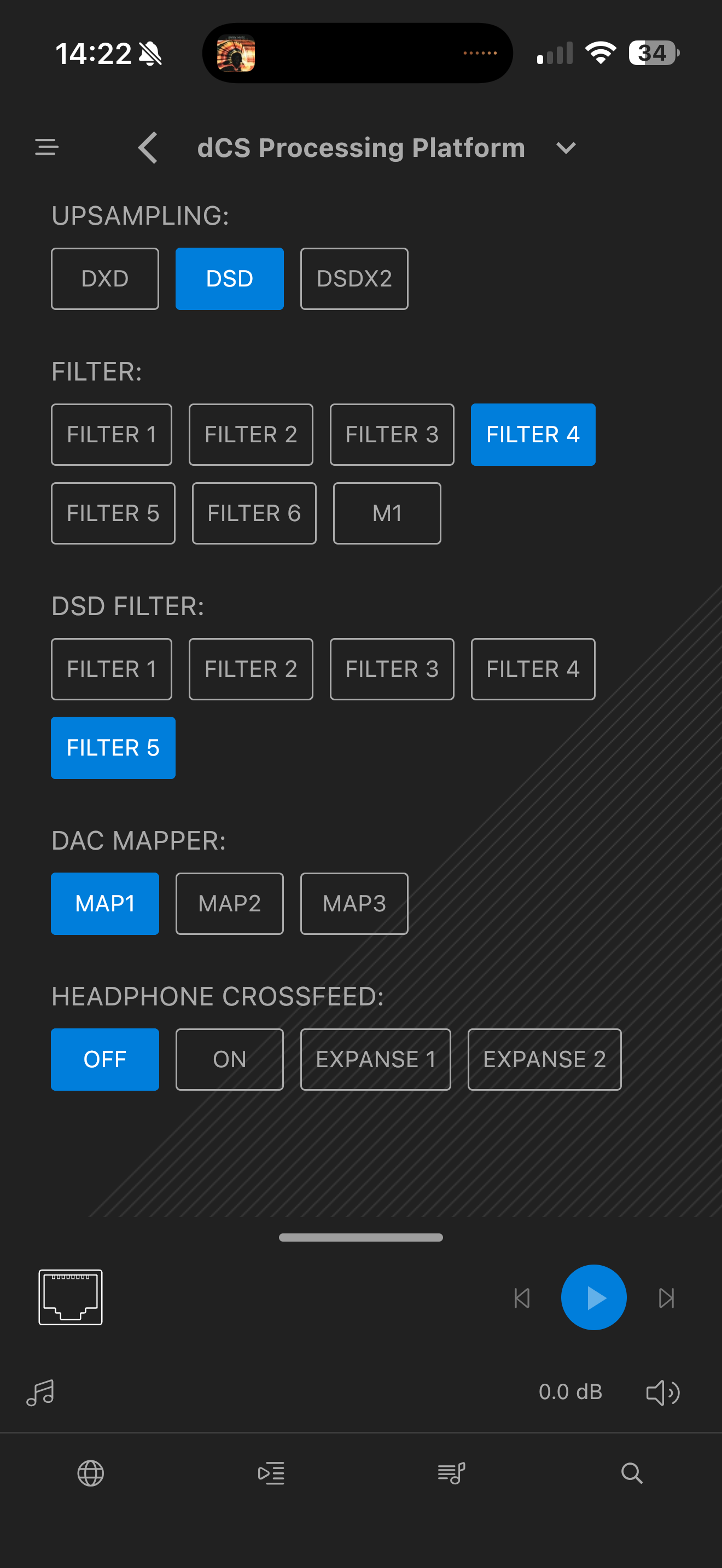

 …..again, assuming I’m a complete novice to dCS - what even is MAP1, MAP2 and MAP3 ?
 . This is also one reason why dCS DACS remember the settings last used so that you do not need to reset them once you are happy.