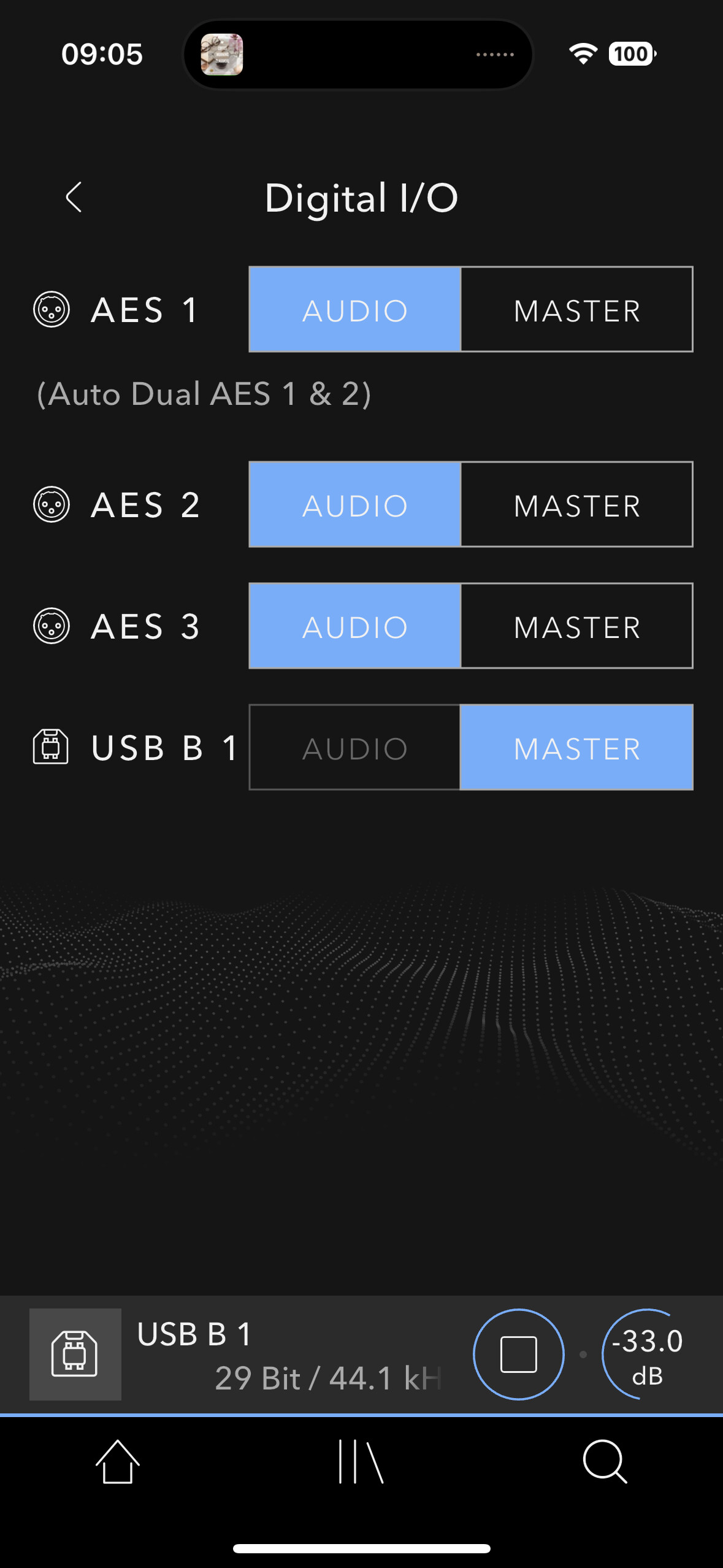
Can anyone tell me what these settings mean? Nothing in the manual to explain them.
And is there any way to set a default input that the dac will switch to when the music stops?
Can anyone tell me what these settings mean? Nothing in the manual to explain them.
And is there any way to set a default input that the dac will switch to when the music stops?
Hey @Tommytwotimes ,
Those are the clock settings. For each of the inputs on the I/O board you can can select if the Core (or Master Clock if you have one) is the master, or if the source is the master. This setting has nothing to do with the selection of the actual source. I don’t have a system in front of me right now but I believe the system defaults to the last source that was active and I don’t think that behaviour is configurable.
To avoid some confusion out there, this view is available with Varese. If you have other dCS models you are not missing out.
USB 29/44.1?
@PAR I wondered about that too…
Good catch Pete. I’ve asked the question..
When the format is displayed then we actually look at the audio that is coming in and display exactly what it is and not the “package” format … so in that case it is likely that the source is outputting 44.1Khz Sample Rate at 32 bits Sample Depth but of those 32bits only 29bits are actually actively being used …
We do the same on our other units too which is why sometimes you can get “odd” bit depths being reported on the display - e.g. 23/44.1.
I hope that helps.
Phil
Thanks Phil. although I have seen 32dB float used in the context of audio engineering to provide effectively infinite headroom when recording , I can imagine that any practical use for 1500dB dynamic range for listening to music domestically is impractical as electronics, loudspeakers and ambient room noise will diminish this significantly. In any case, as you suggest, the capability may not be used. Even 29dB will be similarly limited . I have never seen files for the public offered at this bit depth although admittedly I have never searched.
I guess that the dCS display also shows other received data (rather than metadata descriptions) as for a long time Mosaic was showing BBC R3 HD as 317kB/s AAC rather than the “advertised” 320kB/s ( now reinstated). I wondered if BBC were using part of the bandwidth for other purposes?
Phil, separately, on the Varèse, how is DSD256 handled on USB inputs? As DoP over 24/705.6K PCM or native DSD in 32bits raw data format with the Thesycon ASIO Driver? Or both?