I suggested that I might post more views on the Varèse system, but rather than posting about sound quality, which, (a) let’s be honest, is a foregone conclusion of superlatives, (b) is totally subjective, and (c) has already been covered by a dozen professionals (Stereophile and elsewhere)… I thought I’d post 10 aspects of the Varèse system that I think mostly hasn’t been covered elsewhere 
- System Unboxing -
Unlike recent flagship DACs from other vendors (ahem MSB Sentinel), you (or your dCS dealer) won’t need any machine tools/Screwdrivers to unbox the Varese system. Units come double-boxed and foam protected, with a dCS proprietary inner box, and dCS branded outer box from UK-based supplier Item with it’s ingenious handles, Interlock clips, and tamper-proof secure rotary locks, allowing one to completely “disassemble” the outer box without any tools.
With the ACTUS Cable boxes, a sharp letter-opener comes in handy if you don’t want to damage the outer boxes too much while unboxing.
Brief unboxing vid posted by the Polish dCS Distributer - https://www.youtube.com/watch?v=gWsqjfDeHCw
- Interconnect Cables -
- It's been mentioned in reviews, but it’s worth highlighting that when moving from a full Vivaldi stack, the volume of cables eliminated by ACTUS, both in quantity and potential re-sale value can be significant.
In my case, 5 x MIT MA-X Digital AES/EBU, and 5 x Stealth Audio Varidig 75-Ohms/BNC Clock Cables, which will add up to a nice chunk of change when I successfully sell them off.
One after-market tweak I’m unlikely to re-insert into the system is the Nordost QRT Grounding unit. Previously grounded via a conductor on an AC cable ground pin. after yers of using it, IMHO its benefits are dubious at best. YMMV.
- Unit Dimensions -
- With the exception of the Varèse Core, all the other units enjoy exactly the same dimensions, including the Transport. Whereas with the Vivaldi system, the Transport is the largest, followed by the DAC slightly shorter in height, and only the Upsampler and Master Clock share the same dimensions.
After 13 years, normalizing the shelf-heights on an adjustable rack (Solid Tech) is satisfying for the OCD inclined 
- Turn-Up -
- ACTUS makes all physical connections simple enough even for a child. So, unlike with the Vivaldi stack, there’s really no need to “double-check” cable connections before powering on the system.
The start-up splash screen on the UI front-panel when freshly powered-on is gorgeous - that large-font “Varèse” seen in stock photos.
The overall User experience from when first powered up to playing something is so seamless that it’s a little disarming.
- UI unit
- The interface design language on the touch-screen front-panel is quite different from anything else dCS has done to date. Clearly they’ve put some serious thought into the touch-screen usability which is intuitive enough to not warrant a usage manual. It’s nice to be able to make configuration changes from a single panel rather than on different units. Screen real-estate is well utilized.
The touch-screen comes with a screen-protector that doesn’t hamper usage. Like on the Vivaldi’s little screens, I’ll probably never peel the protector off 
- Varèse Remote -
- I was originally a little concerned with Bluetooth as the connection protocol for the Remote, as it has a notorious reputation for being unreliable. Not to mention potentially problematic with the initial pairing process.
Not so with the Varèse Remote! Its operation turns out to be completely seamless from the get go. When Varèse is first powered-up, the Remote automagically connects and remains connected through reboots, including firmware updates. No special pairing required.
If there was one nit to pick on the Remote, it’d be the lack of a screen, at least showing the volume level (a la the discontinued Senic Nuimo). Though perhaps somewhat unique to my setup since the system is behind a ventilated cabinet space with no viability to the UI unit from the listening chair. So, listening sessions are with Mosaic ACTUS (and Roon/Qobuz/Tidal Connect clients) on an iPad Mini rather than with the Varèse Remote.
- Mosaic ACTUS
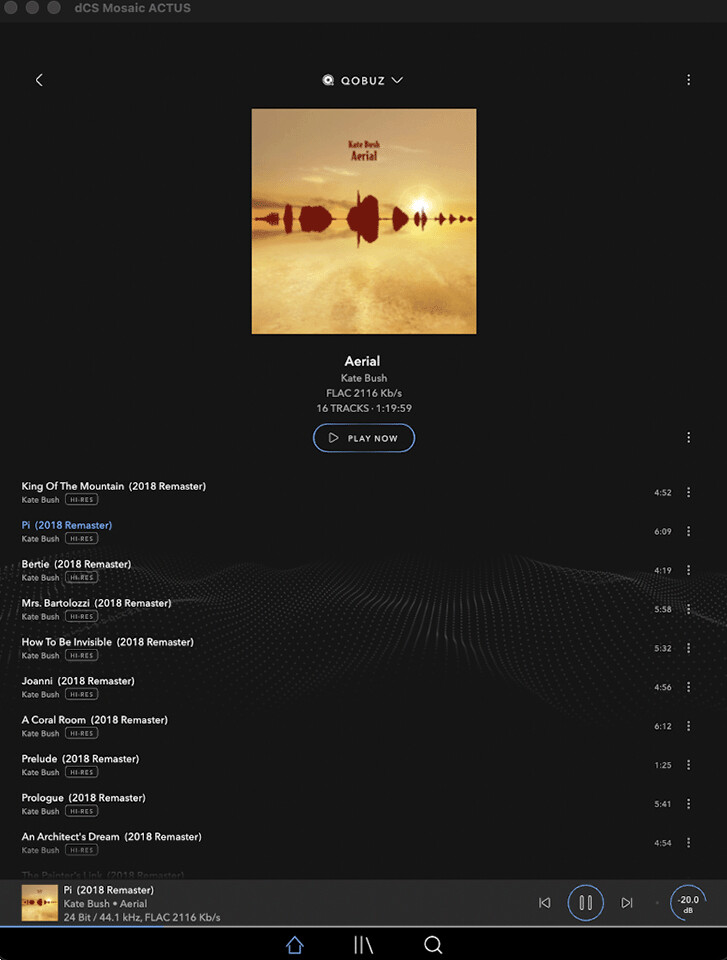
- Mosaic ACTUS is quite a bit different from standard Mosaic. Intuitively so, but it does take a brief getting used to after years of using standard Mosaic.
The biggest difference includes source selection which is now much more prominent at the center top of every page.
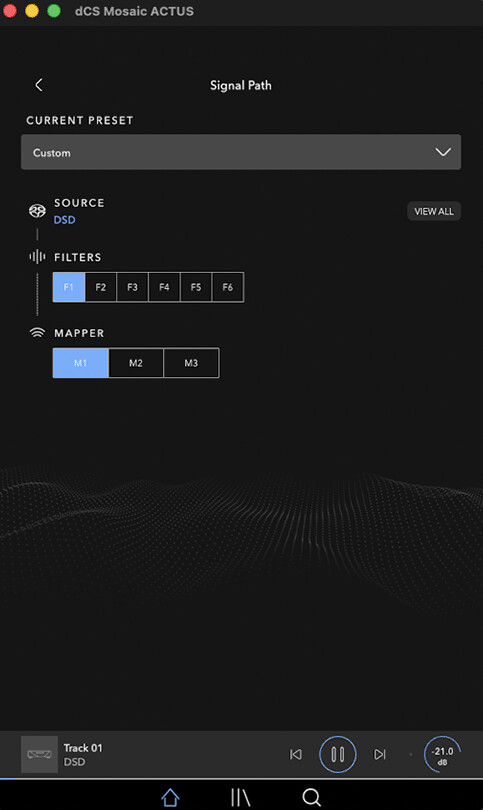
And the Signal path setting which replaces individual Filter, Upsampling, and Mapper settings. Configurable into custom grouped settings for easy switching as a collection rather than having to set each individually.
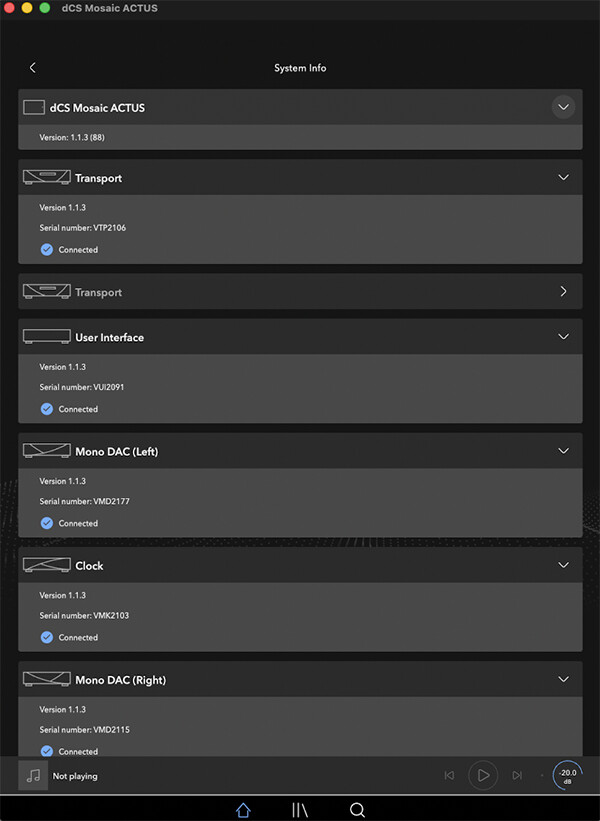
The system info screen is also much more comprehensive.
- Software Updates
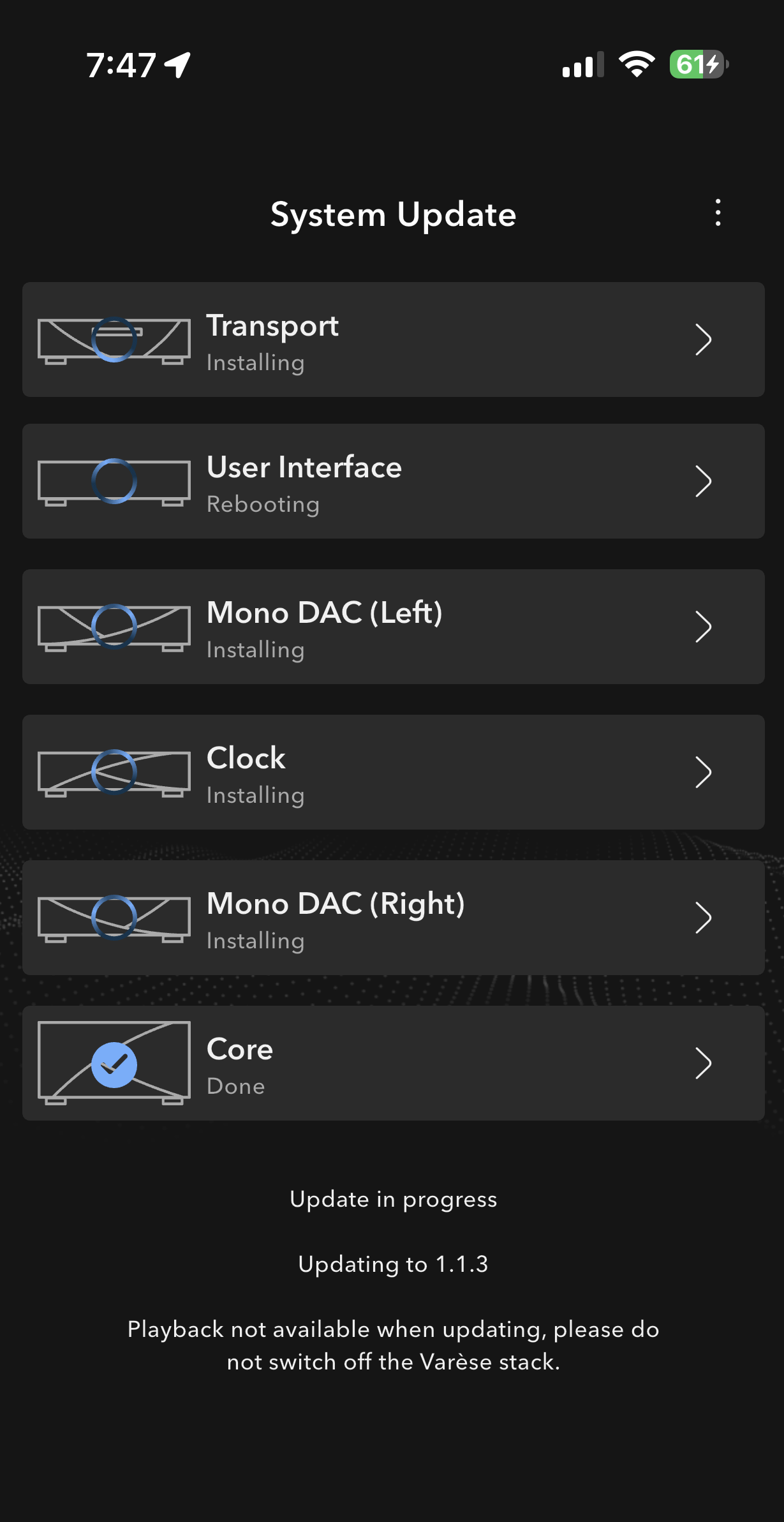
- Software updates on the Varèse are quite different from V/R/B/L/NwB in that while both take a system wide approach with a single update package for both the networking and DSP/FPGA codes, with Varèse, the update is much more visual and detailed where every step of the automatic process is displayed visually on both the UI front-panel and on Mosaic ACTUS.
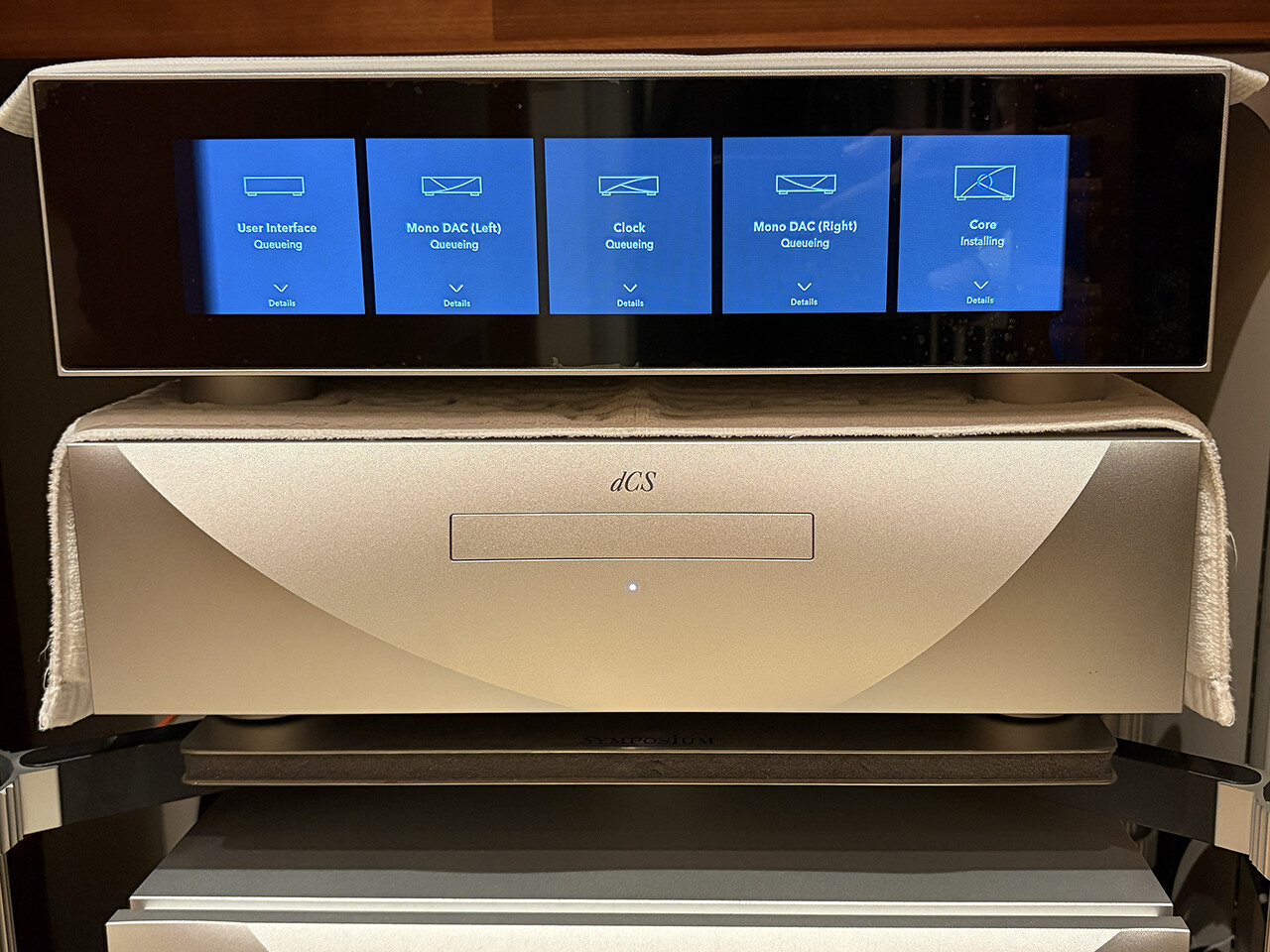
I can think of no other high-end audio system that comes even close to how well dCS has executed on this software update piece. Some other vendors (ahem MSB) are only just this year about to introduced Over-the-Air firmware updates, dCS has been doing OTA updates for literally a decade.
- Service Advertisements
- When dCS systems are powered up (and periodically thereafter), they advertise themselves on the local network for various services - UPnP Renderer, Roon endpoint, Airplay endpoint, and Qobuz/Tidal/Spotify-Connect hosts, etc.
One of the most interesting aspects of the Varèse system is that it occupies 2 IP addresses!
A “Varèse Display” and a “Varèse Core” - only one advertises UPnP availability (Varèse Display), while the other does everything else including Mosaic ACTUS communication, and Internet-bound communications (Airable/Qobuz/Tidal/Spotify, etc). The two IP interfaces maintain a highly active low-latency communication channel between each other.
Also, interestingly the Mosaic ACTUS to Core communication is conducted via an advertised service “mosaic-api” - which looks to be a TLS (encryption-protected) API server within the Varèse Core. The fact that it’s an advertised service suggests potential open API access for integration by 3rd party systems (exciting! ).
And finally..
- Vivaldi Comparisons -
- All said and done, I will miss the Vivaldi stack. Not so much for its sonic attributes, but for its completely open disaggregated architecture. There are things one can do with the Vivaldi’s open architecture that can’t be done with the Varèse.
The Vivaldi stack is the only high-end open-interfaced instrument of its kind even after more than a dozen years since its introduction. No one else builds anything even remotely close.
Sign of a true classic


