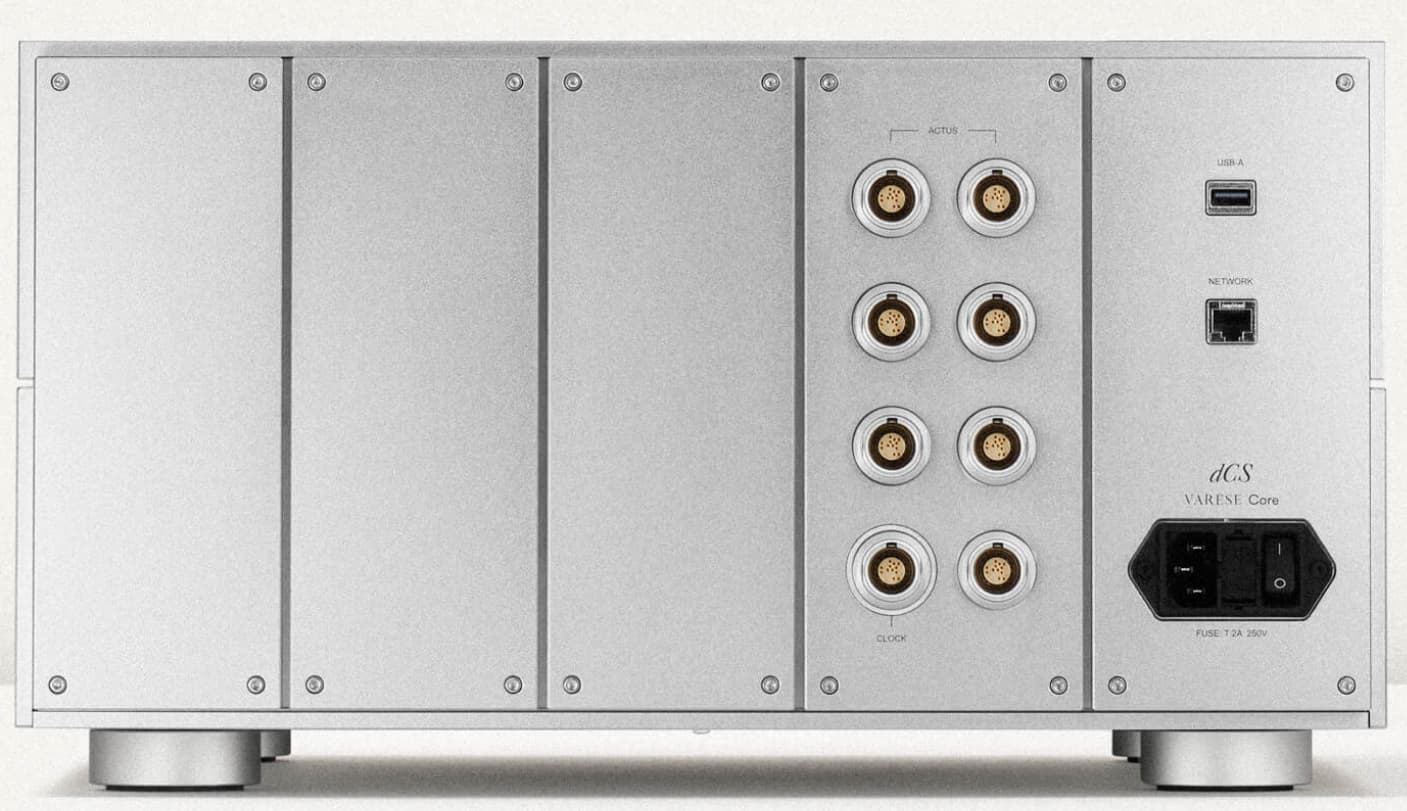
dCS has usually introduced its new flagship first, and then released a series of next tier products based on the former. I would expect the same following Varèse.
As such, just a friendly, light thread on what folks expect next?
Given the price difference between Varèse and Vivaldi, I don’t really consider the former a replacement of the latter, but I do expect a new product soon.
What do you think the architecture will be?
I think:
Three+ box solution:
Core (successor to Upsampler, with DSD256)
Dual mono DAC in one box (similar to MSB Sentinel)
Clock (optional)
User interface (optional)
Transport (optional)
If architected this way, dCS could leverage the new Actus system, and if the Core and the DAC can operate as a pair, it would enable multiple price points for folks to enter and upgrade to.
My assumption is that the Varèse is the flagship of a whole new family. As such, rather than a “Vivaldi successor”, it’s really a question of what the next one down from the Varèse might look like. In other words, the “Rossini to the Vivaldi”.
On that basis, I agree it’s likely a more integrated version of the Varèse. My guess would be a 2+1 box platform with the Core and UI integrated into a single unit (with expansion slot for AES S/PDIF input module), a dual-mono DAC unit, and an optional Clock, all interconnected via ACTUS of course. No separate Transport offering.
Speculation on a replacement for Vivaldi has been aired here on many occasions over the past few years. There have been new models introduced at either end of the dCS range in the meantime.
I think that it is worth remembering from dCS past posts here and from their website that Varese resulted from posing the question “How do we improve Vivaldi?”.
The answer was to use differential mono DACs resulting in aditional casework and novel supporting technologies such as Tomix. This implies that if followed in principle, any lower priced models would still be costly. How Varese can be "cheapened " yet still provide performance better than Vivaldi is, fat least rom the outside, difficult to see given the origin of Varese as the answer to the question of improving Vivaldi.
An associated question relating to a " cheapened" version of Varese is its attraction to its market. Accepting that any Vivaldi replacement would no longer be the dCS flagship ( that being Varese), it would still be expensive if based along the lines of Varese. At this end of the market I would confidently guess that potential buyers will have access to comparatively large disposable incomes. They also want the best. Varese is around £220K for the 5 box version. Any replacement for Vivaldi would need to be priced considerably below this to be feasible for Vivaldi upgraders but not high enough so that buyers find the differential small enough to bite the bullet and go for Varese instead. A bit of a paradox.
I agree on the precept that Vivaldi will be replaced at some point on an “all things must pass” basis. However I won’t speculate on when this may be nor of what the fertile brains at dCS may eventually produce.
I believe dCS are working on how to implement the Vivaldi set up into the Varese. As in work out a way to make the dual mono dac work with the upsampler, as this then gives a stepping stone way to inpove what you already have without going full Varese.
But you can certainly see the way it’s going, milled box design to give better isolation, etc. But I feel its all going to be rather expensive going forward. But it will certainly be interesting to see what cones next. I am hoping for many new upgrades for the Vivaldi, as why not just keep inpoving it if they can, as its already wonderful.
IT’S GREAT TO THINK ABOUT THE FUTURE–TILL YOU GET TO BE MY AGE. !!! (79) I have just been able to get piece together a complete Vivaldi/APEX stack and I am going to enjoy this listening experience until I GO OUT and then my children can fight/sell over it. By the way, I love this site–folks here are about helping–and I have enjoyed that help. I lheard things from music that I have never heard before with this kit!!
From one old geezer to another ( 76 in a few weeks) and to that young whippersnapper @Dunc , I likewise find that Vivaldi Apex fulfils all of my desires. I have no need that I can currently think of for any improvement. So Vivaldi =
The mono DACs are obviously one of the primary values of the Varèse platform to improve on the Vivaldi’s performance (as Pete pointed out), so retaining that across family seems like a logical choice. As the same time though, lots of folks have issues with “box proliferation”.
In which case it might make sense for a DAC unit to have a hybrid design of dual (separate) DAC boards, an ACTUS control board mounted vertically. and dual PSUs, all in a single chassis, i.e. a dual-mono DAC. That would make it pretty much like the Rossini DAC is today, except with 2 DAC boards instead of a single APEX board, and the ACTUS control board instead of the S800.
Alternatively, I could imagine another scenario of mono DACs in Lina form factor; so, a combined Core/UI full-width unit, two half-width mono DACs, and a full-width Clock unit.
–Upsampler (“Core”) with possible user interface integrated here
–Clock (optional)
Interestingly, the only high-level difference (excepting D-to-A technology/approach, of course) between this architecture and the MSB Sentinel DAC (~$400k) is that dCS consistently has a separate clock unit and MSB consistently has a separate power module(s). Sentinel DAC itself is dual mono in one chassis.
MSB Technology and CH Precision also offer the modular approach.
My dCS dealer told me that, as far as a dealer goes, they prefer this over the current dCS offering, since they will see their customers back more often
you did.dCS have improved both this year by adding Qobuz Connect with Spotify Connect to follow. Other improvements may occur but this is not the same as any successor which history so far has involved a new platform e.g. Elgar >Scarlatti>Vivaldi though compatibility has been retained where feasible.
However technology moves on all of the time and improvements for an elderly product cannot continue indefinitely for many reasons especially if costly hardware changes would be involved though even this is not inconceivable, for example Apex.
Current Vivaldi stack new is over $100k USD so I think dCS will need to replace that large revenue stream with another product soon, not just free upgrades, but we will see! : )
Right, and MSB actually had no choice but to do dual-mono as their “Femto” Clocking architecture is very tightly-coupled to the D-to-A conversion stage, it can’t be disaggregated into actual mono DACs without them developing a whole new architecture. Whereas for dCS, it’s a natural extension of what the company’s done from almost inception in the pro space.
W.r.t the main topic of this thread though, I do wonder how much of Varèse’s circuit boards could actually be re-used in subsequent platforms. On V/R/B, the control boards and DAC boards are exactly the same across all unit, just engineered into different chassis/isolation, and power conditioning. So, there’s significant economies-of-scale (albeit they “broke the mould” with Lina). Somehow I doubt the same can be done with Varèse.
A one or two box solution with: the new constrained layer casework, the new power supply, The new “bendy” printed circuit board, dual mono differential DAC and dual AES connectivity in addition to Actus. This would require either a larger 8 or 9 inch tall case or a two box solution with a separate power supply.