To add a couple of points to Andrew’s excellent response;
In fact, in the manual, they actually warn about it without being explicitly;
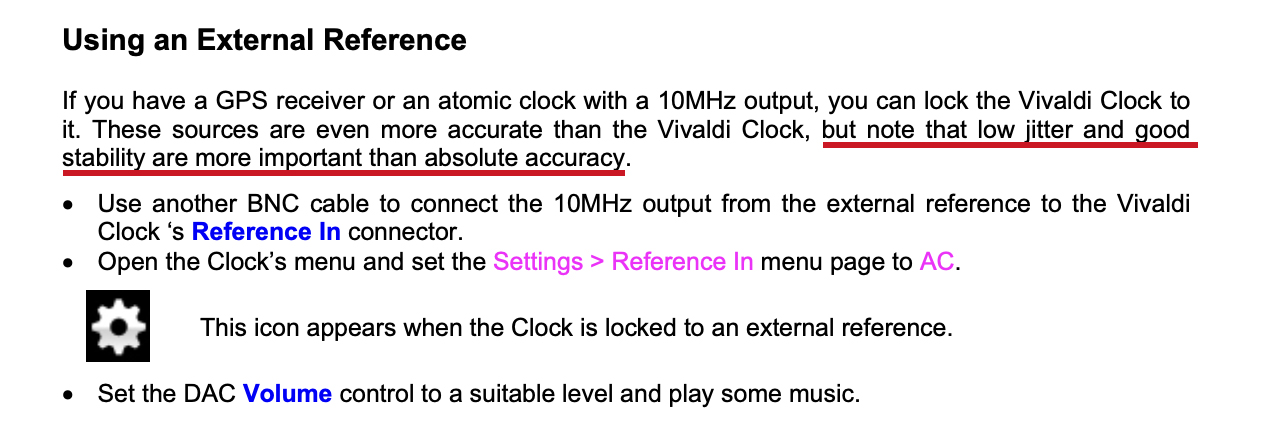
Granted, the Cybershalf has excellent phase noise performance, so the low-jitter part is covered, but, I would highlight this particular point from James back in 2020 - Dcs clock jitter specs - #14 by James
Jitter (and subsequently phase noise) on a reference clock going into the Vivaldi Clock is largely irrelevant as in essence the Vivaldi Clock doesn’t respond to fast changes on the reference input - it has a slow acting PLL (also known as a narrow bandwidth) so any high frequency changes, i.e. jitter, are filtered out. Within limits of course - if the jitter is extreme enough it may cause the clock to fail to lock to the incoming signal, although one would like to think this would be rare on an external master clock!
In fact, that whole thread is a good read, plus there are a couple of others on Clocking that ran for years, just search.
To add to Andrew’s comments, the internal reference OCXO inside the Varèse Clock operates at 22.5792MHz, that’s 512FS, i.e. a direct multiple of the audio reproduction frequency. Whereas the Cybershaft operates at 10MHz which has to be divided (fractionaly) to appropriate audio frequencies.
Also, in a quick specification check, the Varèse’s OCXO exceeds the overall phase noise performance of the Cybershaft OP23A Signature. While about matching that of the SRS Perf10 (which unfortunately also operates at 10MHz).
In other words, the dCS Varèse is not going to benefit from either of those after-market external 10MHz Clocks (even if it did have an external reference clock input  )