This topic has come up before so I thought maybe we could finally get some data : )
What is your DAC-to-speaker signal path? And any thoughts you care to share on why….
- Use a separate pre-amp
- Run direct to power amp
0
voters
This topic has come up before so I thought maybe we could finally get some data : )
What is your DAC-to-speaker signal path? And any thoughts you care to share on why….
Although this may provide some data can these be used to reach conclusions?
This gives only a binary choice but without the ability to give any idea why the choice has been made. For example a major issue for me is that I also have a large LP collection and need a player. Direct connection is not feasible for this without rewiring when swapping to digital. So this is one of my significant reasons for using a preamp
Would whatever the response rate is be sufficient to be considered a reasonable sample from which conclusions can be drawn in any case?
I had similar thoughts: it is an interesting question, but mainly to learn the reason the particular choice was made. Yes, a substantial response from the Forum is needed for the results to have general significance, but the experiences and choices of individual members, if explained, can be helpful. In my case, I have headphones as well as speakers and want to use only the best sounding outputs of the dCS DAC (the balanced ones). Hence I use a combined pre-amp/headphone amp.
So far the majority are pre-amp users…
Also interesting to learn that the Discourse app apparently uses the Trunc(-) function and not the Round(-) function as 16/26 (the present survey result) = 61.5% = 62%, not 61%, as shown.
Just sayin’…
; )
I dedicated a considerable amount of time figuring this out over a few days. I only stream via Qobuz. My system is Magico S3 (2023), D’Agostino Progression stereo amp and Bartok APEX. I had a Progression preamp and borrowed an Audio Research Ref 6se. I level matched all three combinations. Bottom line is the Ref 6se, very slightly edged out the Progression which very slightly edged out the Bartok direct, but I’m splitting hairs. I could hear the difference between the three but the difference was minuscule. I returned the Ref 6se, sold the Progression pre and have lived happily ever after. FYI, the difference between the Bartok and Bartok APEX was far greater.
6 years ago or so, when I almost entirely revamped my system, I was already owning the Bartok which was the only device that stayed in.
I was about to take the route of direct to power amp, the MC462 power amp being the first component I chose for the renewal.
But, tempted to go back to vinyl and quite attracted by the McIntosh C70 limited series “preamp full analog” at that time, I ended up buying the C70 and a MT5 turntable as well…
Since then, I’ve replaced the C70 by a C2800 (not full analog at all) and despite recent firmware jokes, I’m happier with it (still with tubes, but with more body to the sound, much faster transient, better ease of use with a dedicated app to control it)
Over the Christmas holidays I had the chance to evaluate the effect of a good preamp to my system (using ripped CD’s stored in a Melco N5, a Vivaldi Apex stack, a Constellation Taurus power amp and Wilson Sasha-V’s). I had borrowed a passive Bespoke Audio as well as a Burmester 077, a Nagra HD, an MBL 6010, a Vinnie Rossi Brama-2 and a Soulution 725.
There was a distinct difference to the music presentation when each one of those preamps was in place, also compared to the Vivaldi direct to power amp path.
The units that sounded most impressive were the Bespoke Audio (not so much at lower, but at higher listening levels), the Vinnie Rossi Brama-2 and more emphatically the Soulution 725.
Had the same thought Pete. I have a big vinyl collection going back almost 60 years. I use a Soulution 330 integrated amplifier which gives me outstanding sound from both my digital and analogue sources, albeit the display/control is a bit hokey!
Same here. Also still have a lot of vinyl. Using a Soulution pre-amp. And indeed,wonky remote. But it also works on my Bartok. 
I prefer the sound when I route my Rossini Apex through my D’Agostino HD Preamp rather than directly to the D’Agostino mono blocks.
I would guess that the preamp => mono blocks is a better impedance match (same manufacturer, built to connect together). And I’m pretty sure the preamp supplies more current during very dynamic passages. I thought the Rossini direct setup sounded a bit “thin”.
Just my thoughts.
Actually the impedance of the balanced output of the Rossini is lower (3Ω) than that of the Momentum HD (10Ω), but the difference is inconsequential given the very high input impedance of the Momentum power amps (1MΩ for the MxV 400s). I suspect the perceived sonic differences are more likely explained by their distortion spectra, or even more likely volume differences. Level matching between a preamp and no preamp is really tricky to do accurately and the ears are easily fooled by even small differences.
Agree… usage requirements are essential! For me, I my needs only require me to use the DAC
The DAC-to-speaker signal path has been a key issue to unleash the full potential of my dCS Vivaldi One APEX. My affair with dCS began with the launch of the Rossini Player + clock (I solely listen to CDs, mostly classical, jazz and now more rarely to pop i.e. Pink Floyd, Talk Talk, Mike Oldfield, Genesis, ELP, etc). The Rossini was a big improvement in sound naturalness over my Musical Fidelity KW player. Soon later, the system was further improved with a Nagra CLASSIC amp (+ CLASSIC VFS) in replacement of the Musical Fidelity KW550 integrated amplifier. Importantly, the Rossini was operated without the preamp unit with the KW550 previously. The sound was gorgeous with the Nagra. During the first Covid-pandemic, a technical issue made me upgrade my system, replacing the Rossini with a Vivaldi One + Vivaldi clock. Though it resulted in a more detailed sounds, it was definitively not as lifelike… What a disappointment! Playing a Tetris game intensively with the settings, the cables, the connectors, though enabling to establish the optimal setup of my system (Mapper 3, DSD2X, PCM filter 5, DSD filter 4, output 6V [superior dynamic range]; current sections of the Gigawatt PC-2 EVO used to connect the power cables), it didn’t reproduce the fantastic holographic sound that had been delivered by the Rossini. The APEX upgrade didn’t made my system sound “more natural and more lifelike, my music more lively and engaging, the musicians like better musicians”.
Middle of the year 2025, I read an article describing the relationship between dBs and bits (resolution). This remained me of the main difference I had noticed between the Rossini and the One: the volume control level. The Rossini operating range was -27 to -12dB while it was ranging -45 to – 30 dB with the One, depending on the recording level of the CDs. Could this be the cause of the loss of naturalness ? So, I used the Lyngdorf RP-1 that is incorporated in my signal path to attenuate the volume by 32 dB. (I use an RP in my system because my speakers are located 2/3 distance in my living room, are not positioned in an equilateral triangle, and the front wall is made of big sliding glasses giving access to a terrace). The listening volume of the One was now operated in the range -15 to -2 dB. The result on the sound quality was immediate and fabulous! It was globally 10 fold more engaging, more lifelike than the Rossini sound! All the instruments textures and nuances were now retrieved. It was a firework [among other listen the energy of the castanets in the track Fandango by Anastasia Kobekina, Ellipses, or the flower pots rings in the track Boris Kerner by I Giardini, Caroline Shaw-the Wheel). Finally, I have got reconciled with my Vivaldi as it delivered the promises!
To conclude, I think that most of those people reporting a sound improvement with the addition of a preamp in their signal path may actually observe a similar effect as I have observed with the Lyngdorf RP-1 (I connected the Nagra to the LINE output instead of the MAIN output which is used for connecting a subwoofer and hence provides a volume attenuation for matching levels – I didn’t use the matching curves) : the levelling off the dCS volume control. With the difference that active preamps add some coloration, compared to passive preamps, which may also be sometimes beneficial to compensate the coloration brought by non-transparent amps…
[My system: Gigawatt PC-2 EVO > Vivaldi Clock > Vivaldi One APEX > Lyngdorf RP-1 > Nagra CLASSIC Amp (+VFS) > Audio Physic Avantera; all electronics isolated with Nordost Sort Kones]
This brings me to thinking of two interesting directions for product improvement: firstly, since zero dB level results in highest bit resolution so why not incorporating an attenuator by default (-6, -12, -18, -24, - 30, -36 dB preset) in the dCS devices ? (Yet, it raises the question as to whether the level is digitally controlled in the dCS while it is sinewave controlled in the Lyngdorf) Secondly, what about offering an RP module? Indeed, with the advent of AI, RP will become more and more popular. So, I imagine that the dCS DAC could generate a white sound which the Mosaic app on the iPhone could easily measure (using the microphone) at different room positions. The calibrated AI boosted curve could then be integrated in sort of personalized Mapper?
Welcome to the forum Pierre Alain and thank you for posting.
Just want to point out that the volume control in dCS products operates on the upsampled data so there is no loss of resolution/dynamic range above approx -40dB. If you need to go lower to achieve the right listening level we recommend lowering the output voltage, that’s what it’s there for.
You’ll find a fuller explanation here.
Output voltage was tested as one variable of theTetris game I played to optimise my system. Lowering the voltage (6V>2V>0,6V) resulted in a degraded sound quality. Dynamic, immediacy, richness of timbres, etc were lost. A similar approach to reduce the listening level consisted to increasing the voltage sensitivity of the Nagra amp (1V>2V) but it also proved to be not benefitial to the sound. Definitely, bigger is better…
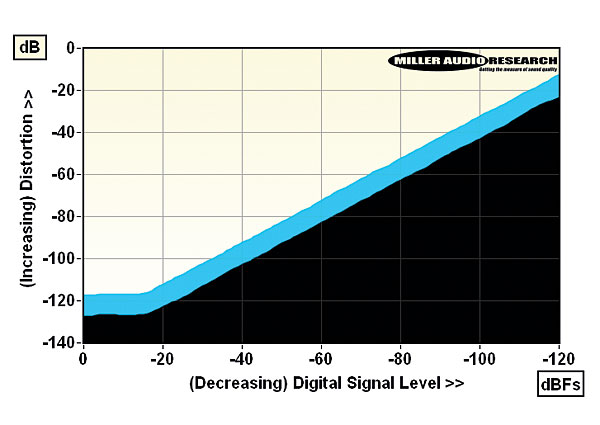
I was re-reading the dCS Guide to Preamplifiers FAQ the other day and noted a reference the Dynamic Range graphics published in Hi Fi news.
How do we interpret these graphs?
Distortion vs. 24-bit digital signal level over a 120dB range at 1kHz (black) and 20kHz (blue) from Hi Fi news review of the dCS Bartok Apex [ed I assume this graph represents the 6V output setting]
I think that you are interpreting the graph as showing distortion v. output level of the DAC. It is not this but (incoming) digital signal level v. distortion in conversion to analogue. Note that the X axis is in negative figures. So the smaller the digital signal the greater the distortion of it.These figures are very low and it is difficult to judge impact on subjective hearing especially as they are likely inaudible  .
.
Pre-Paul Miller and in other measurements, a nominal signal level of circa. -90dB was chosen and distortion of a sine wave recorded ( e.g. see Stereophile). However NFN and Miller are now able to track and display a continuos range of input digital signal levels and resulting distortion.
Nothing to do with the volume control position which changes the analogue output level of the DAC.
Thanks Pete! I’m going to edit my post above. I don’t want to confuse anyone who may look at this thread laster
I’m using digital room optimization (Accuphase DG-68, Trinnov ST-2 Pro).
Phono requires a phono preamp. The output of the phono preamp has to be digitized by the room optimization’s analog XLR inputs or a separate professional quality ADC (dCS 904, Nagra VI). Analog input sensitivity is relatively close to nominal phono preamp output. Sample rate is 24/176,4k.
The optimized signal is then transferred to Vivaldi Upsampler and DAC connected directly to Accuphase A-250, which allows selecting of the voltage gain (DAC out 2V, poweramp gain -6dB or -12dB). No linear preamp required.