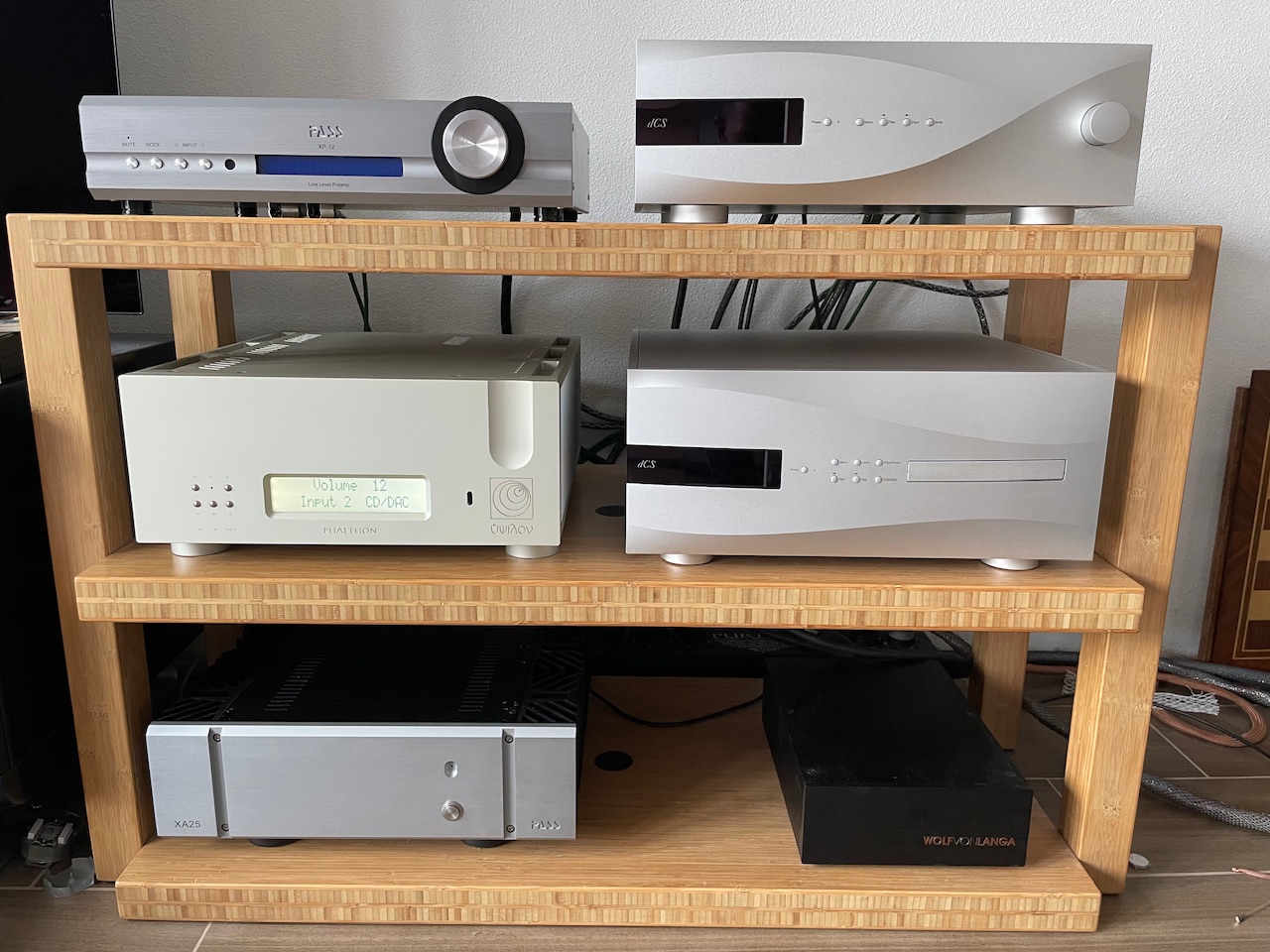
Yes, Ongaku went lower to the floor on a custom Symposium stand. It is better sound-wise.
And yes, I am loving vinyl and I have listened to more vinyl than digital in the last year or so. Vinyl, however, is way more of a rabbit hole than anything digital. In the last year I have spent a sizable amount of money on it, and it seems like it is never ending. I just ordered a custom cartridge! Jeezus. I am not sure I would recommend it in the sense that you need to understand what you’re signing up for!
Miguel, I think you answered this already- but do you adjust the tube bias or do you have a dealer that can do? And when you do tube rolling, do you have to adjust the bias new every time? Thanks!
(I think AN UK with their Tomei, Jinro and Ongaku have auto bias,but not sure)
But not all amps need to be biased, some are auto-biased. I can try different tubes without going through this process but once I decide on a tube I do biasing, and redo it every 1.5-2 years.
Yes on ANUK Ongaku and variants: they are auto-bias. However, hum still needs to be adjusted and doing so involves a similar process as adjusting bias and hum. So all in all I would rather go with the “purer” Kondo design.
Additionally, ANUK’s auto-bias range is more limited than the manual bias in the Kondo, which means some vintage tubes will work ok in the Kondo while they would not in the ANUK. A friend with an ANUK Ongaku gave me a pair of vintage Amperex 211 for this very reason.
@August This is very exciting, I hope you are as amazed and happy with the pairing of the Phaethon with dCS as I am (with my Rossini APEX). It seems like they were made to go with each other. Make sure you have a good, high sound quality XLR between the two components and I know your listening will be rewarded. I really want to hear your impressions once everything has settled in. (I also have a Vertere Pulse HB Mains Power Cable plugged into the back of each, and this upped the SQ to a material degree as well.)
I second all that @ksweiss says, it is a truly wonderful amp. One qualification though - the XLR connections on the Phaethon are unbalanced and - having spoken directly to the designer about this - he sees no benefit over RCA when connecting to it but, clearly, good cables are essential, as is a good power cord (none is provided). Neither is there a manual so - Top Tip - it ALWAYS starts up muted, regardless of whether from cold or from standby so check this before connections if you can’t hear anything. Equally, there is no difference between the inputs, regardless of how they are labelled. Finally, the mains power switch is tiny, and under left of the front panel. But it is a sublime amplifier and I’m sure that you’ll be delighted with it.
If the Paethon is RCA only I would point out that unlike most components, dCS units have completely different RCA and XLR output stages. The RCA stage is OP based and the XLR uses discrete components. Further a major part of the Apex upgrade was a redesign of the XLR ( not RCA) output stage.
As the two stages are different "here is no difference between then no matter how they are labelled " is incorrect in this particular case as the single ended output is not derived from the balanced output as it is in most products.
Can’t argue with that, but my point was that in terms of INPUT, all four sets of connections into the Phaethon (3 x RCA, 1 x XLR) are unbalanced and the designers opinion was that it would therefore not benefit from a balanced output from source, and I am not knowledgeable enough to challenge that (but open to advice if @PAR or others believe that there would be a benefit from a balanced APEX output into an unbalanced input). My comment regarding the input labelling was merely to point out that with no user access to its settings, while the 4 inputs may be labelled (respectively) Phono, CD/DAC, Aux, and XLR, they could just as meaningfully be labelled 1-4, or A-D as the amp treats them all identically.
There are similar views from Linn and Naim. They are perfectly rational being based only on the fact of a balanced connection’s superior ability to reject parasitic noise ( CMRR). The argument goes that this is not relevant in a typical domestic situation where such noise is not prevalent. However it may be worth considering that this view was often formed some time in the past , in both Linn and Naim’s case prior to wi-fi and mobile phones which feasibly may have increased such noise levels. Of course an RCA/XLR connection will lose any such improved noise rejection therefore ,on this ground only, being the equivalent of a single ended connection.
However this view does not take into consideration that in dCS units the comparison is not of like with like but of two inherently different designs which both sound and measure differently. I will stay neutral on any subjective preference as the RCA design is also excellent of its type. However:
My own view is that, everything else being equal, I would only choose a preamp or amp with properly balanced inputs to mate with a dCS unit. However it may be felt that in any particular case other factors are judged decisive.
That all depends on what you mean by “work”. It is possible to wire an interconnect so that only one phase ( half) of the balanced connector signal ( i.e. + or -) connects to the appropriate terminals in the RCA plug. This will work in the sense that a usable signal is produced. The + or - signals are identical but are in opposite polarity in respect of each other, so fine just so long as the same phase is chosen for each channel. Several correspondents here have done just that. Of course this loses the advantage of superior CMRR and, in that aspect, does not work. However the real advantages of improved CMRR may be debatable in a typical domestic set -up.
There was a time when I did not care or in fact, did not know/hear the difference between single-ended and balanced connections but had my Karan KAI 180 MKII running using single ended connection using a very expensive interconnects from JPS Labs. But one fine day, I bought a very simple Mogami balanced interconnects to try the balanced connection and when I played the music, I immediately realized that I needed this kind of presentation. To me, till this date single-ended/RCA, sounds congested in comparison to Balanced/XLR. In my case both source and target had balanced connections. So, as expected, I sold my expensive RCA interconnect and never went back.
Whenever I look at any new piece of gear, if not fully balanced, I stay away.
Completely agree. I never got the single ended argument, it always seemed to me as a cost saving measure not to design a fully balanced amp or pre amp.
Look how DCS does it. They emphasize the class a balanced outputs, as they know it is the less noisy, cleaner connection
Is my amp small or my transport that big?
First impressions; really nice form factor, compact but chunky. Very high quality materials and finish.
Finally a display I can read from the couch. No option to turn it off though?
Mint condition, owner had wrapped the remote in cellophane to keep it spotless(!)
As to how it sounds I will take some more time and let it settle in. It has to go against the Pass XP-12 and XA-25.
Is that Vivaldi transport Mk.1 or Mk.2? If you have the universal R remote that should turn it off ( top button marked “Power”). Have you checked the hamburger menu in Mosaic ? That added controls for Vivaldi transport a year or two back and presumably includes “off” . I can’t tell as Rossini Transport has never been added to Mosaic ( note to dCS : hint, hint). Of course it it turns off from the front panel and full, rather then “soft” , off from the rear rocker switch.

 Tubes for me only in the pre-amp…