My understanding was that Tidal discontinued MQA in 2024 and replaced it with HiRes FLAC, maximum 192kHz/24bit. However, when i stream music from my Roon library with 352.8kHz/24bit MQA, MQA still shows on my Network unit and my DAC shows 352.8kHz.
Does this mean that files originally coded in MQA are still available in full resolution, or am I missing something here?
Tidal did not replace MQA in 2024. They started the replacement then. It was not a simple matter of pressing a button. Cases of MQA titles remaining continue ( sourced from an AI report). The process of replacing huge numbers of tracks may take a long time as replacements may need to be requested from the record labels.
It might help establish if the recording in question is still,available as MQA if you would kindly identify the recording. Tidal users here ( not me) can then see if they can replicate your experience and report back.
I can only conclude that if your Roon library still supplies some MQA tracks from Tidal then this state of affairs should eventually correct itself as Tidal works through their catalogue ( presumably subject to replacements being available).
Thanks Pete,
I have not tried to test them all, but I believe pretty much all of the albums from the Norwegian label 2L are 352.8/24 MQA. Patricia Barber´s albums Higher and Clique also.
Most of the Tidal files in MQA that I had tagged over the years have been replaced by non MQA versions. Every time one of the remaining MQA versions pops up I get a big smile on my face. A reminder of the best sound my system my provided.
AFAIK all of 2L albums are MQA productions and no other versions were released. So there may not be straight versions available to be replaced with high-res FLAC files.
There were a few 2L recordings that were set to Qobuz apparently erroneously with MQA encoding some time ago and were transferred to their server. Qobuz USA affirmed that they do not support MQA and would remove these. It seems that they remain however and seem to have been added to as my search shows release dates to 2025 ( MQA?). My UK subscription shows many.
It is too late in the evening for me to play one but I may check tomorrow to see how they shape up technically. Presumably those released after 2022 should not be MQA as they postdate MQA’s demise.
2L records have remastered their entire catalogue to DXD. Old recordings are upsampled, recent are DXD originals. Mentions of MQA are absent on their website.
352.8 is DXD ( 44.1 x 8). As both enquires cite tracks opening as this I am concluding that the availability may be limited to 2L. I have no evidence of any other labels persuing this path.
MQA and its IP were purchased by Lenbrook in 2022. However some 2L releases sent to Qobuz ( and to Tidal if confirmed) date from later yet are MQA. No doubt there is some kind of arrangement. If not decoded they are 24/44.1 files. Qobuz defines hi-res by bit depth not sample rate so they are listed with the yellow hi-res logo ( there are 2L albums listed without this but I guess this an administrative error on Qobuz’ part).
I have loads of lower resolution files, still showing up as MQA. However, on 352.8/24, besides 2L, I only have two Patricia Barber albums: Higher and Clique.
The Barber albums date from 1019 or 2021. So they may be replaced by Tidal in due course. However I expect that they will now attract few streams so Tidal may just let them lie ( as it were). Tidal may not even be aware of the MQA encoding. So cross your fingers .
WHY IS MY DIGITAL TO ANALOG CONVERTER (DAC) STILL SHOWING TRACKS ARE BEING PLAYED IN MQA?
There were some tracks that were only delivered in the MQA format from content providers when we made this change. In these cases, the FLAC files available for streaming are produced from an MQA source file and certain DACs read them as MQA files.
We’re working with content providers to replace these files with HiRes FLAC versions if available.
I think that the rest of the message from Tidal is effectively explaining that if your DAC has no MQA facility the file will play as a 16/44.1 FLAC but if your DAC has MQA decoding then it will show as MQA. That always been the case.Remember that the whole point of MQA was that the same file could be replayed as 16/44.1 or hi-res depending on the user’s equipment and without the need for a dual catalogue. This will be the case for some files unless everything with MQA coding is replaced ( probably unlikely for some repertoire).
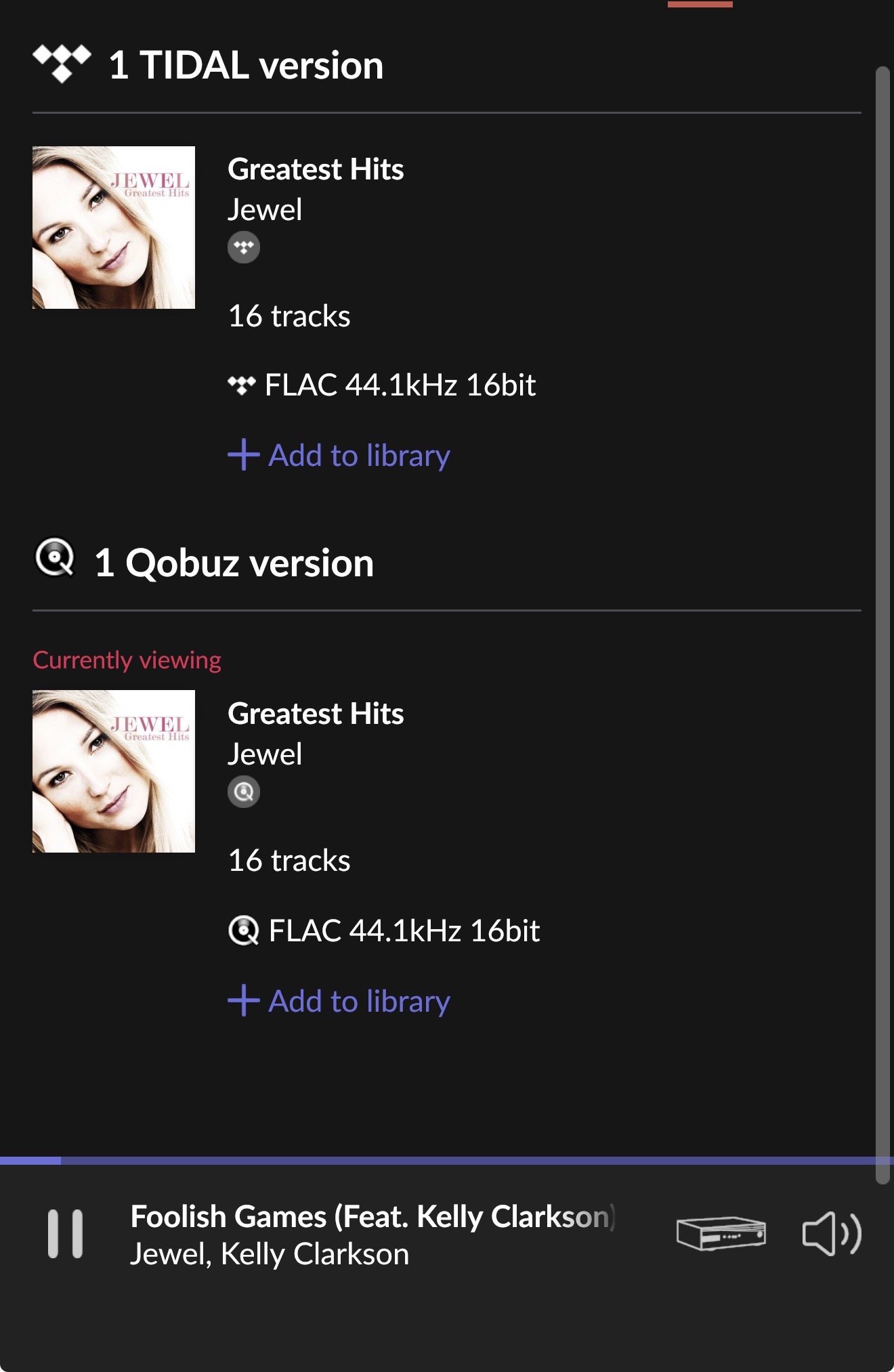
To be clear, I have a Qobuz and a Tidal subscription. This is the only album/track that actually sounds better on Qobuz on my system. On the Qobuz version, it almost feels like Jewel is softly exhaling each word. I can’t tell whether that effect is subtle distortion or simply different mastering, but it’s noticeably more goosebump-inducing.
By contrast, this album/track sounds markedly better on Tidal on my system. The bass stays tight and controlled, whereas on Qobuz it comes across as somewhat boomy. And the piano is more clearly defined. My impression is that there’s less note smearing, each note lands with greater precision. Somehow Tidal works better with my Cardas Clear Beyond cables and my active Avantgarde Acoustic speakers, I believe.
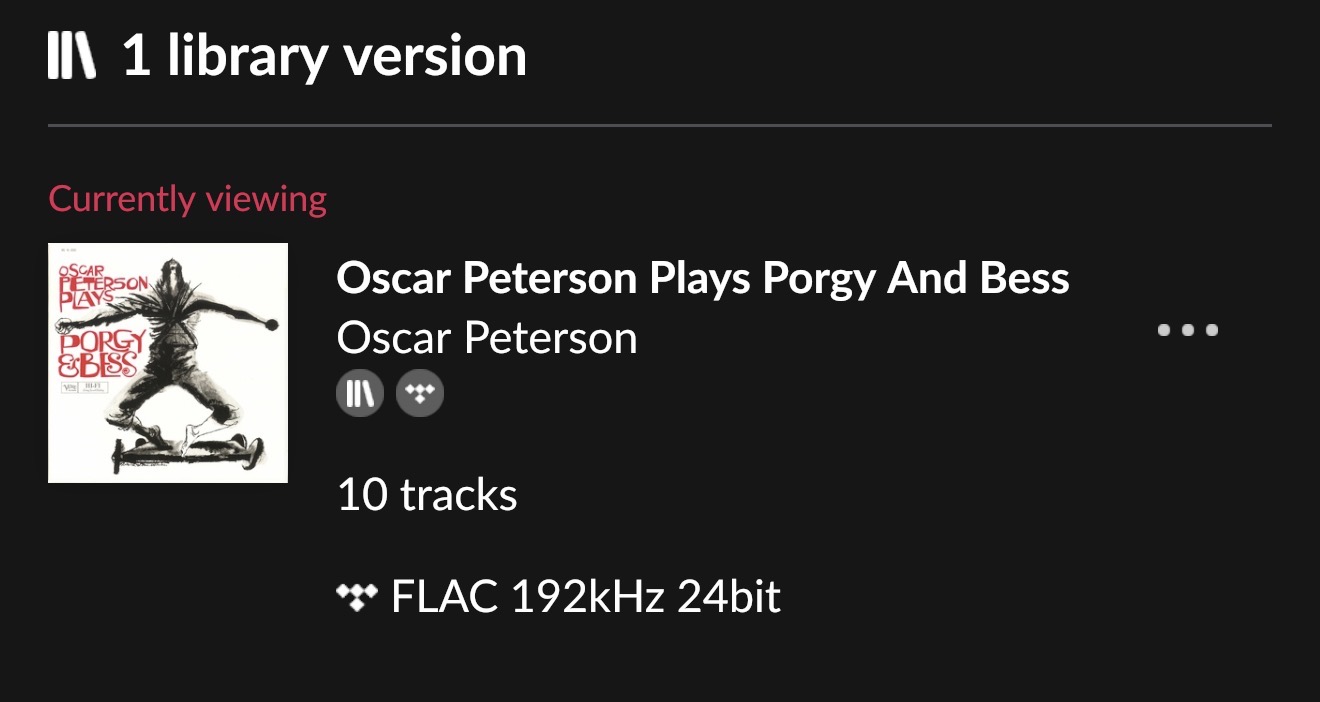
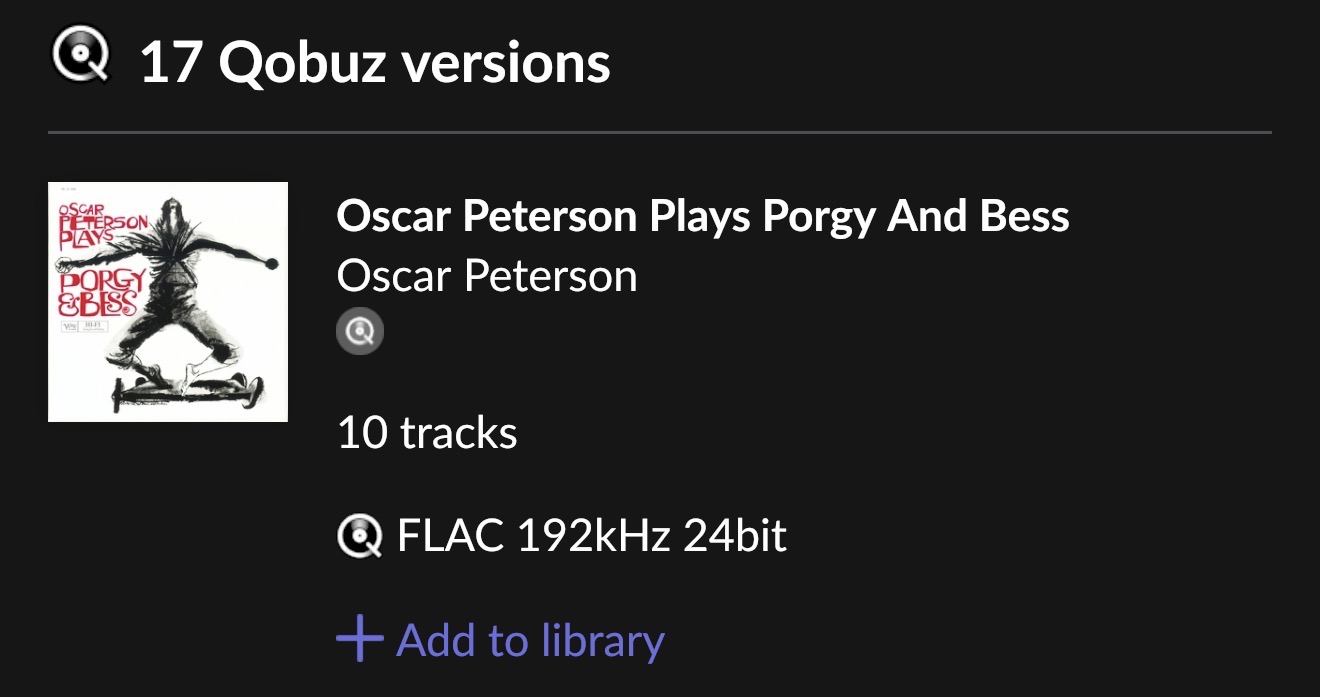
Are you sure as all the versions of Porgy & Bess /Peterson showing on your screenshot are from Tidal? However there are two different bit rate resolutions.
BTW, if there is only a single album for which you prefer Qobuz, why keep the subscription? It would seem excessive just to listen to a single Jewel album.
Except of course MQA encoded FLAC will only have 13-bits of actual resolution (instead of 16) as the least-significant 3-bits are used for MQA encoding.
So, a non-MQA DAC will resolve those “16/44.1” FLAC files with considerably less quality than standard re[d]book FLAC.
(Doesn’t apply to dCS of course as they support full MQA decoding).
I have no desire to revive the MQA debate . However it is true that MQA encoded does lose bit depth . The extent is unclear to me as the figure of 13 bits remaining comes , I think, from Archimago’s Musings and I do not know if or how this was validated.
However if I accept the figure I wonder what its significance is with real commercial recordings. Most ( all?) are compressed in the first place. The dynamic range reported for albums in the current “What’s Spinning” thread range from 4 to 16 dB only. A 13 bit depth has the capacity to support <78dB which not only exceeds the dynamic ranges reported here but is also the practical range of most commercial recordings. I remember a headline from an AES convention in the early 1980s ( when CD started) when a paper was presented indicating that something like 23dB ( from memory) was the maximum dynamic range that ( normal) consumers would accept.
Whatever the case, those recordings are there and if you want to hear them, that is what you get and there is nothing to be done.
 .
.