We’re considering moving to a different, larger house. We’re currently discussing the terms for it.
Most interesting for this hobby, it would have several options for a listening room/space. At the far end of the building is a room of approximately 6x6m and probably around 2.8m high which I could dedicate to listening and which could double as a home cinema room, I could do acoustic adjustments etc. Near the entry of the house it has a very large, open space. That itself is about 5x7m but with a ceiling that opens up partially to at least about 9m. What would be preferred?
There is another seating area upstairs that has an arched ceiling. I think that would be less suited. The other thing is that if I were to put a system in the open area that the sound would travel to other floors. I am curious what a large height would do for sound, is it beneficial or not?
I am also contemplating having more than one system if we would buy it. Not all at the same level though. Let me know your thoughts.
In my experience typically you want to avoid rooms where the ratio of any of the dimensions between two surfaces (front to back, side to side, ceiling to floor) are integers. If the room is close to 6m x 6m, that could give you some modal problems in the room as those surfaces are a 1:1 ratio.
The 5x7 could be preferable purely from that standpoint as you’ll have fewer modes to deal with between the four vertical walls, but the ceiling(s) and floor do complicate things there.
I suppose my main question would be how close to 6m are each of the walls in the first option are? One being 5.8 and one being 6.2 would be better than both being 5.9 for example.
Typically material such as clouds are placed in the headspace between the seating area and the speakers to control the amount of reflection from the ceiling. Higher in my mind is better but control is important. Impulse might make you think more volume is better providing more expansion but it may also add considerable unwanted reflection. The right amount it the ticket. Good luck
5.73 x 6.38 from the floorplan I have seen so not exactly the same.
This has notobvious right answer. The disadvantages of the open area and the upstairs seating have already been noted by you. I will just add that very high ceilings can cause issues with echoes etc.
The 6x6m room looks best but square rooms can be problematic by reinforcing frequencies as James and Barry have said.
Either way you may require acoustic treatment and this could prove costly e.g. installing a false ceiling or acoustic clouds in the open area.
Aside from daydreaming I wouldn’t get too engrossed in detailed planning or even decisions at this stage. You and your partner may find the eventual reality different to what you imagine now as you might decide on new uses and remodelling for the areas now being thought about. For example my friend’s living room was previously a toilet block 
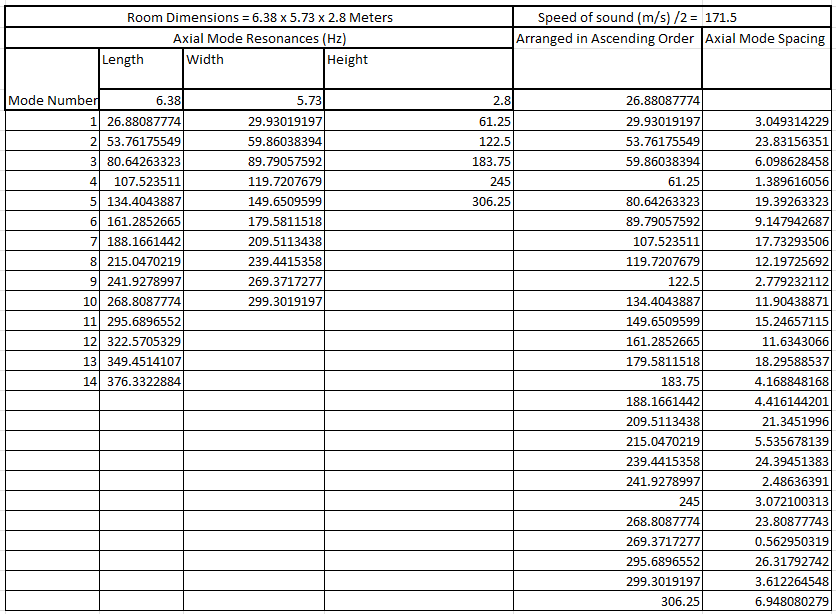
Some quick maths says the room dimensions actually look pretty decent - although the 2.8m height to 5.73 is a ratio of ~1 : 2.05 (not ideal), the room modes that should be generated look pretty well spaced out with no major coincidentals (two room modes at similar frequencies) other than one at 60Hz (plus some harmonics of it) and one at 269Hz.
The room looks like it might sound pretty good though, if my (albeit hasty) maths is correct and you can get something to deal with that ~60Hz mode and put up something to deal with the first reflections.
Then it depends how far down the rabbit hole you want to go of measuring RT60, waterfall plots etc etc.
Thanks James, will dive deeper into it once everything is sorted as to the sale. We’re not there yet as exact price and date are under negociation currently. If it happens, it will be at least late summer of 26 or later still.
Not quite sure about the exact height, but that will be dealt with at a later stage.
Thanks Pete, it does look like the separate room will be the most likely area for my toys but adding in a screen and projector will add fun for the rest of the family. The good thing is there is abundant space but you’re right, I will withold doing more planning until a later stage.
I agree with this. Our listening space is nearly 5 m high, and we have decorated the room with hugh plants overgrowing the listening area at a height of about 3 m, covering it with foliage, and this helped to improve the acoustics greatly. A high pile rug does the same on the floor.
@James could you show us an example of how you make these maths?
A simple way to work out an axial room mode (between two surfaces) is:
( 1 x room dimension ) / 171.5
That gives the frequency of the first mode for whatever dimension you have used - such as 6.38m for the room length.
171.5 is the speed of sound in m/s halved, this is constant.
1 is an integer that you increase to calculate successive room modes - 1 gives you the lowest frequency mode for that room dimension, 2 gives the next and so on. So the second mode for that same 6.38m dimension would be:
( 2 x 6.38 ) / 171.5
Work those frequencies out for each room dimension (length, width, height) up to ~300Hz and arrange them all together in ascending order. Any that have less than 1Hz difference between them are coincidental, and will be notably detrimental to sound quality so should be dealt with.
This is a simplified way of doing it and only accounts for axial modes (modes between two surfaces, and not tangential and oblique modes for four or six surfaces), but its a very good starting point for judging room dimensions to work out how plagued you will be by axial modal problems.
So I ended up with this:
Excellent! Thank you very much.
I have found an on-line calculator for this, which not only calculates (and shows) axial room modes, but also tangential and oblique: