Looking for a bit of advice regarding the types of XLRs.
Whilst I await the delivery of my Vitus SIA-025 Integrated Amp, I thought I’d start the ball rolling and sort out some XLRs to hook up with my Bartók Apex. I was thinking of ‘starting off’ with a Designacable XLR, then progressing upward (If need be) once the Vitus has burnt in.
Designacable have the Mogami W2549 Low Capacitance Balanced Cable. Neutrik GOLD XLR to XLR, also the Mogami Neglex 2534 Starquad Cable. Audiophile Neutrik Balanced XLR to XLR. Which of these would be preferable with the Bartók?
Of course, it doesn’t have to be Mogami. Other XLR suggestions are most welcome.
You mention start quad cables so I thought I’d pass this video on. It is a nice reminder of why cables matter in certain situations (although I suspect that no one here is placing a cell phone charger over their cables :))
AS you know nowadays I do not recommend cables as several factors affect the tastes of individuals. However I try not to think of specific cables for individual jobs in a system but consider the entire loom as far as possible. For example you may not want to mix an interconnect with a “generous” bass end with a speaker cable also having a “generous” bass end as you risk ending up with a result that booms. A loom of cables from a single manufacturer may be the best way to approach this. What you have already may influence your choice or you might find that it is now time to start from scratch.
Sadly there is little chance of anyone loaning you cable looms to try. Basically this is all a PITA.
XLR connectors with gold pins are a good choice as they will not oxidise.
If you knew me, you’d know that my knowledge of electronics could be placed on the back of a postage stamp! However, I did get this video! Very interesting when he placed the Toroidal PS on both cables.
Interesting to note that he was using Canare cable.
Do the big cable companies like Chord, Shunyata, etc…use Starquad and twisted pair construction? Or, do they use their own construction?
This is normally the case for finished audio cables ( i.e. with connectors). A major component of finished cables is the cost of termination which is constant irrespective of cable length.
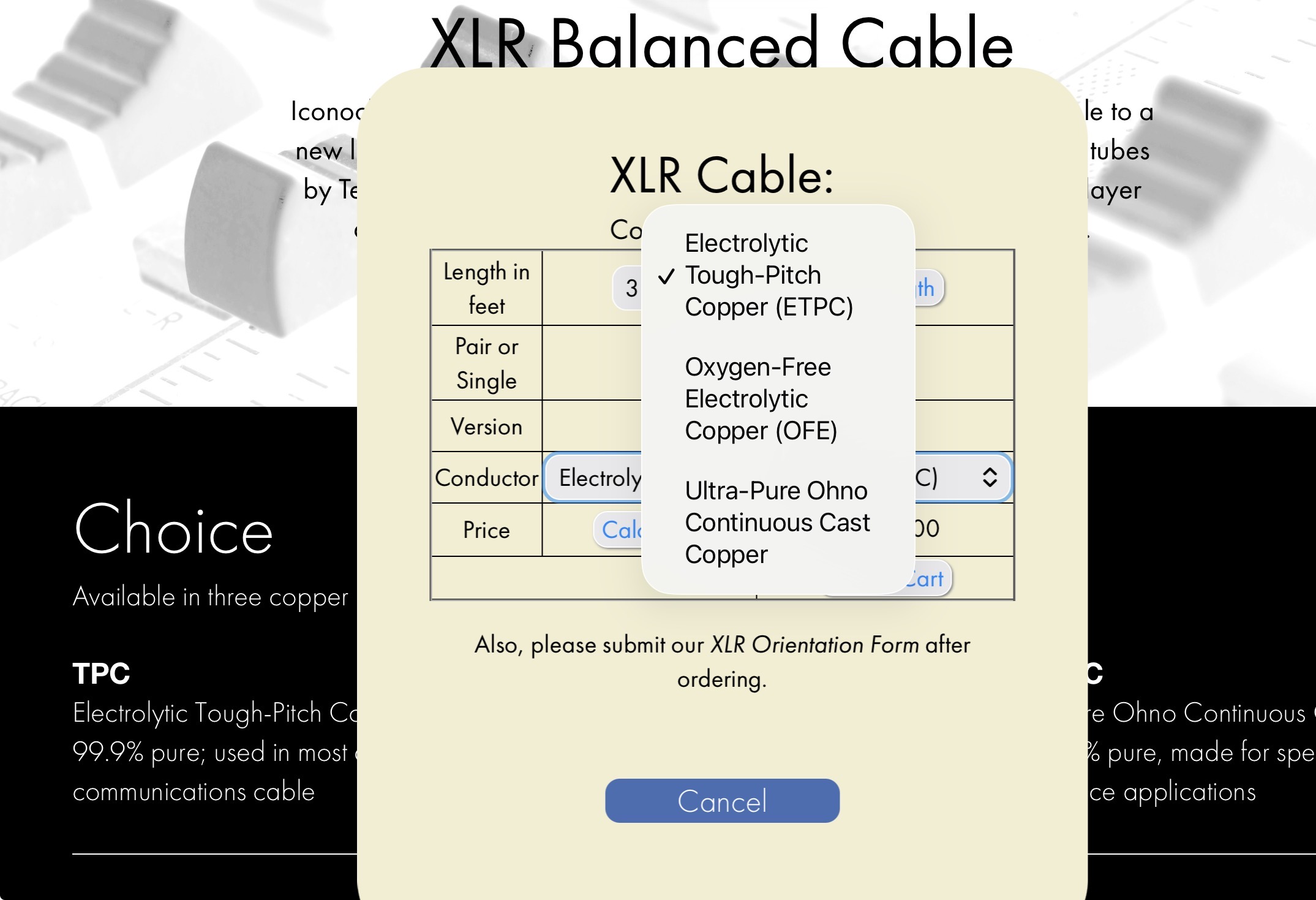
@Merlot queries the use of comparatively low cost cables in his original post. Use of Iconoclast enters a different price category but we are not aware if there is a cost limit for him. BTW, the Iconoclast line comes in a choice of three conductor selections at ascending price. As he is in the “super” audio category with dCS and Vitus, perhaps the lowest cost range might not be the best first choice?
My approach would be to match the speaker cables to the analogue interconnects ( or vicem versa). Try the interconnect first to check that it suits his tastes then, if so, move to speaker connection.
My “loom” approach might also want to include AES/EBU interfaces but I cannot see that Iconoclast make these. Perhaps their XLR terminated cables can be used for this purpose if they comply with AES standards. All that this amounts to is if the cable has a characteristic impedance of 110 ohms. It may well so but they give no specification as far as I can find.
Some cable manufacturers are reasonable with the price for longer cables, agreed. I don’t remember many being quite as reasonable as Iconoclast are, though:
3-foot OCC XLRs for $2,050
30-foot OCC XLRs for $4,750
The Series 1 (4x1) XLRs can be used for the AES connection. Here’s Galen (the chap who designed them) talking about it:
Thanks Ben but Galen only refers to pin count and makes no reference to impedance. Of course if the pin count is correct it will “work” as AES ( you will get a sound) but how accurately?
Mind you my sceptical self suggests that in many cases manufacturers analogue XLR cables and digital balanced cables are the same things but with the latter having the word “Digital” printed on the sheath or sporting a different colour one. At a price premium of course .
I get what you are saying, but I just want to start off with cheapish XLRs, (Mogami and Canare) then work upwards once the Vitus is burnt in. My dealer is happy to loan me cables from £100 to £3,000. I feel that doing it this way will give me the chance to hear cables from both ends of the spectrum.
Vitus have informed me that my SIA-025 will leave their Danish factory this Thursday. Unfortunately though, it looks like there is no more room on Father Christmases sledge, and that it’ll probably be an Airbus A320 the first week of 2026.

 However, I did get this video! Very interesting when he placed the Toroidal PS on both cables.
 .
.