As the venerable @Anupc said above, there are lots of platforms which don’t touch the audio stream and so by definition sound the same. To claim that a new platform is the first not to touch the audio stream seems inaccurate, and to claim that it sounds different is inconsistent with it not touching it.
5 Likes
In fact, all (most?) of you already know how a piece of software that “doesn’t touch the audio stream” operates, it’s how Mosaic (UPnP Control Point) has operated for decades.
Mosaic instructs the V/V/R/B/L to go and directly fetch the selected album/track from the UPnP Server, or in the case of Mosaic’s support for Tidal/Qobuz/Deezer, it leveraging Airable to know how to direct V/V/R/B/L to go fetch the selected album/track directly from the respective caching servers.
The various 3rd party Control-Point Apps - BubbleUPnP, mConnect, JPlay, etc. - do exactly the same thing (except they don’t typically use Airable, they implement the various individual APIs to the Streaming services. So, they genuinely don’t touch the audio stream as well. Note: JPlay’s own claims of sounding better is also bogus, albeit they take a different pitch to that, claiming that the JPlay App generates less traffic on your LAN and thus sounds better, but that’s totally bogus, their impact on LAN traffic is little different then any other Control-Point App.
In the case of Spotify Connect/Tidal Connect/Qobuz Connect, those Apps have adopted the exact same model as UPnP, with their respective Apps acting as the Control-Point. In the firmware support on V/V/R/B/L for these “Connect” services, each has a slightly different (proprietary) API call to directly fetch the selected album/track from the Internet.
Now Johnny-come-lately PS Audio’s Maestro tries to claim it’s the first to do any of this. Not only are they not the first, but on a quick Wireshark examination, it appears that Marcin (JPlay) is correct about Maestro!
The Maestro App itself appears to be pulling down music streams, and then sending it over to the Streamer/DAC, thus acting as a proxy through which all streams flow. So, the App absolutely does touch the music stream! 
Here’s a Wireshark screenshot of exactly that taking place - the top-half (above the blue line), you can see (Maestro on my) MacBook Air is pulling down a Qobuz stream off Qobuz’ caching Server (Akamai), and then in the bottom half the (Maestro) MacBook Air sends those streams over to my Bartok.
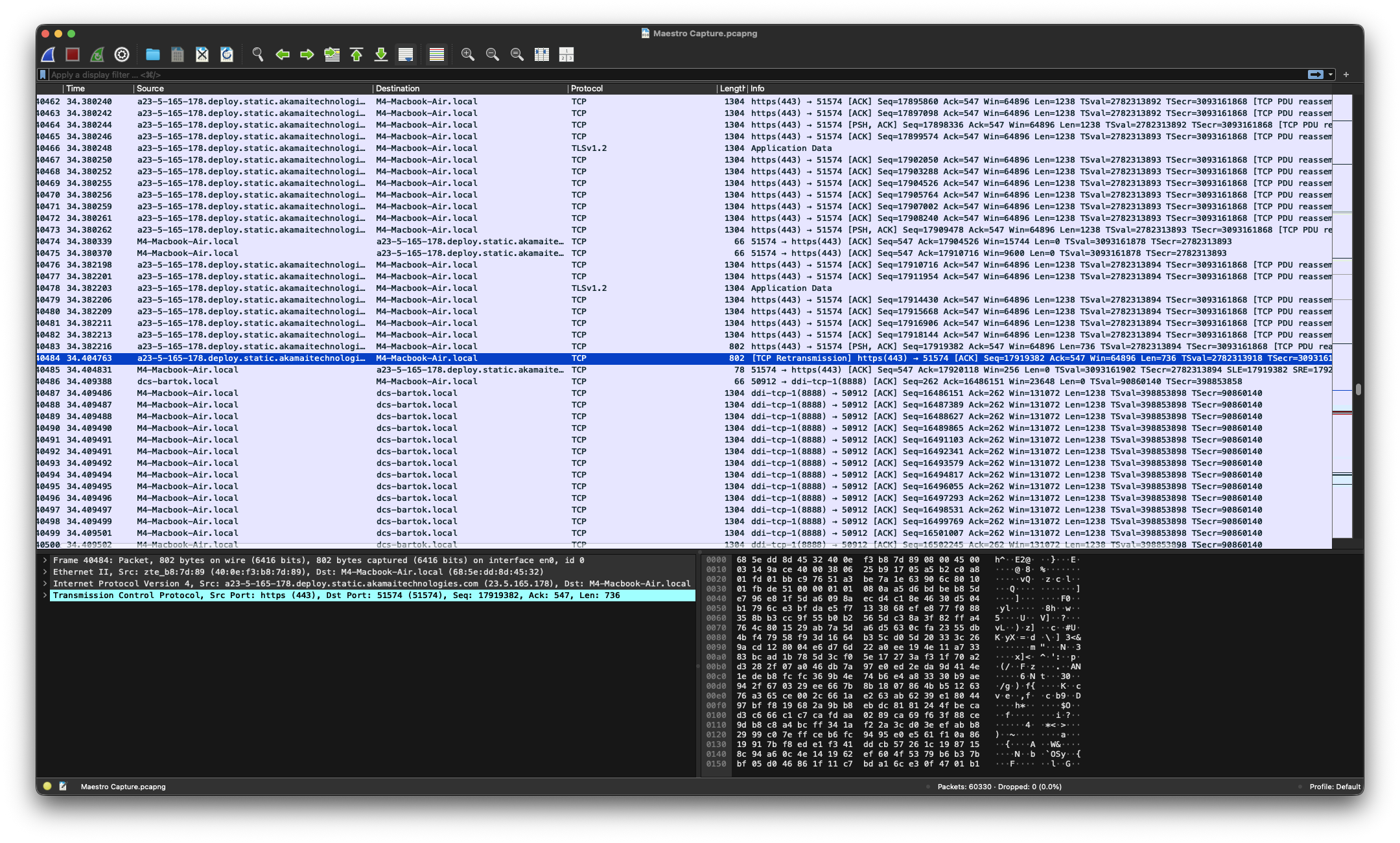
So, not only is it actually touching the music streams, Maestro is as bad as Airplay in that it’s driving double the network consumption on your home Network; once to pull the steam down off the 'net, and once again to send it do your Streamer/DAC.
Bad. Very bad. 
Disclaimer: I haven’t done a thorough analysis of exactly what Maestro is doing, and I probably won’t.
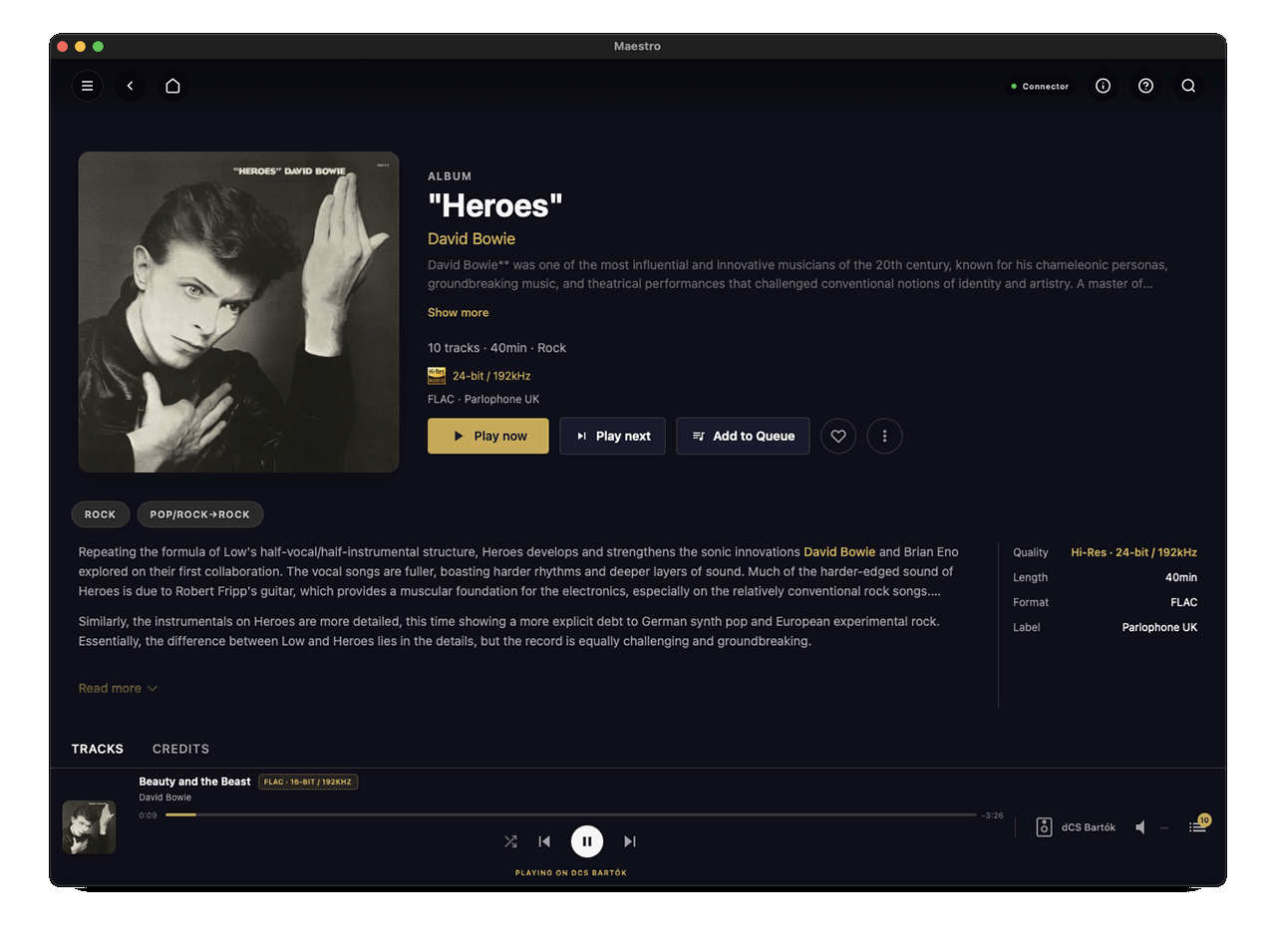
ps: This was what was playing on Maestro 
10 Likes
Great analysis, @Anupc !
For the avoidance of doubt: when you say “as bad as”, you mean purely in network load terms, not that there is a negative impact on sound quality. Is this a correct intepretation?
1 Like
Thanks for raising this. When I’ve said Maestro doesn’t touch the audio stream, I wasn’t trying to mislead anyone — I was using it as shorthand for why I think Maestro sounds the way it does, and I shortened too far. My bad, and I apologize.
Marcin (whom I greatly respect) and the poster in the dCs forum, Anupc, are right about what that Wireshark capture shows. So rather than dance around it, let’s take a look at what’s actually going on under the hood.
So, an admission and apology. But then he goes on to post additional stuff, some false, some misleading, but all of it to dance around the issue!
For example;
What Maestro is doing is reading bytes off one TCP connection (the one from Qobuz) and writing those same bytes onto another (the one to your Bartok). That’s the whole job. The envelope gets passed from one address to the next, and Maestro never opens it, never reads what’s inside, never repackages anything.
Hello! So do the other platform like Roon and Audirvana; when no DSP is engaged, they pass through streams completely transparently.
Once again, Paul has demonstrated the ability to lie, mislead, or be completely ignorant to how things work
5 Likes
But he outlines:
Roon does the same thing — more so, actually. Roon Core pulls the stream and rewraps it inside its own RAAT protocol before shipping it to the endpoint. That’s a heavier hand on the audio than a TCP relay, not a lighter one. The “Maestro proxies, Roon doesn’t” framing isn’t quite right.
—
Which to my understanding is true.
1 Like
This is where Paul demonstrates his utter ignorance. He really shouldn’t post about his competition without understanding, makes himself look like a bozo
Just like Maestro, Roon RAAT uses TCP to re-package the original music streams to the Streamer/DAC. Completely transparently and bit-perfectly. There’s no “heavier hand” involved.
Where RAAT differs is that with [Roon Ready] Streamers/DACs, there is an end-point shim on the Streamer/DAC to which the Roon Core is able to send additional (separate) packets for control & monitoring.
For example, to measure bit-transparency, and where exactly things might be changing within the audio stream to the Streamer/DAC, and to reflect that in the Roon client side App as “Signal Path” information. That gives Roon features above and beyond just UPnP AV capability.
Maestro suffers from the lack of such ability and instead relies solely on a protocol literally designed in the 1990s and yet touches the music stream. Very very bad
4 Likes
Well TCP is always involved in those scenarios. But there is more overhead the way RAAT is doing things. From what I learned Maestro isn’t about creating another Roon app at all, rather than focusing on achieving the best sound quality.
JPlay describes its approach at: https://jplay.app/how-jplay-works
And interestingly: both sound different (better) than Qobuz Connect (which admittedly is very clean and already an excellent level).
Better in what way
Do you mean it’s already generally accepted that Maestro (and JPlay) sound better than Qobuz Connect (I can’t say I’ve picked this up from the forums)? Or that they do to you personally, which of course no-one can argue with(!)?
I think that @Pdave has been wise to recognise the gap between difference and better. though I would have added a ? after “better”.
if “better” only consists of what you prefer then it is not necessarily better to anyone but you. I believe the term “better” seems to need at least an element of objective support. Otherwise anyone can prefer anything.
There is also a need to remove self delusion. A pertinent example. When I installed Qobuz Connect and compared it with Qobuz via Mosaic both myself and a friend heard a significant improvement. The fly in the ointment was that unknowingly I had not loaded connect at all. We believed that we heard a difference but in fact we were only listening to Mosaic all the time!
Of course as we all know apples are much better than oranges  .
.
2 Likes
(a) Are you sure about that?
(b) What do you believe is the consequence of any such “overhead”?
(Nevermind, they were rhetorical questions)
Precisely
I have been using Maestro since day one. Yes, there are still quite a number of issues that need to be resolved, particularly with the Local File Library, especially when handling large collections. That said, the Qobuz streaming experience has been quite satisfactory for me personally.
I have been communicating with Paul almost daily regarding the Local Library issues, and to his credit, he has responded to every ticket I have submitted.
Many problems have already been addressed, although several still remain.
Using Maestro has not always been easy for me, and at times the response can be quite slow. However, I continue to stay involved for one simple reason: I genuinely enjoy the sound quality. In my own system and to my own ears, I prefer it even over Roon, Qobuz Connect, and JPLAY. Of course, I fully understand that this is subjective.
Because of that, I am willing to be more patient with the ongoing issues, as I believe the software still has the potential to become my reference playback platform in the future.
People are free to like it or dislike it — that is entirely a matter of personal preference. If someone decides it is not for them, even without trying it, that is also perfectly fine.
3 Likes
Good of you to state that clearly, I think it’s totally fine to have a subjectively preference.
The problem is there are others who try to justify their subjective preference through mistaken technical reasoning and continue to argue the point without any objective basis nor actual technical knowledge.
Prior to a week ago, supporters of Maestro were touting that it sounds better because it doesn’t touch the music streams (merely on the basis of Paul McGowan’s false claim). Now of course, thanks to Marcin’s initial reveal, everyone knows the truth that it does in fact touch the music stream.
Now Paul has tried to shift the argument that other software have more overhead, etc. and Maestro supporters are touting that everywhere.
But guess what, that’s not actually the case. Maestro does not have lower overheads than the others, including Roon, but especially against Audirvana, JPlay, etc., it’s worse because of the nature of how the software works.
Maestro really has no technical legs to stand on to sound better.
1 Like
Paradoxically perhaps, in purely sonic I’m much more comfortable with and accepting of the Maestro proposition now than I was with the “never touches the audio stream” pitch which simply didn’t stand up to scrutiny vs existing platforms which don’t touch, even if it stood up against Roon.
If it does touch, it might indeed sound different to both Roon and to non-touch platforms, so at least there is now a headline theory to hang off.
The Roon-focused and erroneous initial tagline/pitch won’t have done Maestro any favours at all of course.
1 Like
I fully agree with you Nigel here.
1 Like
This debate seems to me a bit of a tempest in a teapot. On my rig (Bartok, C-J, Wilson) Qobuz Connect, Maestro, JPay and the dCS UPnP programs all sound a tiny bit better than Roon. Tiny bit. So small are the differences, that they seem to disappear with some music choices. Roon still blows all the others away with convenience and features. So much so that when evaluating new equipment, cables, etc in my system, I just use reliable Roon. I know where all my music choices are and how they are presented. Some who are mad at Roon over prior services issues seem to be using this Maestro thing to try and get even. Does not add credibility to their own positions.
5 Likes
Just had an entertaining interaction with Paul McGowan about his maestro project (also see my final reaction 5 posts ahead in that thread)
Edit: …for those still interested, the discussion got its final tail today
1 Like
What is totally frightening is the total and blind engagement of the majority of the crowd, buying every single word of their “Guru”…
“just try it for free, and if you hear what I can hear, then buy it…”
No technical argument at all. Just beliefs…
And the part highlighted in italic is just basic mental manipulation (defy to be as good as the defier to be eligible to the group - reverts the “please join us” into “are you sure you have the level to join us?”)
3 Likes
 …I’m just an “Idiot Dutch Man”
4 Likes
I have steered clear of ‘maestro’, so I must be just an “idiot Englishman”…
3 Likes