Hello, i would like to explore headset systems while i’m owning a Vivaldi APEX stack. I think it is possible to connect my Vivaldi APEX DAC to the Lina AMP through the XLR (my Vivaldi is connected to my speaker amp through RCA). Did someone already tested this configuration and would have some feedbacks ?
Yes, our partner @DubaiAudio demonstrated that combo at CanJam Dubai back in January (you’ll find some pictures here). It works very well indeed, I’d definitely encourage you to give it a try.
In fact, although the Lina Headphone Amplifier was conceived as part of the Lina family, and most people naturally think of it in that context, it works extremely well with all our DACs, which have low enough output impedances to drive its optimum unbuffered inputs.
Thanks @AndrewS for your encouraging feedback. Any recommendation concerning the unbuffered connections ? I’m using today on my loudspeaker system the 2V output.
I think you might be mixing two different things here. The unbuffered vs buffered inputs on the amp and the switchable output voltage on the DAC are completely independent of each other.
The unbuffered inputs on the amp use shunt feedback to eliminate common mode distortion, but this requires a source with a very low output impedance. The impedance of the balanced outputs on the Vivaldi DAC is 3Ω, so with a Vivaldi you should definitely use the unbuffered balanced input.
The switchable output voltage in the DAC is provided to let you adjust the signal level so that your volume control is working in its optimum range at your preferred listening levels. If you are using the digital volume control in one of our DACs that will be >-40dB, if you are using an analog volume control such as that in the Lina Headphone Amplifier it will typically be around the middle of the range of rotation (i.e. 12 o’clock).
The Lina Headphone Amplifier also has a Gain Selection switch under the fascia beneath the volume knob. You can use this to reduce the gain for use with very sensitive headphones. I find that with most headphones I am able to get the volume control in the optimum range using the 2V output of the DAC and then using the Gain Selection switch to fine tune.
Thanks @AndrewS for the clarification and recommendations.
Definitely, the Lina Amp can fit perfectly well with its unbuffered XLR connections. Keeping the Vivaldi at 2V and managing the Lina gain is the right approach.
I very much enjoyed running the lina headphone amp from my vivaldi dac/upsampler. No problems at all and a wonderful pairing using either the balanced or rca inputs.
I tried a few and all had good points over each other, but i feel it really deserves as good as you can go on headphones to fully exploit it all. But its a fantastic set up for sure as it should be.
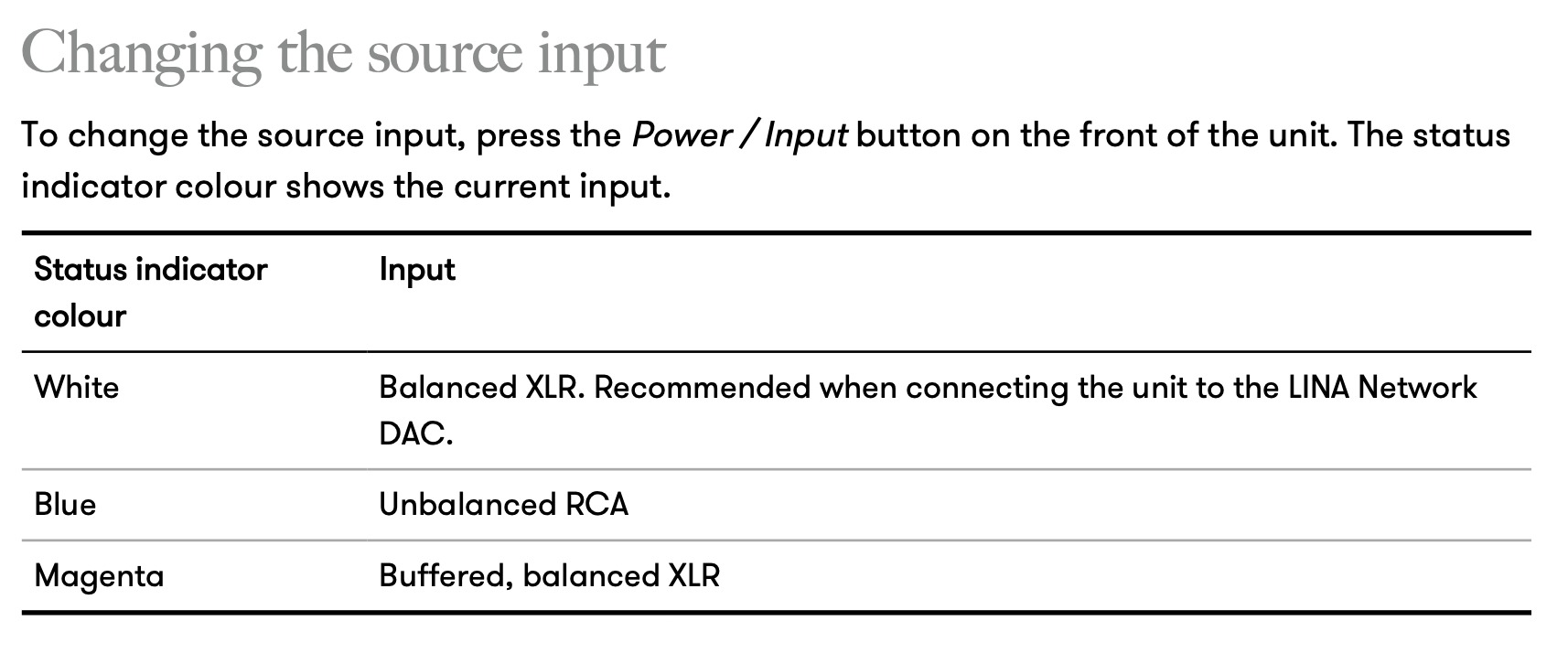
You recommend to connect the Lina Headphone Amp with the Vivaldi DAC via unbuffered XLR. What about buffered XLR? I tried this one, but with the allocated blue indicator input no signal is detected. Only when I switch to the magenta indicator for RCA, I get a signal. Obviously, with buffered XLR the amp automatically switches to RCA. Is this normal with connecting to a Vivaldi DAC?
Buffered XLR Input: Features a 96 kΩ input impedance. It is easier for source components with weaker output stages or higher output impedance to drive, and is indicated by a blue status LED on the amplifier.
Unbuffered XLR Input: Features a lower 16 kΩ input impedance. It offers the cleanest, most direct signal path and highest potential quality, but requires a source device with a robust, low output impedance capable of handling a harder load. It is indicated by a white LED and is recommended when pairing the amp directly with the dCS Lina Network DAC.
I still really want a Lina headphone amp, but unfortunately I have been spending money on other important stuff and so them thoughts have been put on hold for now.
Thanks Duncan. Indeed, the manual obviously wrongly says blue for balanced buffered and magenta for unbalanced RCA. I am using unbuffered balanced anyway. I just wanted to be sure that my unit isn’t somehow faulty. Everything is fine now!