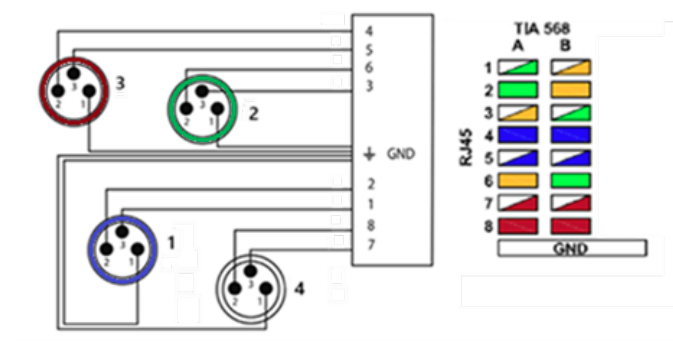
Exactly. The Trinnov Altitude 32 will also work, and the Storm Audio ISP Evo and Elite will work in their AES variants as they output up to 32ch of AES across 4x RJ45 connectors.
Edit: corrected the number of channels for the Storm processors.
Exactly. The Trinnov Altitude 32 will also work, and the Storm Audio ISP Evo and Elite will work in their AES variants as they output up to 32ch of AES across 4x RJ45 connectors.
Edit: corrected the number of channels for the Storm processors.
And the Datasat RS20i - processor that support multi-channel digital outputs.
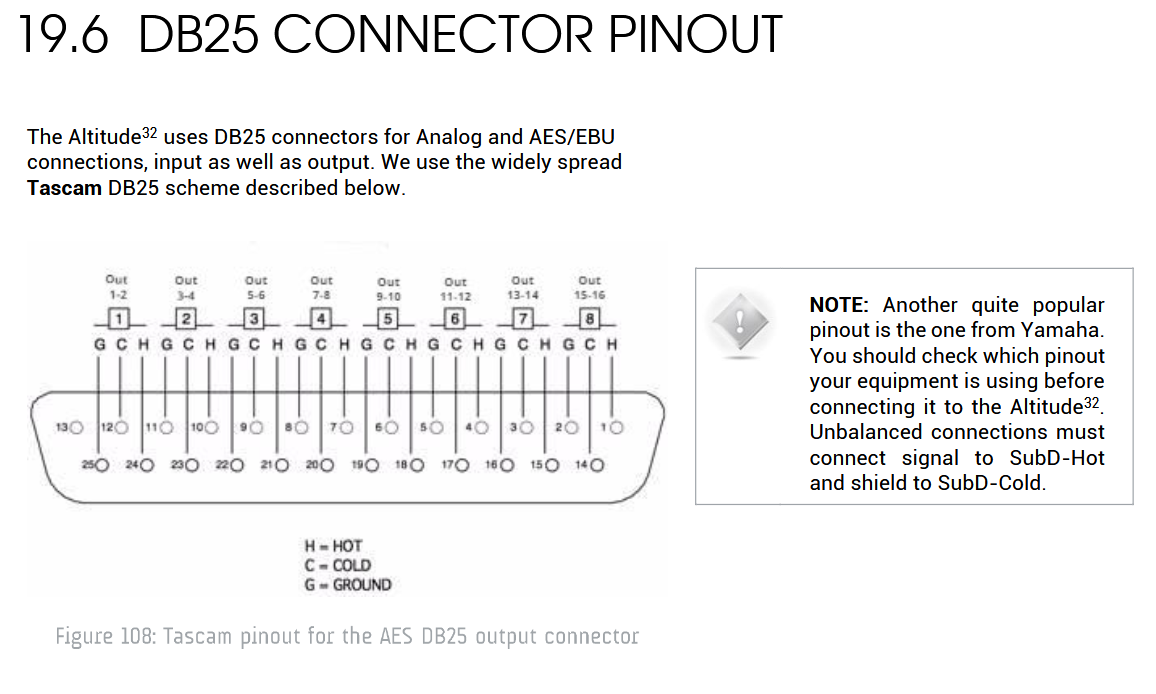
Only just now realising that many of these platforms which have multi-channel AES digital outputs do so via a DB25 connectors. Presumably there’s standard for that?
Actually there seem to be 2 standards for that: Tascam and Yamaha:
https://www.sweetwater.com/sweetcare/articles/aesebu-db25-pinout-guide/
Trinnov uses the Tascam standard, as does Audient.
As does Lyngdorf on the MP-60, and we’re using the same pinout on all of our DB25 connectors. Technically it’s the TASCAM AES59-2012 pinout.
Storm Audio use this pinout for their RJ45 to XLR cables for the AES outputs:
Looks like it’s Trinnov 32 processor out thru AES output 1-16 via DB25 cable to DCS MCD 16 AES input then 2 DB25 cables from MCD analogue out to 2 Trinnov Amplitude 8 amplifiers for 16 channels. Throw in a connection to my DCS Rossini word clock and we are in business. Whew
I often wondered whether dCS would get involved in “room correction” to the audio signal as a next step, but I had not at all imagined them jumping into multi-channel audio where I suppose room correction is very common. Still, for those of us with only two speakers sixteen channels of what I assume is Vivaldi-style D-to-A in one box suggests that two channels of Varese-style D-to-A in a similar box is possible.
Do we know about the internals of the MCD-16 or are we waiting for the Vienna High End Show for that information?
if i had to guess, (and this is only a guess) the MDC 16 may be based on Lina tech with DAC Rings on multi flex boards slotted in a single chassis. Alternately, dCS may have started with 8 Apex style boards slotted on their sides. However dCS did it, it must have been quite a challenge to manage the thermals, noise and clocking!!
I f you assume this then you cannot have a clear understanding of what varese is. Why do you think it is is so large and takes 5 boxes ( they are not full of air). Even if they could shrink it (doubtful), it would make no business sense; “Here is a quarter of a million pound product but we now offer that performance at a fraction of the price in a small box”. I expect that they would not sell any more Varese then!
https://dcsaudio.com/product/varese
I think that @Urbanluthier may be nearer the mark thinking of Lina as a likely comparator but one limited to 2 channels.
By referring to “Varese-style D-to-A” I was just wondering aloud about the space needed for a differential ring DAC as opposed to the Vivaldi ring DAC (or Lina, more likely, as you say). I well understand that Varese is really a system.
More generally, I would have thought that if dCS don’t put something into the price gap between Vivaldi and Varese then competitors will try to do it for them. But now I’m just speculating, and drifting away from the MCD-16 announcement. I look forward to learning more.
There is definitely something in the air about multi-channel right now.
A dealer of mine in Germany has a growing interest in multi-channel audio and home cinema. His interest is centred around Audinate’s proprietary DANTE (Digital Audio Network Through Ethernet) protocol and there are an increasing number of manufacturers offering DANTE-enabled devices including Ascendo and Wisdom as well as Trinnov whose Amplitude amps can be specified with an optional “Audio over IP” DANTE input board which ultimately feeds into an (or more?) internal DAC.
Obviously this is architecturally a very different approach to that which the MCD 16 will play into, but I mention it for the broader context of the market sector: I had not been aware until 6-8 months ago that multi-channel was a thing! I got up to speed as quickly as I could, and here we are with the MCD 16… I can’t be the only observer interpreting this as a strong affirmation that there is a serious mid- to high-end market here, not just a passing fad.
Kudos to dCS for seeing this and making what must have been a substantial R&D investment to get such a technically (and no doubt sonically) excellent product to market.
I had been thinking for a longer time what dCS would do with all the ringdac boards that were left over after Apex upgrades. Wouldn’t it be great to stick eight of them in a case with a mainboard to feed them and create this product? 
Room correction in more traditional two channel audio has been an integral part of Linn’s strategy going on for almost a decade. They call it Space Optimization and it is a built in feature of their entire line of digital streaming DACS.
I’m very curious to read about the full feature capabilities of the MCD16, especially that Ethernet port.
Does it for example, support Roon Multichannel endpoint? Imagine an “all-out-assault” discrete multichannel source file straight to the Ring-DAC D-to-A without any processing! (Albeit, Roon only supports 8-Channels, but it’d still be the closest to the multichannel discrete DAC demos dCS has done in recent times).
The Ethernet port is for control and updates. We have an API in development for using the MCD 16 with control systems, and all unit settings and status feedback is available via the web UI. Firmware updates will also be initialised through the web UI and installed over the network.
We’re really keen to get it into some systems with processors for people to hear as from the testing we’ve carried out, the improvement the MCD 16 brings is significant. It lets the processor stay as an all digital product, drives the amps to their full potential, and naturally lowers the distortion and noise levels in a system very significantly.
It’s definitely an exciting time to be moving into the multichannel space, as there’s so much happening right now in multichannel specifically around music playback. Hi-res multichannel downloads and even streaming services are becoming more common, some of which are starting to be picked up by some of the AV processors, and that will of course have a knock on effect on the technology landscape, which will adapt to meet the needs of the source material.
I think our Vienna demo is a great example of that, being a music / audio focussed demo in a multichannel environment. While there will be some visuals, exploring the possibilities of multichannel music in this type of system is very exciting 
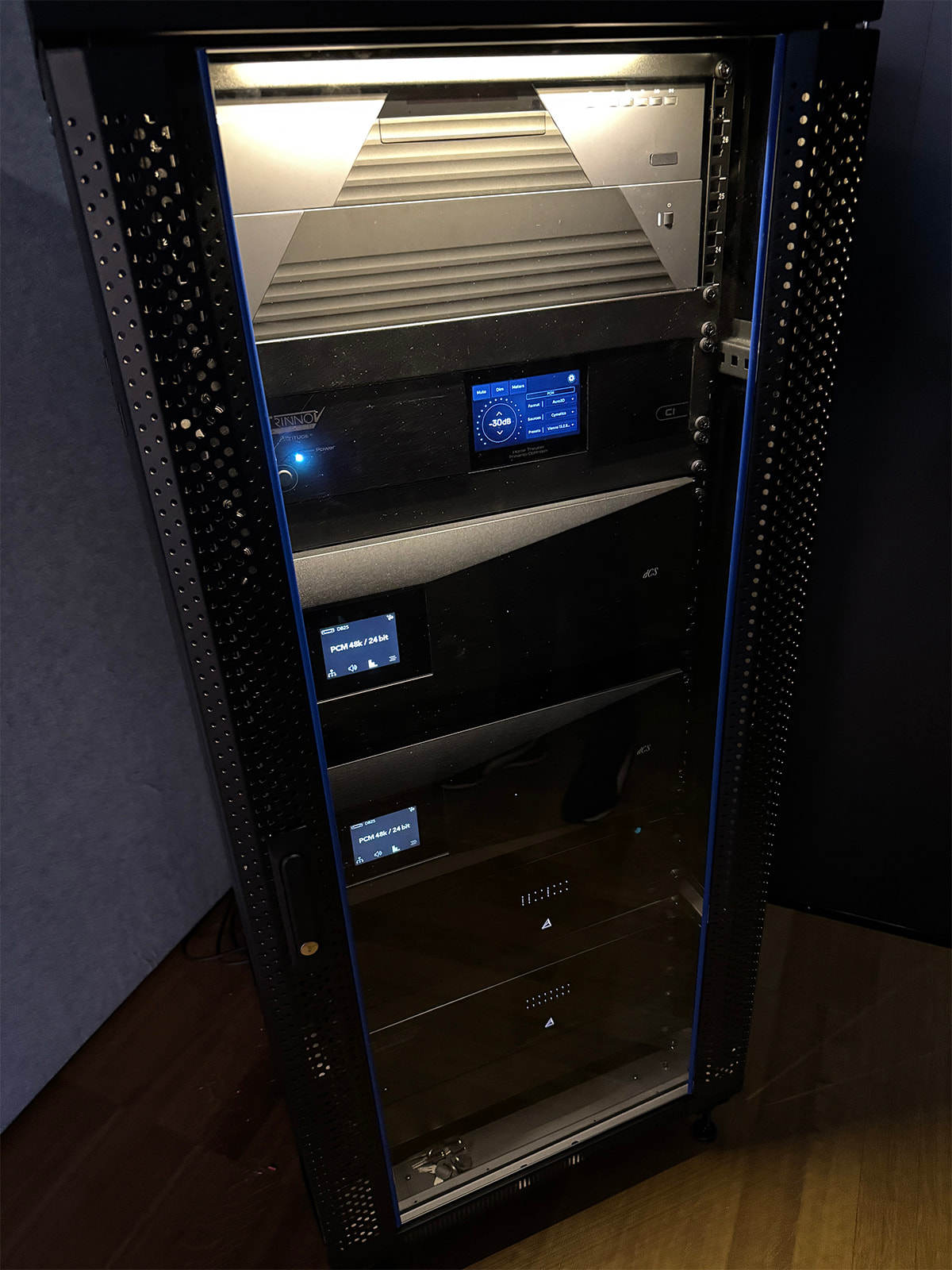
Here is the system rack containing 2 dCS MCD 16s in tandem, as used on High End Vienna 2026:
From top to bottom:
The new Magnetar Ultima, a 2-chassis reference-level universal audio/video transport. This is a strictly digital component with no analog audio output whatsoever. It will handle every physical disc format that the current Magnetar players handle, and can output multichannel digital audio via the dual HDMI ports. The lower chassis houses the power supply, which is comprised of a dual battery system.
Trinnov AltitudeCI audio processor, with up to 32 output channels.
2 dCS MCD 16s, the new dCS 16-channel Digital-to-Analogue converter.
2 Trinnov Amplitude16 power amplifiers.
A report of the MCD 16 multichannel event at High End Vienna 2026 is here:
I can attest that this was an incredible listening session at High End Vienna. I attended two different immersive listening presentations. The one hosted by Justin Gray on his new album Immersed was fascinating. He went through how the immersive mix was done. You were listening in the center of a 360 degree orchestra. Original high-resolution files from the mixing sessions were played. The immersive performances may strike one as counterintuitive to our paradigm of listening to two channel stereo systems. But this really worked to bring a new listening experience - it was truly immersive and I felt exhilarating. The sound was pristine and dynamic.
Having attended this session, I called up the 2 channel mix of Immersed ( 24/96 Qobuz) played through my Vivaldi Apex stack, Soulution 727 preamplifier, MBL 9000a monoblock amplifiers and MBL 101 E MKII speakers. Although it sounded good, it was no match for what I heard in Vienna. The 2 channel mix is flat and not nearly as engaging. The album Immersed must be heard Immersed. Really fun to have experienced the Immersed files on a really top notch system.
Thanks Ned.
The Blu-Ray version is great on a surround system, but not as good as in Vienna
Yea, it was a crazy immersive system. Likely not replicated in many homes. The experience was wonderful and informative as where audio in the future might be. I went to a discussion seminar on immersive audio. The move seems to go for headphones, which make sense as seating in a theater with directional speakers leaves those off the prime spot missing a bit on details. I experienced that in Vienna. My first experience was in the prime seat, then the second session I was just one seat from the prime seat. The experience was not the same as being in the prime seat. That’s why I love my MBL 101 MK II e speakers, there is also prime off center seat for visitors.