In the latest instalment of our Inside Varèse series, we take a look inside the Varèse Transport, our quietest, lowest-vibration CD/SACD Transport to date.
We discuss the Transport’s design and construction, the factors that are integral to ensuring great sound when spinning discs, and the steps we’ve taken to further enhance performance for listeners.
Great article that clearly explains both how the transport mechanism works, and how central the ACTUS cable innovation is/was to Varèse. I learned a lot and will use it as a reference.
What struck me ( unless I missed it) concerns the passing of CD/SACD data from transport to Varese. In previous ranges patent requirements meant that dCS devised an encrypted interface between the two units. Is this no longer necessary? I am assuming that by now the SACD patent may have expired.
It’s nothing to do with the patent Pete, it’s an obligation under the SACD licensing agreement. Afaik the team at Sony that managed that was disbanded long ago, but if someone violated it I could imagine it might still cause Sony’s IP litigation team to stir into life. So, yes, I believe the audio is sent along the ACTUS interface in encrypted form. As usual, @James will keep me honest.
At last I have had time to read the very interesting dCS Edit on the Varese transport. I’m not a prospective Varese purchaser, but I do have a Rossini transport and a keen interest in how these things are put together particularly since mechanical noise - especially on SACDs which rotate very rapidly - is something of a bugbear of mine. The dCS Puccini had a characteristic sound (rather high pitched, which caused some complaint I think), and so does the Vivaldi Mk I which I heard up close and personal for the first time a couple of weeks ago. Seeing the two mechs side by side, which I did at a dCS event, is quite striking: the Puccini mech was, from memory, of mostly plastic construction, while the Esoteric mech in the Vivaldi is a metallic monster by comparison. My only experience of the the D&M mechanism now used in all the dCS standalone transports is with my own Rossini transport.
According to the dCS Edit: “In existing dCS Transports, the disc mechanism is mounted on a sub-chassis constructed from sound dampened aluminium, which is secured to the chassis base plate with standoffs.” The characteristic mechanical sound of a Rossini playing an SACD at the beginning of a disc (when it is fastest) is a low to moderate hum. Having heard a pair side by side (thank you James) I’d say there is some sample to sample variation and I wonder if the performance of the mounting, in terms of minimising noise, depends on the exact degree of bolt tightening, or perhaps the presence of bushings (tried and rejected in the case of the Varese, according to the Edit article). My unit, when first received, was so loud as to be obviously faulty and I never did find out what was done to improve it. This is a question that nags.
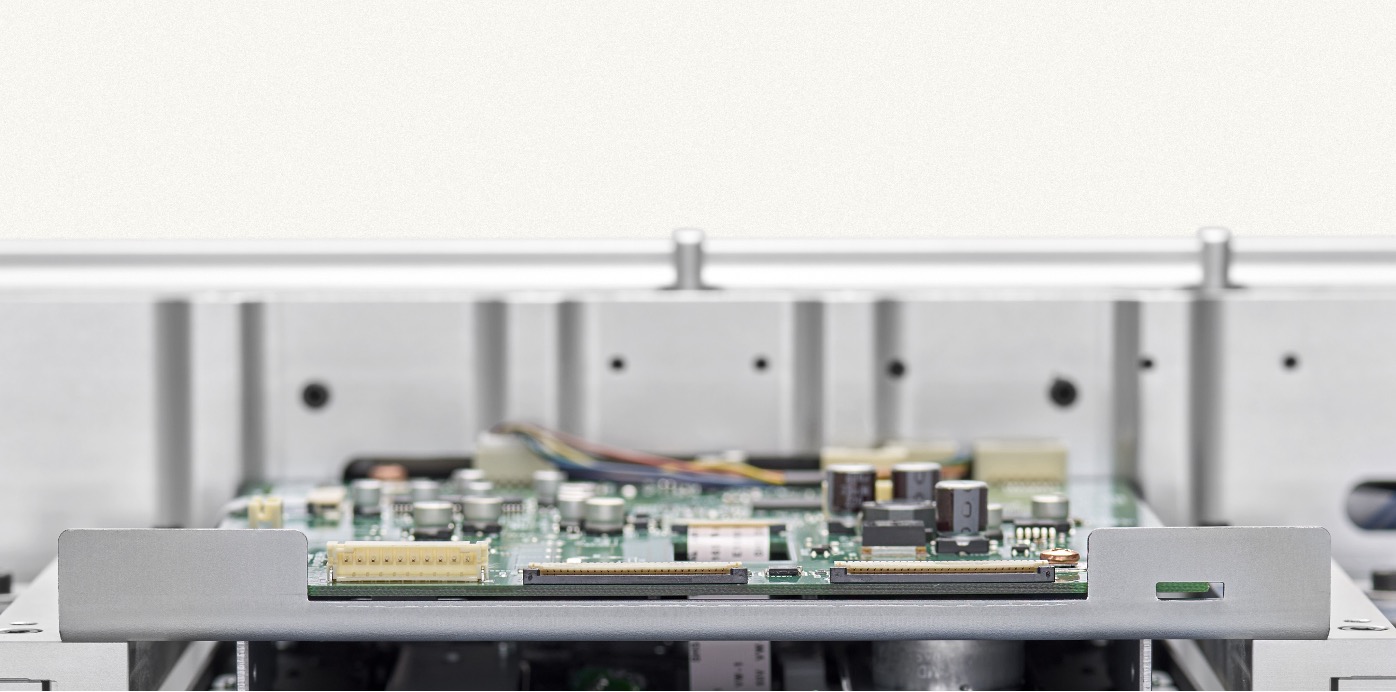
I see that in the Varese the milled-from-solid casework top and sides (one piece of metal) allows the massive mounting for the mech to be part of that casework, and presumably extremely rigid. They say “Using this mounting method has allowed us tocreate the quietest, lowest-vibration dCS Transport to date.” And “This allows for precise alignment of the mechanism tray with the front of the unit, ensuring that the disc tray sits flush with the fascia of the Transport.” That was another problem I have had! It’s impressive to see the amount of effort that has gone into getting this aspect of the design right although, stepping back and looking at the hi-fi industry as a whole, it’s kind of exasperating that these efforts - not always completely successful - are necessary more than forty years after the CD was introduced (and over twenty five since SACDs first appeared). One would think that how-to-spin-a-disc-quietly would have become a solved problem years ago.
In my own hi-fi journey an annoyingly loud mechanism cropped up in my first CD player (an Arcam Alpha). Arcam or Philips produced a ‘damping kit’ as the problem must have been general. The kit did very little. After that, I had various CD players and transports which were fine, followed by a Puccini which I was less happy with from the noise perspective. I had imagined that, at the top end of the market, such things would never be an issue. Of course I realise that dCS can only buy suitable mechs made available by other companies - currently zero, which I hope will eventually change. These days, at least in the UK, many dealers don’t seem to have the transports on dem (mine doesn’t) which means it isn’t possible assess them ‘in the flesh’ except by special request. Still, I hope there will be future dCS transports which will benefit from the experience gained Rossini → Vivaldi Mk. II → Varese.
I am sure that you are correct that there is sample variation in regard to transports’ mechanical noise. I am aware of another contributor here with what sounds like a similar issue to yours. However my Rossini transport exhibits effectively zero noise when playing. I can hear a very faint mechanical noise if I press my ear against the case but so low is it then if I move my ear away by a centimetre I can hear nothing at all.
Of course the new Varese transport may not have this as a problem but , as sample variation exists perhaps with the D&M mechanism ,one would need to listen to a multiplicity of Varese transports before a conclusion could be reached. Unlikely for those outside of dCS staff. Whatever an heroic level of engineering seems yo have been required.
Going back to the early days of silver disc I recall Hi-Fi News investigating transport noise and finding that much was caused by the discs being manufactured outside of the allowed tolerances (i.e. flatness). Yes, I do hear faint whooshing from a few individual discs though this is masked by the music itself.It needs to be borne in mind.
There are, of course, CD mechanisms available. However I am unable to see any activity regarding the market for SACDs that would provide an economic argument for anyone to manufacture a new true SACD/CD mechanism ( rather than a multi standard DVD one). Its sad but outside of Japan, SACD releases seem to be a small niche of what is itself already a niche market ( classical). This too has reduced over the past years and there are ( AFAIK) now only two SACD manufacturing lines on the planet leading to very long lead times.
So, unless something unexpected happens, once dCS run out of their stock of the D&M mechanism it looks like the end. Would they switch overall to CD only?
Congratulations it is fantastic engineering, design and build. But in 2026 the potential client base for a CD player must be very little…If I had the chance of owning a Varèse I think 99% of my listening would occur using the upsampler, I guess…However, congratulations to dCS for building gear at such a high level of quality !
True, it’s down to some classical releases plus a relatively small number of jazz and rock reissues. These seem to be a selection of classics - issued many times and in many formats - plus discs likely to be favourites of audiophiles ‘of a certain age’. A bit depressing, but perhaps SACD will have a very long tail of usage or even a surprising revival one day like vinyl. That seems unlikely, I admit, but if the streamers decide to increase their profits or play fast and loose with album availability maybe that will prop up demand for physical media. (And we should thank the Japanese for where we are today, and maybe China if it is true the major western streaming services aren’t available there.)
Regarding multi-standard mechanisms: am I right in thinking that they do not allow the use of a word clock, at least in the usual way dCS implement their clocking and synchronisation, and that is why they are not used?
For the long term, and as a safety measure, I have copied every disc I own although if I one day put them on a server the task of making all the metadata consistent will be large. I’d feel more encouragement to do that if the general received opinion wasn’t that silver discs still beat streaming by a small margin. I like to think I’m squeezing the best sound possible from my system and don’t wish to take a step back. Another disincentive is the cost of the upsampler.
But I’m getting away from Varese. If I one day meet the transport I will listen to its mechanical noise, or lack thereof, very closely. And I’ll continue to ask dCS questions about all three transports when I get the chance. I have heard the Varese system at the factory, but that was before the matching transport was released.
I have never seen a multi format player with wordclock input. This would affect ultimate suitability. However AFAIK the issue is that such transports do not fully meet the needs of CD or SACD replay as lasers of different focal and wave lengths are required. True CD/SACD players ( as in dCS SACD/CD units) have a mechanism to swap the lasers depending upon the type or layer of the disc. Multi players seem to fudge the issue by using a single laser for both purposes. I have not seen “dual laser” in a description.
Last item I checked I think that you had a Vivaldi DAC . The new Varese transport cannot be used with this as connectivity is via single cable Actus. So use of this transport mandates that you own more or less the rest of the Varese stack. Whether units of new ranges n the future will include SACD or even CD replay is not certain.
Ripping and correct metadata? Yes there may be a need for editing but ripping using dbpoweramp with PerfectTunes makes the task comparatively simple as several editable metadata versions drawn from up to 4 databases are offered for your choice plus cover art with alternatives e.g. UK cover, USA cover, orignal or mid-price reissue.
I was just thinking about what has been achieved to reduce mechanical noise - I understand the incompatibility with the other current ranges. If I get the chance I ought to listen to current Marantz and Denon players for the same reason. Having said that I find that I don’t tend to go into hi-fi shops nearly as much as I used to, even my local ones. Perhaps it’s a game I am not as interested in playing now, except to meet very specific needs.
I use dBPowerAmp and find - valuable though it is - that the offerings of titles (esp. within multi-disc series) and genre classifications aren’t very consistent. I’m not consistent enough either, which doesn’t help.

 .
.