Best streamer connection to dCS

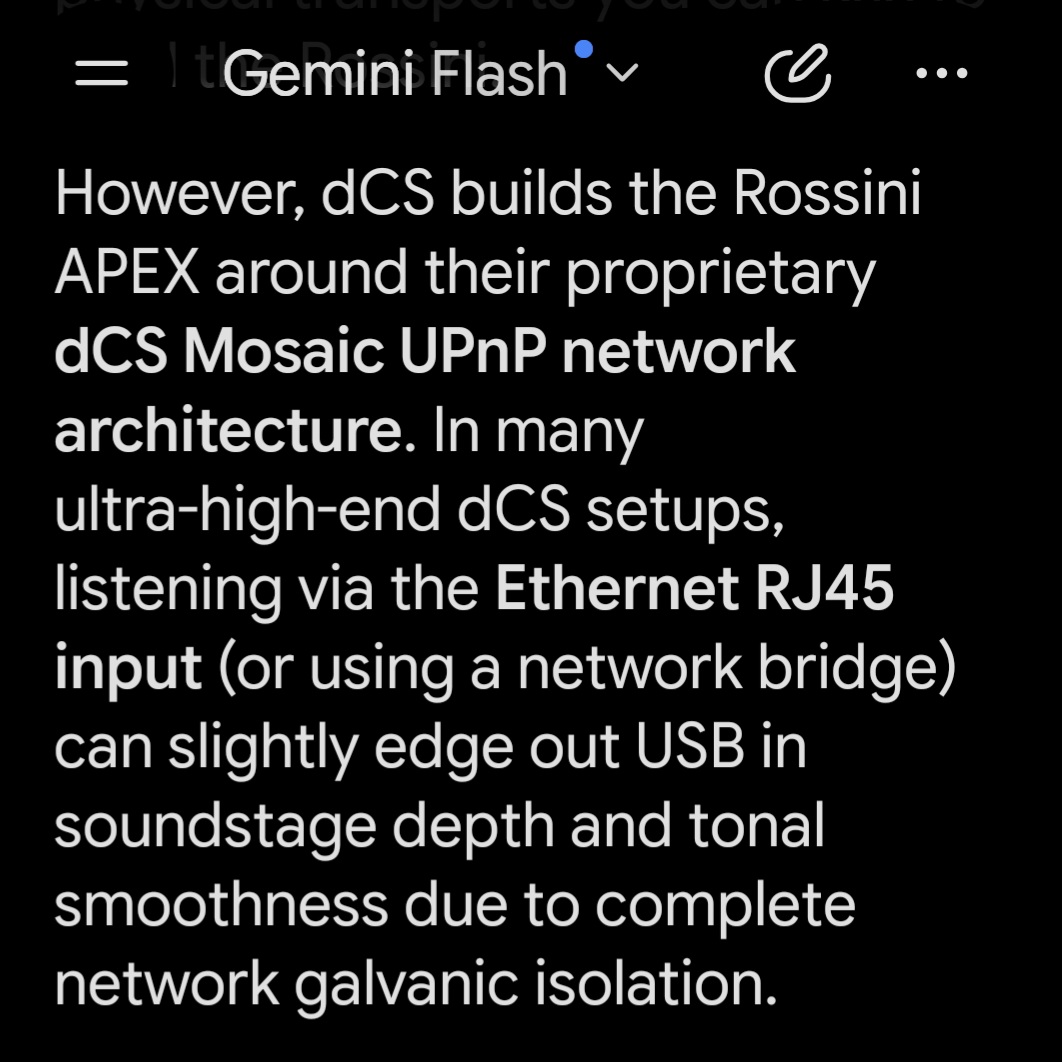
Regarding the best streaming connection to dCS (mine is Rossini Apex), Gemini gave me the following reply.

I wonder where Gemini picked up this information. How would one of the best DAC manufacturers, such as dCS, design a proprietary Ring DAC around a third-party (StreamUnlimited) streaming unit?

Standard industry practice, why reinvent the wheel. StreamUnlimited / Audality / Rasp Pi and Pi Compute modules etc are widely used in all sorts of hifi gear.

Hi, this is an interesting comment and topic, can you explain more about this ?

My point is dCS is a tech leader DAC manufacturer making its own Ring DAC, refusing standard DAC chips like ESS. So why rely on the internal OEM streaming card to extract the best from the Ring DAC if separate streamers like Aurender N20 or Oladra provide a better listening experience?

Angus is correct. dCS do not make every single component of their units. They design, assemble and test. However they do not manufacture in the sense of bashing metal or making circuit components. That is known as vertical manufacture and is not encountered much these days. However ( unless informed otherwise) SME even make the screws on their turntables - very unusual in 2026. Ford or Ferrari do not make every single item of their cars either.

I hope that it is obvious that dCS do not make, for example, the fixings, interface receptacles etc. Although things may be designed by dCS ,most individual parts of a dCS unit are made by their partner companies. For example dcS do not have solder flow lines or multi axis CNC machines. Even the anodising of the cases is carried out by a partner company ( to very high tolerances). It is more economic to have things made by partners who have made the investment (they have other clients too so as to amortise the cost) and have particular expertise in a given area. Sometimes considerable expenditure and R&D has been invested by these companies in products that dCS do not find need improving by designing their own , at least at an economic cost. Soundndstream have long been known for some of the best networking/streaming solutions hence their use by dCS and many other high end manufacturers.

Of course individual units progress and have novel features. The L/B/R/V range uses what was available at the time of design. A more recent model like Varese also uses Soundstream for networking/streaming but using a more recent iteration AFAIK.

@Simon2 . What do Aurender or Oladra use instead? For example Antipodes is a small company in NZ. They will not be designing or manufacturing their own streaming design I’ll bet ( unless someone advises me otherwise :wink:).

1 Like

I have an Aurender N20 and Rossini Apex and compared Qobuz streaming in three ways:

1. From the wall LAN port to Rossini through an Ethernet cable without the N20.

2. N20 to Rossini through AES/EBU and BNC from the Rossini word clock out to the N20 word clock input.

3. N20 to Rossini through USB.

I found that 2 and 3 sounded clearly better (more sound in all frequencies) than 1, so I decided to keep the N20. Then I asked the dCS forum; some replied that AES/EBU has more mid-range (fuller sound) or better sound. To me, I preferred the blacker, clearer/leaner sound of USB.

What I wondered was that the tested AES/EBU cable and BNC cable were 100 times cheaper than the USB cable I used (Inakustik Air Silver Reference), and some pointed out that the USB signal is asynchronous, therefore producing less effect on sound quality. This weekend I plan to recompose the streaming part of the system with an Innuos network switch and hi-fi AES/EBU cables loaned from the dealer.

Still, Gemini informs me that the direct internal Ethernet connection of Rossini is more faithful to dCS’s design philosophy, with which I do not agree based on my experience.

For some things LLMs can be great but they have comparatively small factual databases and therefore find solutions on the internet. These may be incorrect ( the LLM has no way of distinguishing this).

Well, about 81% of dCS owners disagree with that opinion and in fact find the dCS’ built-in streamer to be the best. The survey was done back in 2024.

It doesn’t make your opinion wrong, but yours is just another subjective perception, not an objective fact.

1 Like

For this kind of topic, I agree LLMs would have very little or biased writings to gather on the internet. I had a similar experience with firmware update history for the Soulution 725 from Gemini, which proved to be totally wrong after confirming with Soulution HQ.

To be fair, in dCS’s release article restricting the beta testing of software versions to only Bartok and Rossini users, dCS states the restriction is because the majority of dCS users are Bartok and Rossini users.

With this in mind, for them, adding an Aurender N20 may not be an attractive cost option, not even trying good separate streamers (or tried and upset with mid-tier streamers such as the N150 or N200, like I have). For other smaller dCS users with more financial resources, they may have moved up to Vivaldi or are using top-tier separate streamers.

Rationally speaking, how can only a small streaming board compete with a good separate streamer with a dedicated streaming board, signal insulation, separate power supply, and noise filtering? And they still need a DAC.

Considering the aforementioned situation, 81% of dCS customers using dCS internal Mosaic does not validate Mosaic’s sonic superiority over separate top-tier streamers like the Aurender N20, Innuos Zenith NextGen, or Oladra, among other streamers.

Of course, I feel adding a good streamer/cable may yield marginal returns. In my case, I traded second-hand Aurenders of N150, N10, N200, N20, N30, and W20SE, eventually coming back and settling on the N20. By the way I demoed Bricasti, Oladra , Lampi, Lumin streamers and gave up them all, not my taste.

It’s all a subjective matter, but at least I tried n20 and felt clear/superior sonic differences which may not be to others’ taste; thry may like other streamers such as Olandra,etc.
As a Bartok owner I would agree that I do not see adding an external streamer as an attractive cost option, not because of the cost but because I do not believe it to be necessary. I have tried an Innuos streamer (to test my belief) and found that, for me, it added nothing. Of course my conclusion may be driven by expectation bias. You have obviously reached a different conclusion with your Aurender.

I think the rationale you state for the necessity of an external streamer does not hold water. Paraphrasing it is “the dCS streaming board can’t be any good because it’s small and mass produced”. I see it like this: The dCS Ring DAC requires the right data to be in its buffer inside the dCS product at the right time in order to play the file, no more than that. The music file is digital data so either is or is not right when it arrives, it has no inherent quality that can impact its degree of correctness (and consequently its sound). The job of the streaming system is to put complete and accurate data in that buffer ahead of when it is needed. No matter what its size or manufacturer, the dCS streaming board does this perfectly so is hard to improve upon. This is a digital data transfer task that is carried out with complete accuracy by any number of tiny mass produced devices. Our current digital world works because of such devices. (@Anupc has given full explanations in other threads of how TCP protocols ensure that data transmitted across ethernet is ensured to be complete and accurate so I am not going to attempt that, he does it far better than I ever could).

Of course external streamers have music file storage and provide more user friendly interfaces perhaps than Mosaic so have utility and are the choice of many (but according to the survey: a minority :grin:).

3 Likes

Well, audio is eventually a hobby, and I appreciate your point. I have not tried Innuos models, and I do not know which Innuos model you used, but in my case, Aurender N150, N200, and W20SE did not win against the dCS internal streamer board. Only N20 and N30 won, which sounded positively fuller. Streamer benefit will be model-dependent, from my experience. To me, Lumin and Oladra were behind N20.

If possible, loan an N20 and give it a listen. It may change your idea about the N20.

I used Bartok and later Bartok Apex with and without an N10, and I added an N10; better fancy UI and display were only a bonus.

By the way, I presume many dCS users connect dCS directly to power amp(s) as it simplifies the signal path. I was one of them, then loaned the stereo demo unit to put after Rossini. It was a total revelation. One of the best purchases in the system. A hobby isn’t determined by the majority. If so, where is the fun?

Aurender have their motherboards manufactured by an external partner in S Korea to their own design. Antipodes buy in motherboards aimed at industrial machines from 2 partners, as far as I can see they customise the firmware/code and use a lot of trick power supply & noise filtering tech.

Many of the models mentioned as being Streamers are in fact Servers that Stream. A dedicated Streamer aka Network Transport is a simpler device, I have tried many variants over the years from basic Pi based ones to high end. With the Rossini Apex I am using the internal Streamer as it has been preferred to an external Streamer every time, as a combined Streamer/DAC the new V3 code has lifted its performance up a level for me. I keep my Server separate by choice but have tried/owned a few Server Streamers, always reverting back to a dedicated Server tucked away in another room/comms cabinet on a separated mains supply.

At this level it’s not so much about “Better” as “Different” in my view, good to try new options and see what’s out there pushing boundaries.

I agree with you Simon and thank you for the N20 recommendation. You never know, I might try it at some point!

On the pre-amp point you made I have gone the opposite way to you: I started convinced that a pre-amp was necessary and was then inspired to try Bartok direct to power amp by a post by one of the DCS staff on this forum.

Over an extended period I found that I preferred direct to power amp and eventually reluctantly sold my Jeff Rowland Corus pre-amp and have not regretted it.

It’s great to have so many choices to find the sound that we are seeking.

Contrary to your view, I would suggest that anyone who can afford a dCS has probably tried an external streamer of some kind over the years.

That’s where you’re mistaken. Once you properly understand what it does, you’ll realize it’s completely logical.

The Streaming board is the modern-day equivalent of a CD Transport Mech - the specialized mechanical and Optical pick-up unit inside CD players. And just like a CD Transport, the Streaming board inside a dCS has just one job to do; reproduce the original PCM samples error-free to the rest of the system.

The Streaming board takes in Ethernet streams, strips out PCM from the IP packets framed in various IP-transport/session-layer protocols (TCP, HTTP, UPnP, Roon RAAT, etc), and feed those PCM samples directly to the dCS’ FPGA stages. It doesn’t do anything else. No processing. No filtering. Nothing.

Conversely, an Aurender (or any other external streamer for that matter) will never sound better than dCS’ native built-in streamer because the Aurender unnecessarily fiddles with the PCM bits after it’s been extracted from the IP packets.

Take a look inside an Aurender, you’ll see that it too has a small Streaming board, but then it also has a bunch of other stuff that just unnecessarily fiddles with the extracted PCM, like re-framing it into AES, or re-packetizing it into USB etc etc.

Bottom line is that your impression that an external streamer sounds better than dCS’ built-in one is just your subjective sonic personal preference. Which is totally fine, but it’s not objectively better.

3 Likes

I am glad to hear your opposite path regarding the preamp.

As far as I am concerned, I feel bored with the audio system after some time, and then I add, replace, or subtract a component looking for a different sound. Usually, the change is heavily influenced by the “authoritative” magazines and reviewers.

Well, hi-fi is a hobby, and I always enjoy creating new sounds.

I totally agree with you that the topic is not about “better” but about “different.” The choice is up to personal taste, as in dCS vs. MSB.

Well, I like the sound the way I like it to be reproduced or colored. I am not sure I pursue pure fidelity of the original sound signal, as listening environments are all different. Also, I am not a big fan of monitor sound such as from Genelec.

I understand now everyone clearly had a different ear for the “better” sound. That is why dCS and MSB compete in their own house sound with a totally different conversion architecture.

Out of curiosity, higher models in Aurender and Innuos seem to have more parts and boards. Then are they negatively affecting the original signal more?

Yup, pretty much. The more a platform tampers with the source bit stream, the further it’s going to get from transparent. The sonic results may sound great to you of course, but not much point trying to argue that it’s objectively better or more transparent.

Nothing can be “more transparent” or objectively better than source bit-perfect, and you can easily prove that dCS’ streaming boards deliver source bit-perfect bitstreams.

By the way, just to be clear, it’s not just dCS who use 3rd party streaming boards, pretty much ALL of the top DAC vendors do!

The two main suppliers are StreamUnlimited and ConversDigital, both of whom have boards of about the same form-factor. Here’s a (partial) list of who uses which;

  • StreamUnlimited: Arcam, Burmester, dCS, McIntosh, Musical Fidelity, Naim, Linderman, Eversolo, Wadax
  • ConversDigital: Ayre, EMM Labs, MSB, Mytek, Nagra, Playback Design, PS Audio

The exception tends to be the Chinese, Korean, and Japanese vendors, like Aurender, Lumin, Melco, HiFI Rose etc., who use their own custom boards, typically from their IT sister companies (like Melco uses Buffalo, Lumin uses Pixel etc.), but all of them leverage the same ARM SoCs as StreamUnlimited/ConversDigital.

As for the Server based external streaming hardware vendors, ALL of them use custom variants of SuperMicro, ASUS or Gigabyte, i.e. the Taiwanese motherboard manufacturers (who specialize in small-volume custom work). This includes Antipodes, Innuos, Pink Faun, Taiko etc.

3 Likes