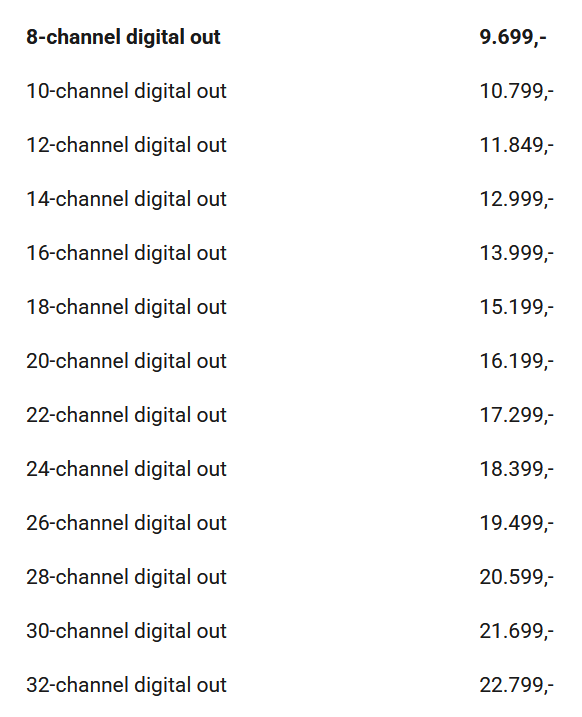
Instead of a fixed MCD 16: Would it be possible to introduce -let’s say- a MCD 8, and then gradually expand with extra RingDAC boards to 10 - 12 - 14 - 16 channels if and when needed?
I have understood that it is not possible to do this with the upcoming MCD 16.
The plication isthat it is 16 channels or nothing. AFAIK many MCH enthusiasts do not use so many channels but e.g. the classic 5.1 setup being popular. Of course when I say AFAIK I use AI. AI meaning Absolute Ignorance ( I don/t think I have even heard a domestic multi channel setup).
I imagine that in practice for a 5.1 setup one would simply leave 12 channels dumb, however the DSP firmware.etc.. outlined implies that this may not be the case.
Incidentally I think you would sell lore MCD units if the channel count was configurable with purchasers able to start with a smaller number leaving empty bays but able to add as the system expands. Not that I am a potential customer .
That of course is my idea behind my feature request.
I currently have a 7.1 multichannel system, and I might expand that to 7.1.4 , but that is it. So I need 8 channels initially, and perhaps once 12. The MCD 16 will in all these cases be overkill.
So with the MCD 16, one of the reasons we have chosen to go with AES3 connections over other formats like AoIP is that typically the installation of the MCD 16 will be close to the source device such as an AV processor. In this case, you can achieve better performance using electrical connections instead of network connections, particularly for clocking.
Looking at the most common AV processors, the AES3 outputs tend to come in groups of 16-channels, or not at all. On most this is by way of a single DB25 connector carrying 16 channels of audio - apart from Storm who use RJ45s carrying 8 channels each. While the MCD 16 does have individual XLR inputs in case someone wanted to use a DB25 to XLR breakout cable, all of the installations we have used it with thus far has been in a system where the source can feed at least 16 channels. The only processor I am aware of that can do multichannel AES3 outputs but can also have a lower channel count than 16 is the new Trinnov Altitude CI, but that has enough AES3 outputs on 2x DB25 connectors for 32 channels, so the hardware for more is already there.
I’m not aware of any AV processors that use discrete XLR outputs for AES3 connections - I can’t even think of any sources outside of that which use them either aside from maybe some very specific pro studio gear
So an installation using fewer channels than 16 via AES3 would likely still require a processor with a multichannel AES3 output, and then using a DB25 to XLR cable ad having some of the XLRs left hanging. It wouldn’t make sense to have a DB25 input with half of the pins just not connected to anything
None of this to say different channel counts is not a valid use case, just to clarify why we landed on 16 channels and the I/O we have. It makes for the cleanest installations with the available AV processors while maximising the sound quality from the system
Out of interest @Ermos, what source device would you be looking to feed the DAC with in your case?
I’m actually quite interested in Ermos’s suggestion about an MCD-8 as well.
From a user’s perspective, I think it would make a lot of sense to allow people to start with fewer channels and gradually add more as their system develops. That way, users wouldn’t have to pay for channels that they simply don’t use.
In my own system, I currently only need around 13 channels. Most importantly, I would still want to keep the Left and Right channels separate and have them handled by my dCS Vivaldi APEX, rather than sending them through the MCD-16.
So, for me, a configurable MCD-8 that could be expanded gradually would actually be a very attractive solution.
My system is 7.4.2 so I require 13 channels. The MCD16 is not going to be cheap so the ability to start with fewer channels and expand to what you actually need would be a great feature rather than wasting three (expensive!) channels.
Exactly. However you also already have two channels via the dCS DAC that you already have have.. so you could be wasting 5 channels in total,Judging by what we know so far far potential owners will be unable to substitute the MCD16 for their ( say) existing Vivaldi should they still wish to play music and via which 2 channels could be routed
To me from the outside it looks as if dCS have fallen under the spell of Trinov ,a device that appears to be an essential addition and around which which connectivity decisions seem to have been taken. . As a new product looked at from a business angle I wonder about the potential ize of the market for MCD16? .
To be clear Pete, the Lyngdorf MP-60 also uses a 16-channel AES3 output via DB25, as do the JBL Synthesis SDP-75 and SDP-80. There is no way to output multichannel digital audio from these units on a connector that carries any less than 16 channels. In the case you use fewer channels, the extras are simply unused, but it is on almost all multichannel source devices a 16 channel interface.
Outside of AV processors, even multichannel pro audio source devices like the Audient Oria use a 16-channel output on a DB25 connector.
The processors from Trinnov, Storm, Lyngdorf which use fewer channels (with the exception of he Altitude CI) do not have multichannel digital outputs so would be incompatible with an external DAC of any type. They’ll only have a “Zone 2” output on S/PDIF which has a downmixed 2-channel version of whatever is going through the processor.
My point above is that I am not aware of any source devices other than the Storm ISP Evo and Elite that use a multichannel connection that carries less than 16 channels.
Thanks James. To me it looks as if dCS has decided that MCH means 16 channels and has found a processor that offers 16 channels via AES,t I am aware from this thread and elsewhere that common MCH setups are 5.1, 7.1and 11.2 channels and that HDMI is common for input connection to the source.
I wonder why dCS has chosen not to cater as well for what I perceive as the most common MCH users. Surely your choice limits the market that is available to you ?
Anyway I admit that it is only an academic point for me and it is quite feasible that I totally misunderstand the market. However others on this thread are asking for those smaller formats to be served.I was expecting your response to correct me and that e.g. 5.1 setups are catered for with the press of a button! But, no.
I think the point you are looking for is actually something that should be handled by the processor in front of the MCD-16.
For example, I’m using a Trinnov, and honestly, it’s hard to beat. As you said, you basically press a button and it takes care of the channel configuration, optimisation and calibration for you. Whether the system is 5.1, 7.1, 7.4.2 or something larger, the processor is really the place to manage that.
For me, dCS has always been about getting the most important part right — taking the digital signal and reproducing the music as naturally and faithfully as possible. That’s where I want dCS to concentrate its engineering.
So rather than asking dCS to build every possible channel configuration into the MCD-16, I’d almost rather see them put their effort into something even more interesting…
How about putting an APEX Ring DAC into the MCD-16?

 ( I don/t think I have even heard a domestic multi channel setup).
 .


 I would love that, but some others living here, and around, do not.

