I have wanted to create some short playlists of tracks that exercise or show off different aspects of a system for a while, and somehow never got round to it. Then some travel dead time presented an opportunity to finally put something together.
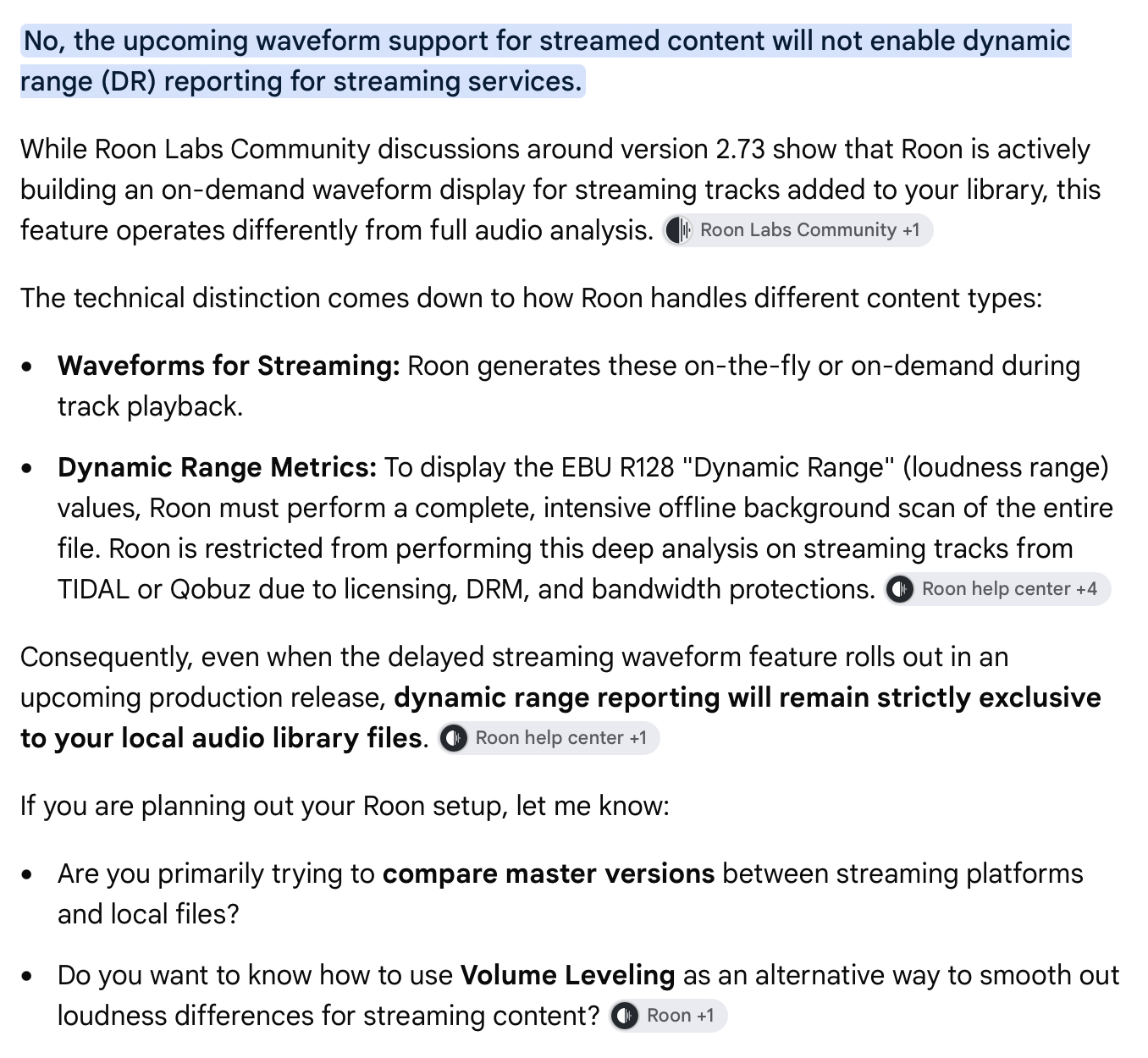
One of my first ideas was to mine the rich seam of information formed by @Bauer ‘s many posts in the What’s Spinning series and where he diligently notes the dynamic range (DR) score of the various tracks using (I believe) the reporting feature in Roon. Since this function requires a locally stored file and most of my daily consumption is streamed tracks this feature is not available to me.
I asked ChatGPT to compile a list of albums posted by Bauer over the last few years which had the highest reported DR. I then asked it to find these tracks on Qobuz, my go to streaming service.
I am highly sceptical of AI, based mostly on the AI-supplied answers others have posted here to technical questions about dCS products, which I know to be incorrect and probably trained by speculative answers provided by uninformed (but well intentioned) respondents to the same questions asked online. However, this is fun to try and the consequences of incorrect information far less serious (a misleading recommendation or a bit of wasted time) so why not? A few caveats:
- the DR measurement can be misleading for various technical reasons and should not be interpreted as a proxy for sound quality. With that said all of the following recommendations offer superb sound quality IMO.
- Most of Bauer’s recommendations are ripped from SACDs and may come from different masters than the PCM versions available on streaming services. This leads me into a much bigger and more difficult question of provenance in the streaming world and the fact that it is often impossible to identify which recordings and masterings we are being served by the streaming services (or indeed if they have altered them in any way). I am very curious to learn if there are any ongoing initiatives to address this. I’ll return to this subject in the future but in the meantime if anyone knows of any, or even any articles on this subject please post them here.
- I was unable to locate the Martin Sieghart Mahler recording in Qobuz, but I suspect it’s there. Please comment if you find it and I will add it to the playlist.
So I offer no guarantees, but since this is only for fun here goes. Serious cred to Bauer for some excellent recommendations, and ChatGPT for the analysis and report. ChatGPT hereafter…
8<-------------------------------------------------------------------------------------------------------------
I’ve used the Bauer DR figure as the selection criterion, but chosen individual movements that give a good demonstration of the recording’s dynamic scale. Bauer’s number is generally an album/recording-level figure, not a measurement of that particular movement.
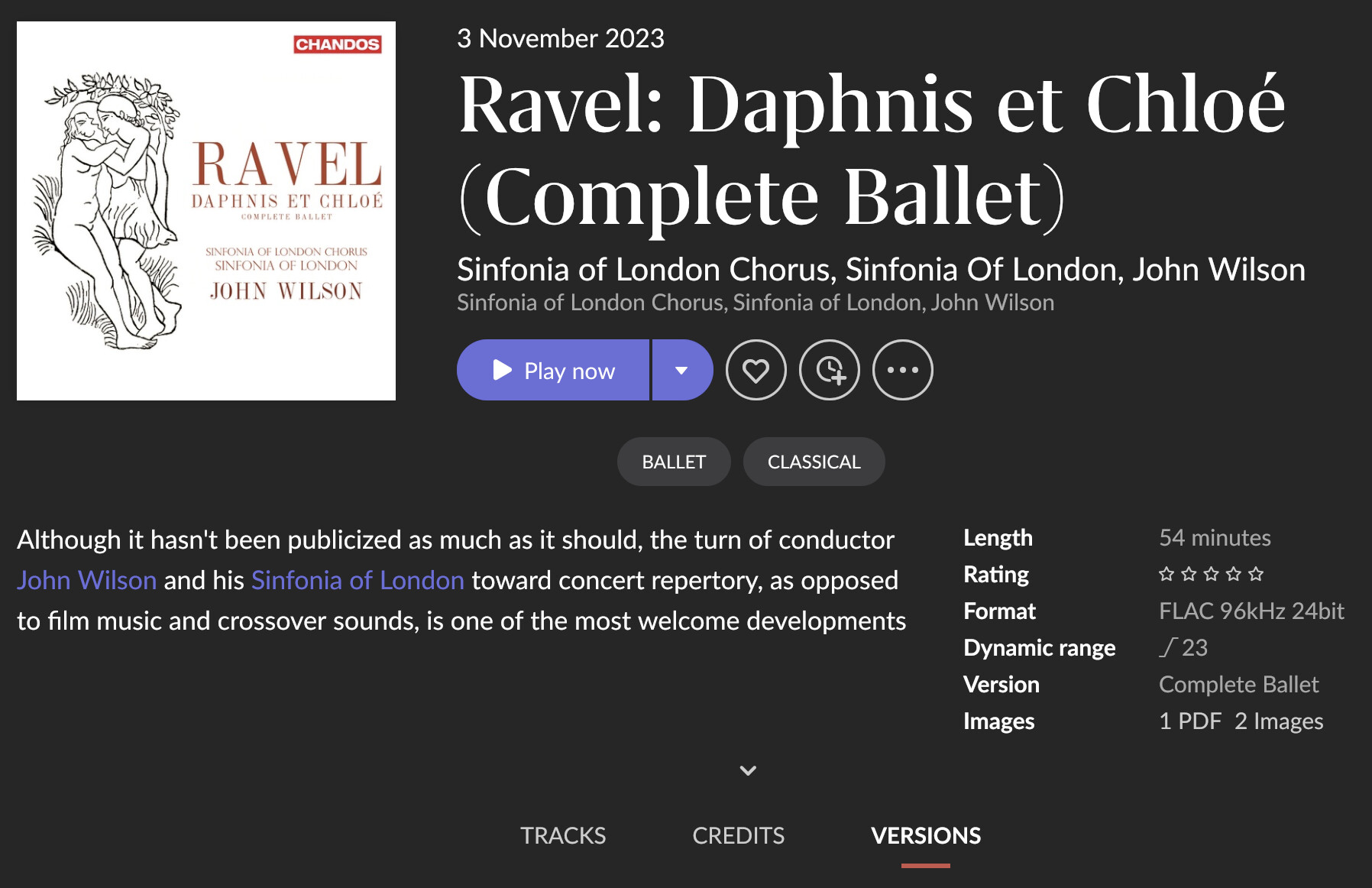
I’ve also checked that the principal versions below are available on Qobuz; for example, the Honeck Shostakovich is available in 24/192, the Fischer Mahler 2 in 24/192, and Wilson’s Daphnis in 24/96.
My Bauer high-DR listening list
1
DR 25
Shostakovich 5 – IV. Allegro non troppo
Honeck / Pittsburgh SO — Reference Recordings
Probably the ultimate test of large-scale orchestral dynamics
2
DR 24
Mahler 2 – V. Aufersteh’n
Iván Fischer / Budapest Festival Orchestra — Channel Classics
Starts intimately and ultimately becomes enormous
3
DR 23
Ravel – Daphnis: III. Danse générale
John Wilson / Sinfonia of London — Chandos
Explosive final section following extremely quiet passages
4
DR 23
Bruckner 3 – I. Mehr langsam, misterioso
Jaap van Zweden / Netherlands Radio Philharmonic
Huge orchestral scale and very quiet opening
5
DR 23
Mahler 3 – I. Kräftig. Entschieden
Bychkov / Czech Philharmonic — Pentatone
Massive dynamic contrasts
6
DR 22
Debussy – La mer: III. Dialogue du vent et de la mer
François-Xavier Roth / LSO — LSO Live
Exceptional quiet-to-loud orchestral contrast
7
DR 22
Ravel – Daphnis: Danse générale
Charles Munch / Boston SO — HDTT
Vintage recording with extraordinary scale
8
DR 21
Mahler 5 – V. Rondo-Finale
Bychkov / Czech Philharmonic — Pentatone
Very clean modern recording with big orchestral peaks
9
DR 21
Rachmaninoff PC 2 – III. Allegro scherzando
Anna Fedorova / Pitrenas — Channel Classics
Piano/orchestra contrast rather than just orchestral mass
10
DR 21
Dvořák 9 – IV. Allegro con fuoco
Kertész / Reiner — HDTT
Fantastic orchestral climax
11
DR 21
Beethoven Violin Concerto – III. Rondo
Niek Baar / Concertgebouw Chamber Orchestra
A very useful soloist-versus-ensemble test
12
DR 21
Mahler 6 – IV. Finale
Martin Sieghart / Arnhem Philharmonic — Exton
Extraordinary range and very long-form dynamics
13
DR 21
Berlioz Requiem – Tuba mirum
Pappano / RCO — RCO Live
Particularly good for testing very large-scale dynamics
14
DR 20
Rimsky-Korsakov – Scheherazade: IV. Festival at Baghdad
Fritz Reiner / Chicago SO — HDTT
Sudden orchestral attacks and tremendous bass energy
15
DR 20
Ravel – Daphnis: Danse générale
François-Xavier Roth / Les Siècles — harmonia mundi
More historically informed sound and very different colour
16
DR 20
Johann Strauss – The Blue Danube
Yakov Kreizberg / Vienna Symphony — Pentatone
A surprisingly good large-scale orchestral test
17
DR 19
Rachmaninoff PC 3 – III. Finale
Fedorova / Pitrenas — Channel Classics
Piano attacks against full orchestra
18
DR 19
Mahler 2 – V. Finale
Bernstein / NY Philharmonic — DG
Interesting contrast with the Fischer recording
19
DR 19
Mendelssohn – Midsummer Night’s Dream: Scherzo
Gardiner / LSO — LSO Live
Fast transients rather than simply huge climaxes
20
DR 18
Respighi – Pines of Rome: IV. The Pines of the Appian Way
Dorati — Mercury Living Presence
Superb old-school crescendo test
If you only listen to five
I’d make it these:
1. Honeck — Shostakovich 5, IV. Allegro non troppo (DR25)
This is the one I’d put at the top of the playlist. Qobuz has the Reference Recordings release as 24-bit/192 kHz, with the fourth movement running 12:30.
Qobuz — Honeck/Pittsburgh: Shostakovich 5 & Barber Adagio
2. Fischer — Mahler 2, V. Aufersteh’n (DR24)
The Channel Classics recording is from 2006 and Qobuz currently offers it in high-resolution stereo.
Qobuz — Fischer/Budapest Festival Orchestra: Mahler 2
3. Wilson — Daphnis et Chloé, final Danse générale (DR23)
This is particularly good because the complete ballet is available as 24/96, and the Chandos booklet confirms the three-part structure.
Qobuz — Wilson/Sinfonia of London: Daphnis et Chloé
4. Roth — La mer, III. Dialogue du vent et de la mer (DR22)
This is track 8 on the LSO Live release, available at 24/96.
Qobuz — Roth/LSO: La mer / Rapsodie espagnole
5. Fedorova — Rachmaninoff PC2, III. Allegro scherzando (DR21)
This gives you something substantially different from the Mahler/Bruckner material: piano, orchestra and very large transient contrasts. Qobuz has the 2022 Channel Classics recording in high-resolution stereo.
Qobuz — Anna Fedorova: Rachmaninoff Piano Concertos 2 & 4
One especially useful comparison
I’d actually encourage you to listen to the three Daphnis recordings back-to-back:
- John Wilson / Sinfonia of London — DR23
- Charles Munch / Boston Symphony — DR22
- François-Xavier Roth / Les Siècles — DR20
The Roth/Les Siècles recording is definitely on Qobuz at 24/96, with Lever du jour and the final Danse générale separately indexed as tracks.
Qobuz — Roth/Les Siècles: Daphnis et Chloé
That should be a very revealing comparison, because you’re listening to essentially the same musical material through three quite different recording approaches. And importantly, the difference in Bauer’s DR figures isn’t simply explained by resolution: the Roth recording is 24/96, while the Wilson recording is also 24/96.
One qualification about the list
I would not interpret DR25 versus DR23 as “DR25 sounds better.” DR is a useful indicator of the available recorded dynamic range, but it doesn’t tell you about tonal balance, distortion, microphone perspective, hall sound, noise, mastering quality, or whether you actually prefer the performance.
For a dCS system, however, these are particularly interesting recordings because the highest-DR material gives the DAC/streamer/amplifier/speakers much more opportunity to reproduce the difference between the very quiet and very loud parts of a performance.
And there’s a particularly nice test hidden in the list: Honeck Shostakovich IV → Fischer Mahler II finale → Wilson Daphnis final dance. If your system remains composed and uncongested through those three, you’re giving it a pretty serious workout.