Yet, in my region it’s well 24/96…
See below:
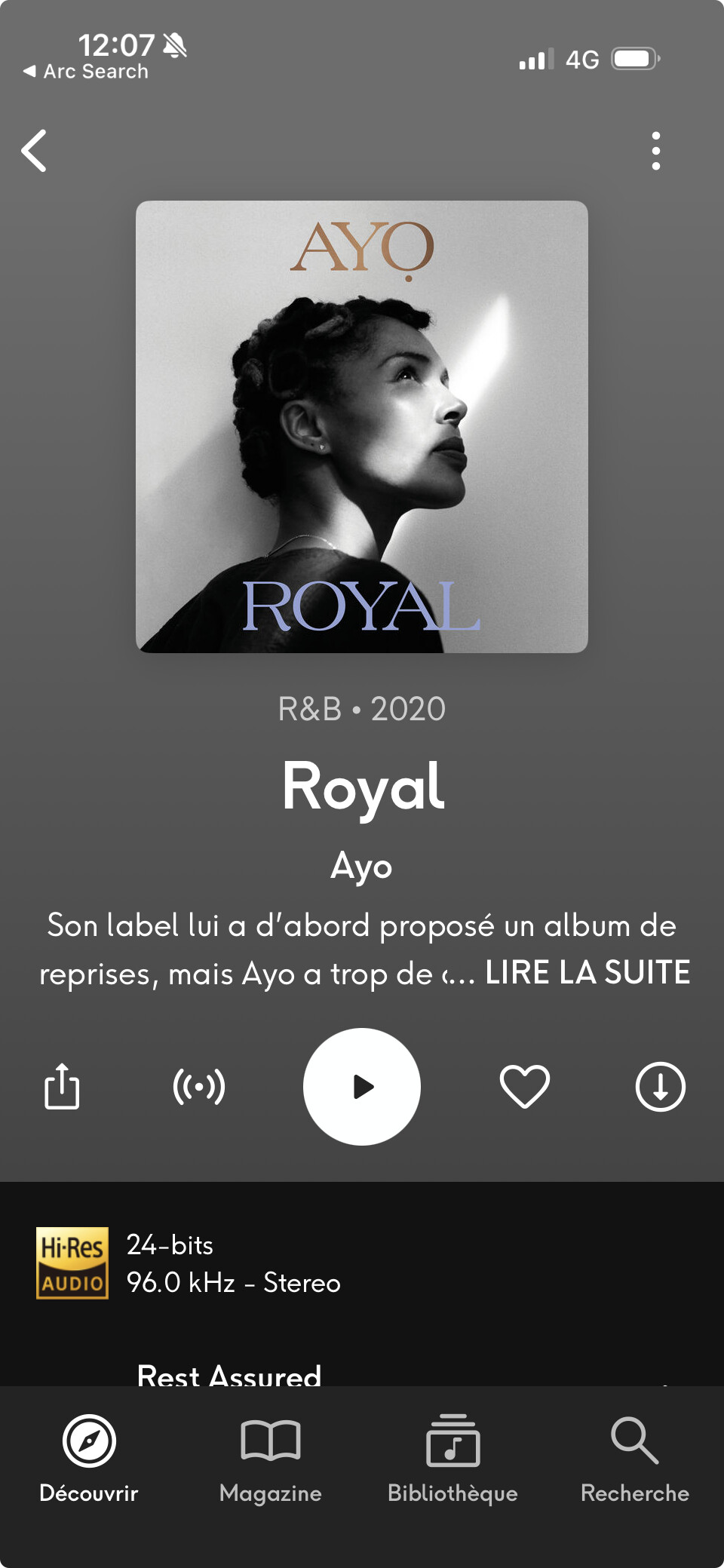
And I get a region error if I click on your link towards the 24/88.2 version…

Yet, in my region it’s well 24/96…
See below:
And I get a region error if I click on your link towards the 24/88.2 version…
Great album… works great!
Very strange indeed. I find it extremely dodgy that one album has two “highres” versions in 24/88.2 and 24/96. To me that suggests one (or both!) are artificially upsampled. A quick search didn’t reveal anything about the format of the original master. 
I hate to agree with you however it makes one question exactly what are we getting (resolution wise) when these albums are being streamed.
Does the front panel of our DAC (or Upsampler) indicate a resolution which our units are able to determine or does it instead read a resolution “title” embedded with the file name?
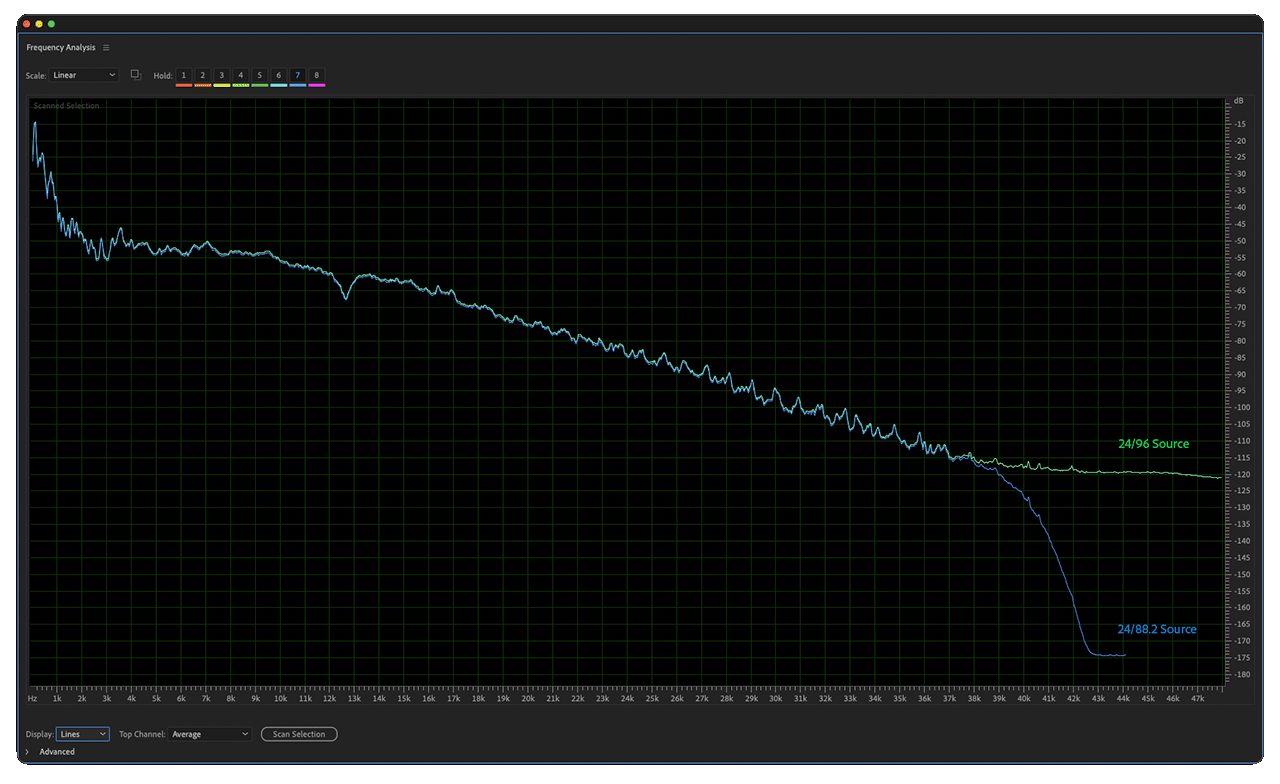
I took a closer look at 2 random tracks from that Ayo “Royal” album, as in I ripped the Qobuz 24/88.2 Stream to a .wav file and looked at the overall frequency response of the tracks.
That 24/88.2 stream looks to be genuine highres; both tracks featured a very smooth frequency response spectrum all the way up to 40kHz, after which there was clear signs of a filter applied. If it was upsampled from 16.44.1, I’d see filtering just past 22kHz.
Now the question is whether that 24/96 is genuine 
dCS will show the actual incoming bit-rate of the source stream. Of course there’s no way for the dCS platform to know if that source stream was from artificially upsampled sources or not.
We can find a way such as I transfer you a couple of tracks from my 24/96 version for your analysis if you wish.
If so, please PM me.
Faith in Qobuz restored 
Turns out both the 24/88.2 and the 24/96 streams are actual highres sources. In fact, the 24/96 version seems even better as the frequency response spectrum extends well beyond 40kHz. That said, any musical content up there at the 40kHz is at -120dB down, so it’s not like you (or your dog more likely) is going to hear anything at those frequencies anyway.
But there’s another interesting little mystery though.
In both of the tracks I analyzed (and for both sample-rates), there’s a significant null/notch at just around 12.5kHz. On track 1, it’s a 15dB notch, so should be quite audible.
I don’t know the exact cause of it, but a quick search suggests possible causes include Comb filtering from mixing misalignment/mic pair feeds misalignment, digital artifact from sample-rate manipulation in the recording chain, or even microphone or preamp issues.
I’m guessing only Mark Wilder who did the mastering for the album knows what’s really going on.
What you are reporting is sadly not untypical ( in general terms). The record and streaming companies are really only interested in being able to stick a hi-res label on the recording,by whatever means this can be obtained.
The UK magazine Hi-Fi News has a monthly feature devoted to this type of thing (Hi-Res Downloads) where circa 6 albums are analysed with graphical results shown with explanatory comments. The current issue includes an album where all of the data is 48K in a 96K envelope and another were some tracks (with distortion) appear to be 48K and others upsampled to 96K.
I have written in the past bemoaning that the old SPARS coding for CDs has no download ( or steaming) equivalent. Though even this was crude but at least it recognised some kind of provenance.
What record labels make available in different countries may be down to the local label manager and what he/she thinks best suits their market.
Fiddling with recordings to produce a result that looks more attractive to the punters, irrespective of strict technical l justification, has always been the way. I remember when stereo records emerged in the late 1950s in the UK. We then had a decade or two of mono recordings “electronically processed” to stereo.
I really enjoyed track 6 as well. Thanks for sharing.
I agree with you @PAR I find it very difficult sorting thought various Jazz releases - they are all over the place
Albeit a very very small part of the market, it is a little easier I think for new classical music releases. Pretty much anything from the major labels (like DG, Decca, Warner, Hyperion, Chandos, Alpha, Channel, Pentatone, BIS and other boutiques) is going to be true high res - they often publish details right in the notes (although there have been exceptions). I tend to buy from Qobuz these days, but if provenance is unclear, I try to buy from the record label directly
Still with Ayo:

Interesting. No ambiguity on this album. The link works perfectly to the 24/96 version 
Could it be due to the different record label?
Quite possibly!
By the way, I gave this album a quick listen, it’s not nearly as well engineered/mastered as “Royal”; the first couple of tracks were clearly suffering from “Loudness Wars”.
Agreed.
“Royal” mastering is way above this one.
New The Strokes album, “Reality Awaits”
Two or three keeper tracks, but by and large a disappointing mixed bag. I’m struggling to understand the artistic intent of a singer like Casablancas using autotune on virtually all of his tracks… WTF
Up on Qobuz in 24/96