Music Server with dCS Network Streamers?

Hi Robert,

I don’t think I’ve seen a UPnP server that didn’t offer at the very least the ability to browse by artist, album and genre.

Twonky was a very popular media server many years ago and used to be bundled in with lots of older NASs but they moved over to a paid business model and seemed to fall out of favour which wasn’t a bad thing as it used to have a few “interesting quirks and features” that would necessitate making it do a complete rescan and rebuild of the music collection on a fairly regular basis with any kind of sizeable music collection.

The “free” version of MinimServer that is available on Synology (there is also a Synology Media Server application as well) does offer quite a bit more functionality than Twonky did as far as audio use is concerned (but of course it “only” handles audio files, not video files and photos) so you shouldn’t find there is a need to pay for an additional media server application unless you are wanting to configure up your own custom browse trees and not that many people are into doing that - it’s generally more worthwhile to make sure that your basic tagging on your files is present and consistent (on many files it isn’t either of those things).

Tagging and metadata management is one of those very poorly understood “things” and one of my friends - no matter how much I tell him otherwise - still thinks that updating the tagging on his music files means going in and changing the file and folder names. (I then end up jumping onto his computer remotely and use MP3Tag to extract the information from the modified folder structure details to update the tags on his music files because “Nothing changes” in so far as what he sees when he then browses his UPnP server…) :rofl:

1 Like

Hi Robert,

I just re-read this…

… and I’m wondering whether there might be a little bit of basic terminology confusion / misunderstanding. If there isn’t and I’m explaining stuff that you are already aware of then please forgive me (I’m sure it’ll be useful to others anyway).

When you select the UPnP option in Mosaic the app shows a list of UPnP servers that are on your network - and the UPnP servers will usually have an option for browsing folders and files - but that doesn’t mean that the app is actually “seeing” the folders and files, just that the UPnP server is doing the interpreting between the folder structure on the storage device and is presenting that as a UPnP browse tree.

UPnP itself is essentially a very simple protocol - the server basically sends a list of options to the client and the client tells the server which item out of that list you’ve selected. From that the UPnP server either then replies with a further list of options (a bit like one of those “make your own story” books we had as kids) or a virtual file handle if you have reached the “leaf” of a browse tree.

The UPnP client never actually sees a folder and file structure on the device being browsed - nor does it ever actually see or access the actual file being played - and wouldn’t know what to do with them if it did as it has no concept of network filesystems such as SMB or NFS etc. - the UPnP client accesses a virtual “world” that is totally generated by the UPnP server on the fly.

Hopefully that will be helpful to someone anyway.

Cheers

Phil

1 Like

One might say a control circuit (designing some was homework for me in collage) should not impact that which it is controlling. Therefore one might say that the signal should not pass through it.

Are you sure that the audio signal actually goes through the control hardware with which the Mosaic app communicates? I would find that odd in a circuit as sophisticated as the Ring DAC. Something to convert the Ethernet packets to something the upsampling circuit can handle would of course be needed, but there shouldn’t be a reason to pass audio through the circuitry with which the Mosaic app communicates.

Maybe so, but others have.

Cheers back to you,
Robert

Ha,
I am not thick, but I did flunk mind reading three times. I am merely wanting specifics. Some of which Phil has now provided.

Sincerely,
Robert

1 Like

Thanks for that. It is different than that with which I normally work.

:slight_smile:

Such as? Can you give an actual example of a particular UPnP Server that doesn’t support the ability to browse by folder, album, or artist?

Both Mosaic Control (i.e. the Control Point) communication and the Streaming audio, are processed on an ARM Cortex-A8 processor within the dCS DAC; it has more than enough headroom to manage all that. The UPnP control signals obviously don’t flow into the rest of the DAC’s Upsampling and D-to-A conversion stage.

This sort of architecture is not unique to dCS, pretty much every DAC on the market which supports an Ethernet interface for streaming via UPnP/Roon will have a Compute board in it that acts as the primary (packet-based) transport.

My point was that the audio should stay separated from the control circuity and pretty much anything that is not absolutely required to be in it’s path.

Also, are you a DCS employee or somehow connected to the development of the DCS products?

Furthermore, don’t you mean processed by? Normally CPU and microcontrollers don’t actually touch that which they are controlling.

BTW, I am aware that there is computing power in other streaming DACS, some even use a Rasberry Pi, but that is not pertinent to the current discussion.

Take care,
Robert

No, but on other forums it was discussed. I think on AV
S Forum. Didn’t Phil indicate that as well?

Anyway, I will soon find out what the current builtin UPNP server on the Synology can do as hopefully it will be here in a few days.

This is about finding the truth and having something the Rossini can use in a manner with which I am satisfied, not whose is bigger:-)

Sincerely,
Robert

Not in the Consumer space; you won’t find any consumer streaming DAC with control-plane and data-plane separation. However, in the professional space things are a little different, where increasingly the protocols of choice for streaming control is AES67/RAVENNA or DANTE, where there’s C/U separation.

Nah, just a long time dCS user (next year will be my 20th “anniversary” :grin:)

I don’t quite follow your question :thinking:

Both the UPnP and Roon/RAAT control traffic and the actual music streams traverse the same Ethernet port onto the Streaming board within the dCS DAC. At the heart of that board is a compute module with an ARM A8 SOC and ancillary chips like RAM, Ethernet PHY chip, EEPROM etc). So, everything flows through it; that includes control traffic to mange the UPnP/Roon stack, and a full TCP stack for the HTTP streams carrying the music.

1 Like

Morning Robert,

OK so what exactly are you meaning here by audio signal as I believe we’ve changed terminology here, earlier you were asking …

…and it is correct that the data that comes in from the Ethernet “connection” comes from the Ethernet hardware and is buffered, managed, decoded etc. by the control board (as is digital audio data from the AES, S/PDIF and TOSLink inputs) before being passed on to the DAC for digital to analogue conversion.

However when you refer to “the audio signal” are you now meaning the analogue audio AFTER conversion?

…and…

…are quite different things though surely?

I’m not sure I understand - wouldn’t a control circuit that doesn’t impact the thing that it is controlling be like a steering wheel that doesn’t impact steering?

The control board and DAC are physically separate entities, hence how we are able to do the APEX upgrades for Rossini and Vivaldi - the APEX upgrade replaces the DAC board in those units but not the control board or the front panel display / button board or the power supply or the rear panel connector board etc. but I think that by “signal” and “audio signal” you now mean the analogue audio after it has been through the DAC which is very different to the data that makes up the original “streams from UPnP servers” … is that correct?

I’ll obviously do my best to answer any queries that you may have and hopefully this will also provide some useful information for those who come along later and find it as reference so please do ask away.

Remember that the audio data that comes into a streamer via the Ethernet connection is very different to the audio data that comes into the streamer via an AES / S/PDIF or TOSLink connection and both are again very different to the analogue audio that is obtained after the D-to-A process in the DAC - certainly the pre-DAC digital audio and the post-DAC analogue audio don’t take the same signal path. Post-DAC the analogue audio would be routed to the rear panel connector PCB via the most direct path that is practical.

The audio data that comes in requires a lot of processing to be done on it … even PCM/DSD via AES / S/PDIF or TOSLink requires that the incoming signal is (re)clocked (as appropriate) and read into a buffer, its sample rate and bit depth determined etc. and Ethernet audio data needs to be extracted from the data packets, its file format decoded to extract the audio data etc. - all this is done by the control board so that the DAC can essentially be fed just audio data to convert to analogue audio as cleanly as possible.

Sorry - I’m not quite sure what I indicated here but I’d definitely be interested - just out of curiosity - to have a play with one that doesn’t if you are able to point me at one, I keep as many different UPnP servers as I can installed (or at least available to install) as I can for testing and diagnosis purposes so any new ones that I’m not aware of would be really helpful.

I hope that everything that I (as an individual) or we (as a group) put up here is truthful - it certainly is to the best of my understanding and if anyone thinks otherwise then I would certainly expect that they would comment regarding it. I know Anup and a few others have picked me up previously when I’ve been a bit lax with something that I’ve written.

Whatever questions you have we’ll certainly try to get to the bottom of for you…

Phil

2 Likes

Hi Robert,

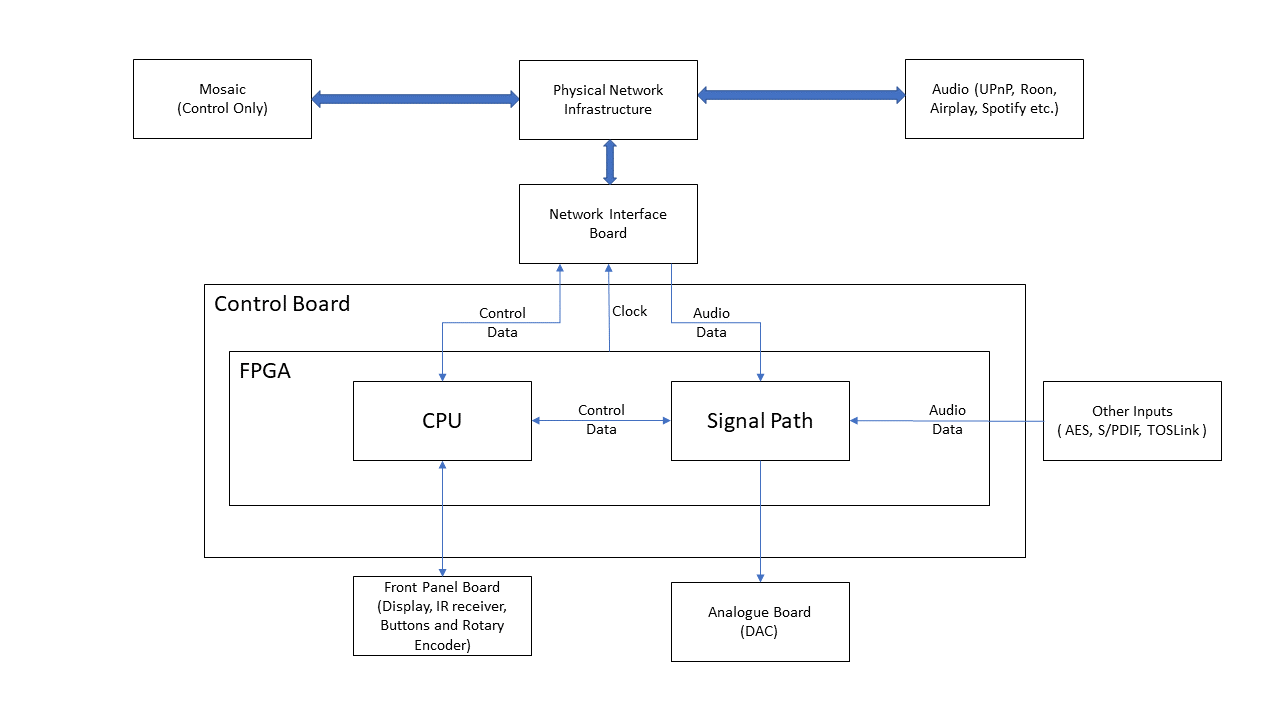
Absolutely - hopefully this (much simplified) block diagram of a Rossini will clarify.

Remember that the Ring DAC itself is a separate entity to the Control Board…

Phil

4 Likes

@Phil Thanks for providing the block diagram showing the functions that the Rossini and Mosaic provide. I’ve always thought of the Mosaic app as providing the control element to search folders/files and render playback and has nothing to do with the audio path. This can be proven by launching Mosaic and start playing songs from a NAS, Radio station, Qobuz, etc. You can stop the Mosaic app or power off the device Mosaic was launched from and the song queue continues to play without interruption.

1 Like

That’s still true. The music stream does not flow through Mosaic Control before it reaches the DAC. The DAC pulls streams directly from UPnP Servers or over the the 'net from Qobuz/Tidal/Spotify.

What Phil’s diagram shows (and I mentioned) is that the Mosaic Control signals go through the same Ethernet interface, and is processed by the same CPU that pulls streams down.