Haven’t tried myself. It has to do with compatibility: the mainboard can handle it and USB can, but the S800 streaming board can’t which they’re still trying to find a way around.
I don’t understand why it isn’t available from the other USB port then (the one for flash drives).
Does that port route stuff through the network board?
Can’t imagine a viable way for a workaround, if the hardware can’t support it. If they downsample 256, or even 512 to 128, then it wouldn’t make much sense. Yeah, you wouldn’t have to convert your 256/512 stuff to 128 yourself, but that would be pretty much all.
Has anyone else noticed that the channels are swapped with DSD256 on the usb input? With my Aurender N30SA, every DSD256 recording has the left and right channels swapped.
Hello Cory and welcome to the forum. I hope that you find it interesting and useful.
I somehow think that a DCS product that gets channels in reverse would be unlikely and one that only does it with DSD256 recordings even .more so.
You do not say which dCS DAC you have but a more likely explanation is that you have selected to swap the channels inadvertently. This feature is available on most (all?) of their DAC units. You will find the option in the menu so check your user manual.
JUst out of interest could you give us some examples of the recordings affected if the above is not the answer.
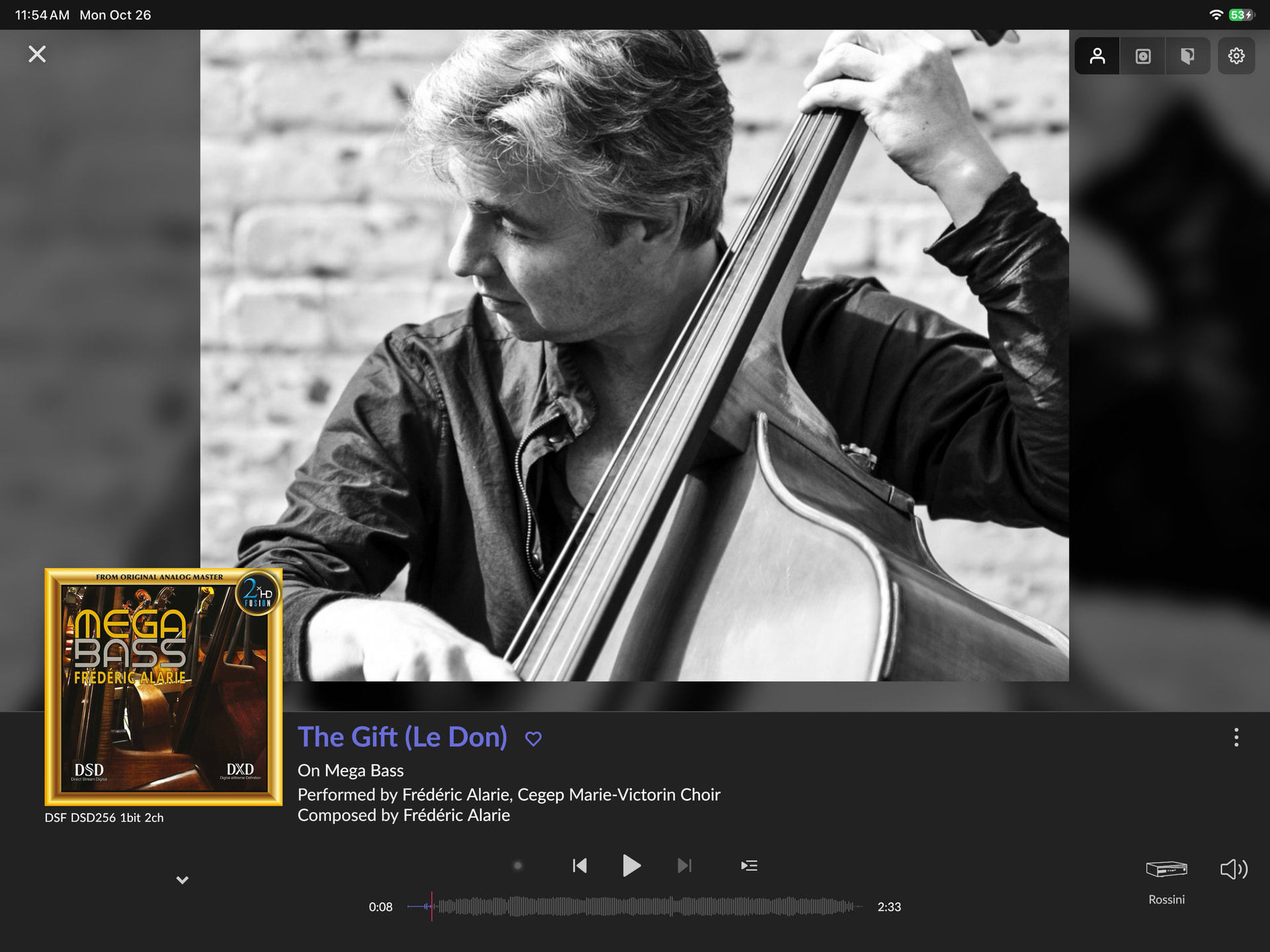
Yes, I agree, it seemed very unlikely which is why I asked. This is on my Rossini Apex with the clock. I have several DSD256 recordings, and verified it on many of them. The first one I played is this one, in which it is obvious as there is great separation and an opening chime that should come from the left speaker.
If I play via Ethernet, Roon will downsample, and it plays as expected. If I take my Roon server directly to the USB input or use an Aurender N30SA, the channels are reversed only for DSD256 recordings. I have several recording from HDTT that are in various formats/resolutions and all have the channels reversed via DSD256 in the USB input.
Thanks. I asked for examples of what you were playing with this issue because I wondered how you could tell that they are being played in reverse. As classical orchestras use only one or two basic seating arrangements it is usually feasible to tell recorded channel orientation by ear. With other genres such as the recording you cite there seems no standard positioning or the performers.
Aside from dCS thoroughly testing upgrades, in this case v.3.0 as in an early version was made available to many Rossini and Bartok users for a 6 week test over the summer. The final version was released subsequently to usage reports from test users being provided dCS,
So if it wasn’t inadvertent selection of the swap channels option it may be the cording itself or be a connection issue with your rig. Given the test period and postings over the past few days there have been no other reports to this forum of channel reversal. At the time of writing it seems to be only you which, unless further reports are received, suggests that the cause lies other than with the dCS update and which may provide a solution.Or if however you have discovered something overlooked by many other.s I would suggest reporting it to support at dCS for heir response.
The DSD256 over usb was not in the early release version, so no one had a chance to try it. There is already another issue with it in that it does not reliably lock to the clock in this mode, which dCS has acknowledged.
It’s not that big a deal, but it is obvious to hear on any familiar recording including orchestral which is what I listen to most often.
Also, I have a second dac and can move the usb cable to it and hear the expected result. As I mentioned, the soundstage also sounds different, which may indicate a phasing issue as well.
I will drop a note to support. Thanks!
Actually, it was. Just that the Early Access testers were not made aware of it. Unfortunately, I’m guilty of not noticing this issue as well even though I did test DSD256 over USB during the beta. Forgot the basics
I just confirmed with DSD256 Test tracks via Audirvana USB to my Bartok, that the channels are indeed flipped for DSD256 over USB. Perhaps an XMOS code issue or something.
Yes, but that issue is only with the Rossini DAC/Player though. The Bartok is fine. Whereas this DSD256 playback channel reversal is on the Bartok as well.
Thanks Anup. It looks like I was wrong. Oh well! Let;s hope thay get it right by the timer of the Vivaldi version. Not that I am likley even to try DSD256.
I also have channel swapped issue. I use HQPlayer upsampling to DSD256, the channel swapped. If HQPlayer upsamples to DSD64 or DSD128, the channel is correct. I use HoloRed as NAA and connect HoloRed to Rossini Apex DAC via USB cable.
Appreciate the responses. I did end up sending a note to support and I must say that the response I received was in the exceptional category!
I’ve previously used the network connection and only tried the USB connection as I’m evaluating an Aurender and wanted to try my DSD256 recordings with the v3 update.
It’s not yet clear to me that DSD256 is superior to DSD128. But more fun ahead to compare!
I agree with you, Cory E. The multiple of DSD is only a part of the equation for the subjectively better sound of the individual. I know a well-renowned Canadian DAC brand with a DSD×16, and it is an excellent DAC. I just still personally prefer the sound of the Rossini APEX with the V3 update.
The basic question is - how many native recordings are in DSDx4 or above?
Very few. I have purchased some recordings from DSD Native - very few were natively recorded in DSDx4 or above. If upsampling, then I prefer to leave that to my dCS.
Though it’s fun to play around with those recordings if you have. I did some experiments on USB in DSDx4 where the USB cable is a cheap one and signal taken directly from Roon ROCK. Vs Roon downsampled to DSD x2 over Ethernet ( of decent LAN cables + hifi switch + optical decoupler). I found the downsampled over Ethernet presentation much more analog and less fatigued to listen. It might well be the USB cable or lack comparable isolation treatments via USB that made presentations edgy (dynamics wise seemed exciting but after awhile I felt weary). Over the same tracks via Roon.
Most reports around state that lesser USB cables, particularly when on the long side, can sound edgy and fatiguing. It’s the scenario where a better isolated, higher quality cable gets recommended.
I got a Furutech GT2 NCF just for the sake of trying DSD256 once the 3.0 update will be available for my Vivaldi One, but I’m well aware most 256 stuff around is just an upsampled 64/128, and I don’t see this changing in the future. DSD seems to have become a strictly niche thing. It was a 350euro affair for a 5m cable, thus not beyond the common sense.

 Let;s hope thay get it right by the timer of the Vivaldi version. Not that I am likley even to try DSD256.